

Alibaba’s Qwen team released Qwen-Image-2.1 on September 20, 2026, pitching it as the most balanced and cost-effective AI image model in the Qwen-Image series. Its weights are available through Hugging Face and ModelScope.
Built around a 7-billion-parameter visual generator, the release combines text-to-image generation and image editing in one model. It accepts as many as 10 reference images, produces transparency data alongside RGB output, and targets use cases ranging from portrait editing and product compositions to typography, panoramas, and virtual try-on mockups.
The model could consolidate several steps that currently require separate generators, editing models, background-removal tools, and compositing software. Several qualifications remain: the 7B figure does not describe the entire pipeline, Qwen has yet to publish a detailed technical report, and the weights use a non-commercial research license instead of a permissive open-source license.
A 7B Generator With a Larger Supporting Stack
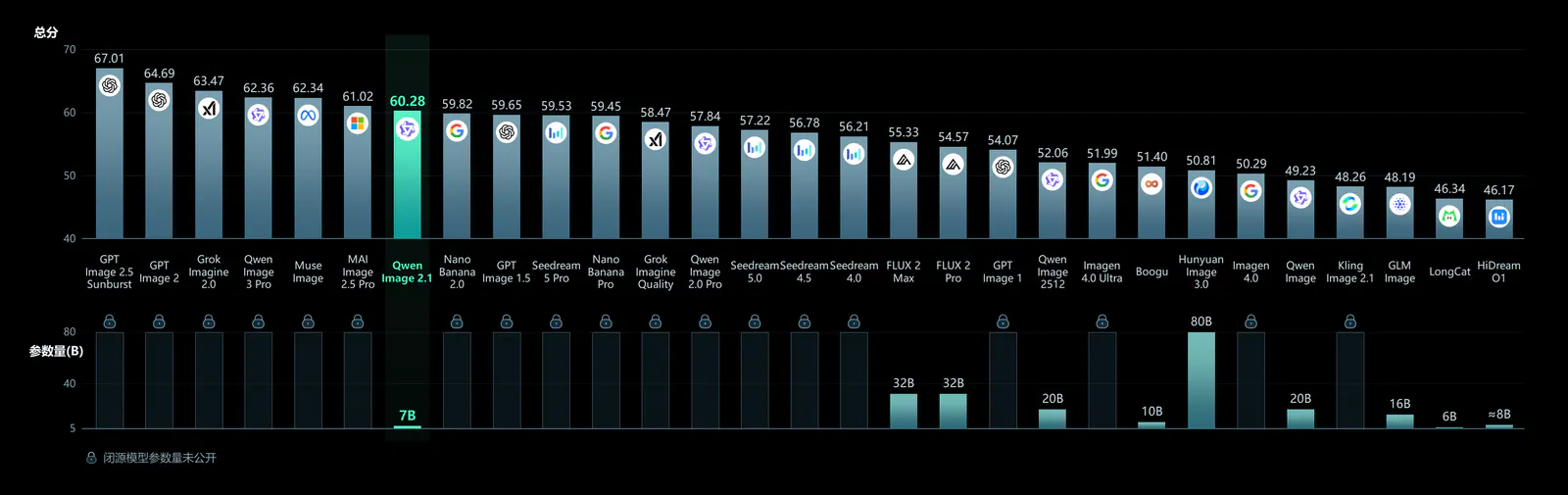
The original Qwen-Image technical report described a 20-billion-parameter MMDiT model. Qwen-Image-2.1 reduces the visual generation component to 7B parameters across 32 single-stream diffusion transformer layers.
The new architecture uses mixed-granularity attention and prefix key-value cache reuse, according to Qwen. Cache reuse is particularly relevant when several reference images are involved, as the pipeline can reuse previously calculated conditioning data instead of repeating the same work at each stage. Qwen cites this design as the basis for substantially faster multi-image inference.
The official repository also describes a block-causal attention system. Text receives token-level causal masking, while image data uses bidirectional attention within image chunks. This allows the model to process instructions and visual conditions together without treating every token identically.
The 7B figure covers the core visual generator, not every component loaded during inference. The complete Qwen-Image-2.1 pipeline includes additional language or vision encoding components and a VAE that converts between images and latent representations.
It should still be more economical to operate than the previous 20B generator, though the complete pipeline may not fit comfortably on every consumer GPU. Qwen has published neither a minimum VRAM requirement nor a detailed comparison of latency across hardware, resolutions, and reference-image counts.
RGBA Output Turns Transparency Into a Native Capability
Most AI image generators produce RGB images. Designers who need an isolated object or transparent background usually have to process the result with segmentation or background-removal software.
Qwen-Image-2.1 can generate an alpha channel alongside the RGB result. Alpha represents per-pixel opacity, allowing the pipeline to distinguish fully visible, partially transparent, and invisible areas. The official transparent-image script receives an image and alpha data, then combines them into an RGBA PNG.
The editing pipeline supports the same capability. Users can provide transparent assets, edit them, and retain transparency in the output. Potential uses include:
- Product cutouts and catalog assets
- Logos, stickers, icons, and game assets
- Text overlays with transparent surroundings
- Compositing people or objects into other scenes
- Editing existing PNG elements without rebuilding their masks
Native transparency does not amount to a complete layered design file. The model outputs an image and alpha map, not a Photoshop document with independently editable objects, text boxes, and adjustment layers. Even so, generating opacity information during inference is cleaner than estimating a mask after rendering.
Fine details will provide the difficult test. Hair, glass, smoke, soft shadows, fabric edges, and semitransparent materials can expose errors hidden by a simple opaque-background demo.
Editing Is the Stronger Practical Story
Qwen-Image-2.1 supports as many as 10 reference images in one request. Its launch examples include a group photograph generated from six separate portraits and an outfit assembled from five inputs representing a person, clothing, shoes, a bag, and a hat.
That capacity opens several useful workflows. A retailer could combine a product photograph with a scene reference. A creator could build a character composition from separate identity and clothing images. Design teams could provide multiple brand, style, and layout references instead of encoding every requirement in a long prompt.
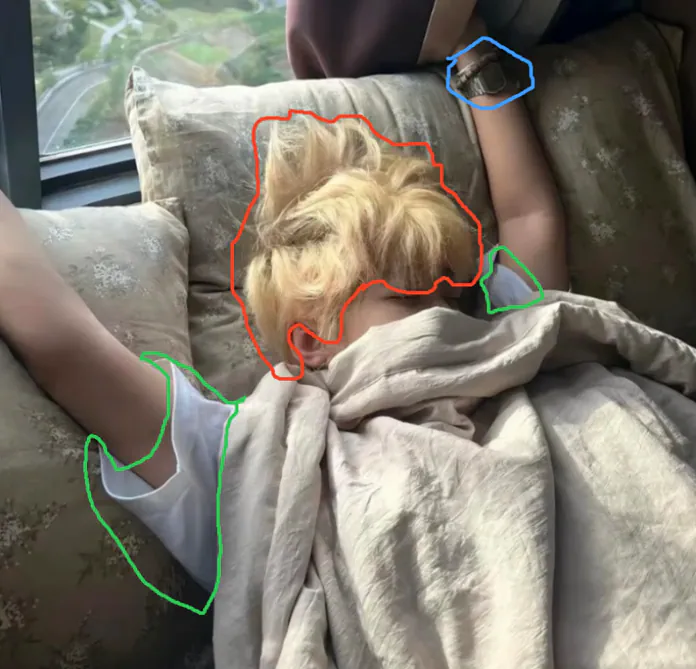
Qwen also demonstrates circle-guided local editing. Users identify one or more regions and describe the intended changes, such as removing a watch, replacing clothing, or altering hair color. The goal is to edit those regions while preserving identity, pose, lighting, and untouched content elsewhere.
Generative editing models often change more than requested. Replacing a shirt may also alter the subject’s face, body proportions, background, or camera angle. Qwen specifically emphasizes portrait and product fidelity, although curated examples cannot show how consistently that fidelity survives difficult inputs.
Consolidation is the main deployment advantage. Generation, reference-guided composition, local editing, and transparent output all use the same checkpoint, so developers do not need to route each operation through a separate Qwen-Image generation or editing model.
Conventional tools will still have a place. Production virtual try-on, for example, may require reliable garment geometry, sizing, physical draping, and body-shape handling. A visually convincing mockup is not necessarily an accurate representation of fit.
Typography and Panoramas Broaden the Use Cases
Qwen’s showcase goes beyond portraits and products. The model generates posters, infographics, stylized lettering, panoramas from selfie references, and storyboards based on multi-view character images.
Text rendering has been a consistent focus of the Qwen-Image series. Qwen-Image-2.1 appears designed to treat text as part of the composition instead of an incidental visual texture. Possible applications include advertisements, presentation graphics, menus, packaging concepts, and social media assets.
Panoramas and storyboards test another skill: maintaining structure across a wide canvas or several related scenes. The model must preserve identity and visual style while introducing meaningful variation. Its multi-reference system is well suited to the task, especially when creators can provide several views of the same subject.
All of these are vendor-selected examples. A model may produce an impressive poster yet misspell words under different fonts, languages, layouts, or prompt lengths. Typography claims require testing for exact-string accuracy, not visual appeal alone.
Qwen's Benchmark Lead Still Needs Independent Testing
Alibaba says Qwen-Image-2.1 delivers top-tier generation and editing quality while outperforming most closed-source image models. The company also presents it as the best balance of visual quality, inference efficiency, and versatility in the Qwen-Image series.
Such comparisons are sensitive to prompt selection, output sampling, model versions, human preference criteria, and the vision-language model used as an automated judge. Small changes to any of these elements can affect the rankings.
According to the Qwen-Image-2.1 repository, a more detailed technical report is still coming. Until it explains the datasets, baselines, inference settings, and evaluation methods, the benchmark lead remains Alibaba’s launch result rather than a settled ranking.
Speed comes with similar caveats. A smaller generator and cache reuse provide credible reasons to expect faster inference, but “exceptionally fast” is not a reproducible measurement. Developers need wall-clock results covering GPU type, numerical precision, image dimensions, sampling steps, reference count, and memory optimization settings.
At launch, the model’s most defensible advantages are functional: one checkpoint handles generation and editing, supports many visual references, and produces alpha data.
Open Weights Do Not Mean a Permissive License
Qwen describes Qwen-Image-2.1 as open-source. Its weights can be downloaded, inspected, modified, and run on user-controlled infrastructure, offering more deployment flexibility than an API-only image service.
Its legal terms are considerably narrower than the phrase “open source” usually suggests. The Qwen Research License Agreement grants rights for non-commercial research and academic use. Commercial use requires a separate agreement with the licensor.
Developers considering Qwen-Image-2.1 for advertising tools, e-commerce systems, paid creative software, agency work, or commercial content pipelines must account for that restriction. Public access to the weights does not automatically authorize those applications.
The license also differs from the original Qwen-Image release, which was published under Apache 2.0. “Open-weight research model” is therefore more precise than describing Qwen-Image-2.1 as a conventionally permissive open-source release.
Commercial licensing further complicates the “cost-effective” claim. Researchers can evaluate and modify the model without paying an API provider per image. Companies, however, must consider licensing terms, local GPU costs, engineering work, storage, and the full pipeline’s memory footprint.
How Developers Can Run Qwen-Image-2.1
The weights are available from Hugging Face, with an alternative download through ModelScope. Qwen has also published generation, editing, and transparent-output examples in its GitHub repository.
At launch, Qwen recommends Hugging Face Diffusers and instructs users to install the latest code from the Diffusers repository. The pipeline class is QwenImage21Pipeline. Its editing workflow accepts either one image or a list of reference images.
Official examples use BF16 precision on CUDA. For constrained systems, the model card documents CPU offloading, VAE tiling, and VAE slicing. These techniques reduce peak GPU memory by moving or dividing parts of the computation, though they can increase generation time.
A useful evaluation should cover more than a few favorable prompts:
- Output latency with one, five, and 10 reference images
- Peak VRAM at several resolutions
- Exact text-rendering accuracy
- Identity preservation across repeated edits
- Product geometry and logo consistency
- Alpha quality around fine or translucent details
- Unrequested changes outside marked editing regions
These tests will show whether the compact architecture lowers operating costs for a particular workflow.
Final Thoughts
Qwen-Image-2.1 combines a smaller visual generator, multi-reference conditioning, localized editing, and alpha-aware output in one model. Together, those capabilities address real friction in AI-assisted design pipelines more convincingly than a claimed benchmark victory alone.
The release is also less open than its “open-source” label implies. Commercial users need a separate license, while the missing technical report leaves questions about benchmark methodology, memory requirements, and measured speed unanswered.
If independent testing confirms Qwen’s quality and acceleration claims, the 7B architecture could become a practical base for research and custom image-editing systems. For now, it is a technically interesting open-weight release whose workflow improvements are easier to defend than its performance superlatives.
Frequently Asked Questions
4 questions
1What is Qwen-Image-2.1?
Qwen-Image-2.1 is Alibaba’s unified 7B AI image generation and editing model. It can create images from text, modify existing images, combine multiple visual references, perform localized edits, and generate transparency information. Its weights are available through Hugging Face and ModelScope under the Qwen Research License Agreement.
2Is Qwen-Image-2.1 open source?
Qwen-Image-2.1 is open-weight but does not use a permissive open-source license. Its research license permits non-commercial research and academic use, while commercial deployment requires a separate license from Alibaba or the relevant licensor. Businesses should review those terms before integrating the model into products or paid services.
3How many reference images does Qwen-Image-2.1 support?
Qwen-Image-2.1 supports up to 10 reference images in one editing or generation workflow. Qwen demonstrates this with a six-person group composition built from individual portraits and a virtual styling example assembled from five references covering the model, clothing, shoes, bag, and hat.
4Can Qwen-Image-2.1 generate transparent PNG images?
Yes. Qwen-Image-2.1 can produce alpha information for transparent images. Its official generation and editing scripts return RGB output and an alpha map, which are combined into an RGBA PNG. This can simplify workflows involving product cutouts, stickers, logos, isolated characters, overlays, and compositing assets.
Sources
- Qwen-Image-2.1qwen.ai
- Hugging Facehuggingface.co
- ModelScopemodelscope.cn
- https://x.com/Alibaba_Qwen/status/2101659302792679789x.com
- Qwen-Image technical reportarxiv.org
- official repositorygithub.com
- Qwen-Image-2.1 pipelinehuggingface.co
- official transparent-image scriptgithub.com
- editing pipelinegithub.com
- Qwen Research License Agreementhuggingface.co
- Qwen-Image releasehuggingface.co


