Sam Altman doesn't mince words. In a post on X, he stated plainly: "Codex is the best AI coding product and we want to make it easy to try. For the next 30 days, we are giving companies that want to try switching over two months of free Codex usage." That's a direct, time-boxed offer aimed squarely at engineering teams sitting on the fence between AI coding tools.
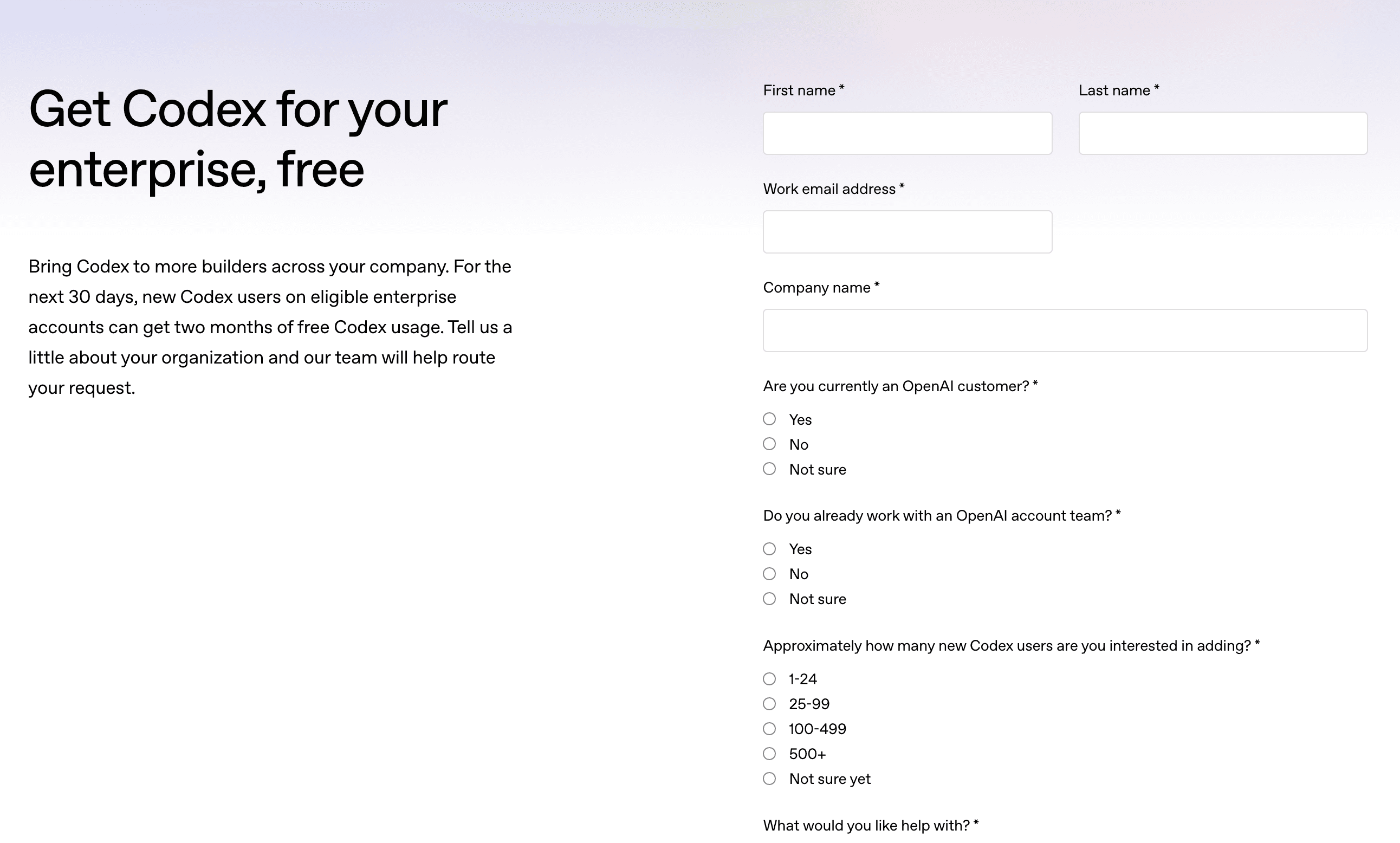
The pitch from OpenAI is straightforward: bring Codex to more builders across your company, and for the next 30 days, new Codex users on eligible enterprise accounts can get two months of free Codex usage. The promotion is accessible via the OpenAI Codex Enterprise promo page.
OpenAI is likely betting that hands-on experience will drive long-term lock-in, and this is a direct shot at GitHub Copilot and Cursor, which still charge per seat. With Codex adoption accelerating, the timing is deliberate.
What Is OpenAI Codex?
Codex is an AI agent that helps you write, review, and ship code. It's not a simple autocomplete tool. From routine pull requests to your hardest problems, Codex reliably completes tasks end to end, like building features, complex refactors, migrations, and more. The Codex app is a command center for agentic coding, and with built-in worktrees and cloud environments, agents work in parallel across projects, completing weeks of work in days.
In 2025, Codex moved beyond being just a coding model and became a software engineer teammate, connecting models, local tooling, and cloud to help developers tackle longer, more complex coding tasks.
The agent runs across multiple surfaces: GPT-5.3-Codex is available with paid ChatGPT plans, everywhere you can use Codex: the app, CLI, IDE extension, and web.
Key Technical Highlights
GPT-5.3-Codex sets a new industry high on SWE-Bench Pro and Terminal-Bench, and shows strong performance on OSWorld and GDPval. GPT-5.3-Codex achieves state-of-the-art performance on SWE-Bench Pro, a rigorous evaluation of real-world software engineering. Where SWE-bench Verified only tests Python, SWE-Bench Pro spans four languages and is more contamination-resistant, challenging, diverse, and industry-relevant.
Notably, GPT-5.3-Codex achieves this with fewer tokens than any prior model, letting users build more.
Additional capabilities worth knowing:
- With Skills, Codex goes beyond writing code to directly contribute to the work that turns pull requests into products, like code understanding, prototyping, and documentation, aligned with your team's standards.
- With Automations, Codex works unprompted, picking up routine but important work like issue triage, alert monitoring, CI/CD, and more.
- Codex supports various interaction modes, so you can decide how much autonomy to give it, from simple question-response permissions to the ability to access your network and run commands autonomously.
- Support for AGENTS.md and MCP makes Codex easier to adapt to your repo, extend with third-party tools and context, and even orchestrate Codex via the Agents SDK.
- GPT-5.3-Codex is built to support all of the work in the software lifecycle, including debugging, deploying, monitoring, writing PRDs, editing copy, user research, tests, and metrics.
The Enterprise Promo: What You Actually Get
OpenAI is switching to usage-based pricing for Codex in ChatGPT Business and Enterprise. Admins can enable free Codex access across their workspace and pay only for actual usage, with no upfront licenses required.
Eligible Business customers can also claim up to $500 in promotional credit per workspace as part of a limited-time promotion. The move is designed to lower the barrier for enterprise adoption, OpenAI says.
The mechanics of the credit offer work as follows, per OpenAI's help documentation:
- For a limited time beginning April 2, 2026, eligible ChatGPT Business workspaces can earn promotional workspace credits for adding and activating new Codex seats. For each new eligible Codex seat added while the promotion is available, the workspace will receive $100 in credits once that seat initiates its first Codex message.
- Promotional credits are automatically applied to the workspace's credit balance and may be used toward usage-based Codex billing. A maximum of $500 in total promotional credits may be issued per workspace under this offer.
- Eligibility is limited to ChatGPT Business workspaces created by an owner with a professional domain and not currently on a ChatGPT Business free trial.
Pricing and Plan Structure
Codex is included in ChatGPT Plus ($20/mo), Pro ($200/mo), Business ($30/user/mo), Edu, and Enterprise. There is no standalone Codex subscription.
Codex usage is priced based on API token usage, calculated as credits per million input tokens, cached input tokens, and output tokens. On average, Codex costs roughly $100 to $200 per developer per month, though there is large variance depending on model used, number of instances users are running, and automations.
For teams approaching limits, switching to the GPT-5.4-mini model can make your usage limits last longer. And for Enterprise and Edu users, there are no fixed rate limits — usage scales with credits.
The Competitive Context
Codex crossing three million weekly users on April 8 represents a 5x increase in three months. OpenAI says over two million developers use Codex weekly, with Business and Enterprise usage growing sixfold since January.
The free enterprise offer isn't happening in a vacuum. The new $100 Pro plan is priced identically to Anthropic's Claude Max 5x tier, which also costs $100 per month and includes elevated limits for Claude Code. Claude Code has become the fastest-growing part of Anthropic's commercial portfolio, with an estimated $2.5 billion in annualized revenue by early 2026.
Real-world results from companies already using Codex are notable. At Harvey, Codex transformed how they build by cutting early iteration time by 30 to 50%, freeing engineers to focus on system design and high-leverage decisions. Codex performed best in backend Python code-review benchmarks, being the only one to catch tricky backward compatibility issues and consistently finding hard bugs that other tools missed.
Why You Should Care
Coding tools typically spread from individual developers to full teams. "This model gives organizations a simpler way to support that motion inside a managed workspace," OpenAI writes.
The two-month free window is meaningful for enterprise teams evaluating AI coding tools. With average costs of $100 to $200 per developer per month, two months of free usage at scale represents a real budget for a meaningful evaluation period. Teams can run Codex across real repositories, across their actual CI/CD pipelines, and against production codebases before committing to billing.
OpenAI Codex is now natively integrated into JetBrains AI chat, and you can use Codex with a JetBrains AI subscription, your ChatGPT account, or an OpenAI API key, all within the same interface. Integration breadth matters here. Codex isn't asking teams to change their tooling stack to try it.
Final Thoughts
The two-month free offer is a calculated enterprise acquisition play. OpenAI knows that switching costs in developer tooling are real: teams have configured their CI pipelines, built their AGENTS.md files, and trained their workflows around whatever tool they're already on. A free, zero-friction trial window removes the financial risk of evaluation, which is usually the first excuse engineering leaders give for not switching.
What I find technically interesting here is the shift to token-based pricing. The new format replaces average per-message estimates with a direct mapping between token usage and credits, and is most useful when you want a clearer view of how input, cached input, and output affect credit consumption. That's a more honest pricing model for enterprise buyers who need to forecast costs accurately. It also means teams doing heavy, multi-file refactors will see very different bills than teams running lightweight PR reviews, which is exactly the kind of transparency that procurement teams need before signing off.
The clock is running on this offer. If your team is evaluating AI coding tools, the enterprise promo form is the place to start. What do you think? Is two months enough time to evaluate a tool like this, or does OpenAI need to go further? Drop your thoughts in the comments.
Frequently Asked Questions
5 questions
1Who is eligible for the two months of free Codex?
New Codex users on eligible enterprise accounts can get two months of free Codex usage during the 30-day promotional window. Eligibility is limited to ChatGPT Business workspaces created by an owner with a professional domain and not currently on a ChatGPT Business free trial.