Physical Intelligence’s Pi API beta, announced on October 13, 2026, combines data uploads, managed fine-tuning and a hosted gateway for inference. Robotics teams can apply to adapt the company’s models to their own robots without managing the training infrastructure themselves.
The company’s beta application says it is starting small and onboarding in batches. Access is limited to an early service; this is not a generally available production platform.
Teams still need robots, task data and a way to evaluate behavior on physical hardware. Pi proposes to handle the compute and infrastructure needed to adapt its models, then serve the resulting model through its API. That could remove a substantial engineering burden. Pricing, service guarantees and local-inference availability, however, remain unanswered deployment questions.
The API Manages the Model Adaptation Loop
Physical Intelligence describes three service components: upload robot data, launch fine-tuning on infrastructure it manages, and access the fine-tuned model through a hosted inference gateway.
Fine-tuning adapts an existing model to a particular application using additional training data. The company’s examples center on robot demonstrations: recordings of how a task should be performed. Developers would use those recordings to adapt Pi’s models without building the entire training pipeline themselves.
After the first training run, developers test the resulting policy, the model governing robot behavior, on their hardware. Evaluation results guide which demonstrations to collect next, and the process repeats.
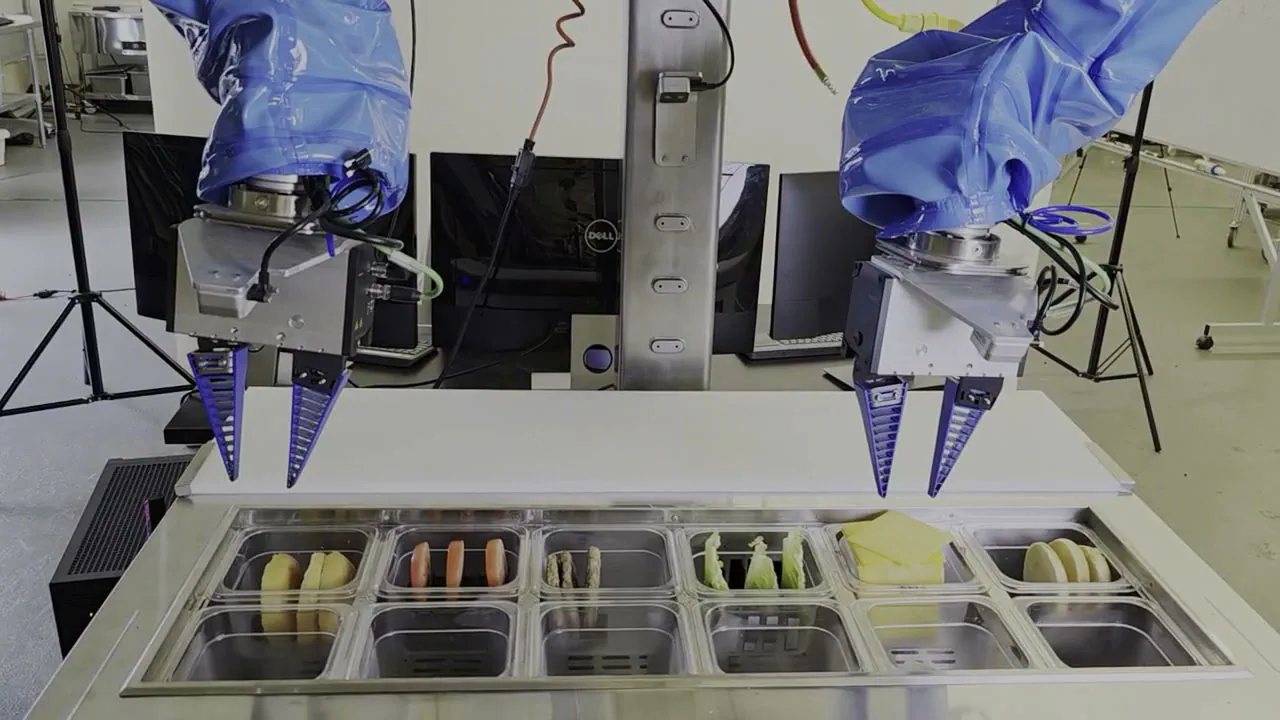
Teams still have to understand why a robot fails. If a policy struggles with a misplaced manufacturing part or an ingredient that slips out of a scoop, the team needs to identify the failure and collect useful examples. Pi’s announcement uses those problems to explain why repeated data collection and evaluation remain central.
The company references π0 and π0.5 as examples of its general-purpose robotic foundation models. It says the latest model available through the API offers more data-efficient fine-tuning and improved capabilities for partners. The announcement provides no quantified comparison that would let applicants estimate their own data savings.
The offer is a managed adaptation process, with no promise that a fixed number of demonstrations will produce a reliable policy for any robot or task.