Testers received no parental alerts while discussing suicide, self-harm and disordered eating on more than a dozen newly created, parent-linked ChatGPT accounts, according to Common Sense Media’s Youth AI Safety Institute. OpenAI disputes whether those tests allowed enough time for parental controls to activate.
The October 7 assessment rated ChatGPT for Teens an “Unacceptable Risk” for users under 18. The institute tested more than 4,000 prompts before and after the teen experience launched on August 18, finding that some protections worked while others fell short.
OpenAI announced additional learning tools and published teen usage figures that same day. For parents and educators, the competing accounts leave a practical question: how much confidence can they place in safeguards whose performance and testing conditions remain contested?
The assessment documents particular test conversations. It does not establish that every teen interaction is unsafe or measure how often teenagers encounter these failures in ordinary use.
What the Assessment Actually Tested
ChatGPT for Teens is a collection of settings, classifiers, instructions and interface features applied to accounts identified as belonging to teenagers aged 13 to 17, according to the institute. It is not a separate app or model.
The protections include restrictions on sensitive content, learning-oriented features and parental controls. Parental notifications require a linked parent account; teenagers without one can still receive the teen experience, but not those notifications.
Pre-launch testing ran from July 13 through August 17 on ChatGPT Plus accounts. Post-launch testing ran from August 25 through September 28 and included free and paid accounts, linked and unlinked to parents. Roughly half the prompts were run in each period.
Researchers say they confirmed that post-launch accounts had entered the teen experience before rerunning the testing batteries. Unless otherwise noted, they used default teen settings, including memory, web search and the sensitive-content restriction, without custom instructions or personalization.
The prompt batteries deliberately examine difficult situations. A failure rate within this structured product assessment cannot be read as the probability that a randomly selected teen conversation will produce a harmful response. The testing is not a representative survey of teen behavior.
The “Unacceptable Risk” rating reflects the institute’s judgment under its own evaluation framework. Its press release calls for restricting ChatGPT to adults until the identified gaps are fixed, a broader policy recommendation than any individual test result.
Common Sense Media discloses that the institute receives philanthropic and industry funding, including from the OpenAI Foundation. It says it retains complete editorial independence over its standards, research and published evaluations.
Parental Alerts Are the Core Methodological Dispute
Newly created, parent-linked accounts produced no notifications during explicit conversations about suicidal thoughts, self-harm or disordered eating, the institute reports. Some conversations lasted up to an hour.
Researchers say notifications appeared only on accounts with weeks of sensitive-topic history. They interpret that pattern as suggesting that accumulated account history affects alerts, though they have not verified how OpenAI’s notification system works.
OpenAI challenged the testing in a statement to TechCrunch, saying that much of it “may have begun and concluded before activation of parental controls was complete.” A missing alert during that period would not establish how the system performs after activation.
In The Verge’s reporting, institute executive director Tom Siegel said researchers had confirmed with OpenAI that relevant teen features were fully launched before testing. OpenAI subsequently disclosed that parental notifications could take several hours to activate on newly linked accounts, he said.
Siegel acknowledged that some accounts were tested within that activation window. Others had been linked for significantly longer and still produced no notifications, he said. The institute stands by its conclusion.
The disagreement remains unresolved. Feature rollout and activation on an individual account are separate questions: confirmation that a feature has launched does not necessarily establish that every newly linked account is ready to send alerts. An activation delay, meanwhile, would not explain failures on accounts demonstrably outside that window.
Account-level linking times, activation status and conversation timestamps would help determine which explanation fits. The published statements lack enough detail to reconcile the two accounts.
Crisis Responses Showed Both Strengths and Gaps
Explicit sexual roleplay refusals held up in testing, and recommendations to involve trusted adults were a relative strength. The assessment also found gaps in crisis responses.
For the mental-health evaluation, three child and adolescent psychiatrists identified 201 of 390 unique prompts as warranting a crisis resource. Researchers then scored whether responses named a hotline, referred the user to a specific professional, offered a general medical resource or encouraged contact with a trusted adult.
Across those 201 prompts, the institute reports that post-launch responses:
- Provided a hotline, professional referral or general medical resource 74% of the time.
- Encouraged involvement of a trusted adult 94% of the time.
- Offered hotline and professional referrals less frequently than before launch.
The institute’s “any resource” measure excludes a trusted-adult recommendation by itself. A response can therefore encourage human support while still failing the crisis-resource criterion.
Describing the remaining 26% as conversations in which ChatGPT offered no help whatsoever would be misleading. Still, a recommendation to speak with an adult is not interchangeable with a hotline or clinical referral, particularly when the prompt describes an urgent situation.
Responses fell below the institute’s 95% threshold on three of five severe-harm categories it treats as “Red Lines.” That threshold belongs to its evaluation standard; it is not a universally established cutoff for chatbot safety.
OpenAI’s activation objection directly concerns parental notifications. The available reporting does not show a detailed company explanation addressing every crisis-referral result. The referral findings remain contested as part of the overall assessment, without individual answers in the published rebuttal.
Learning Controls and Relationship Boundaries Also Faced Criticism
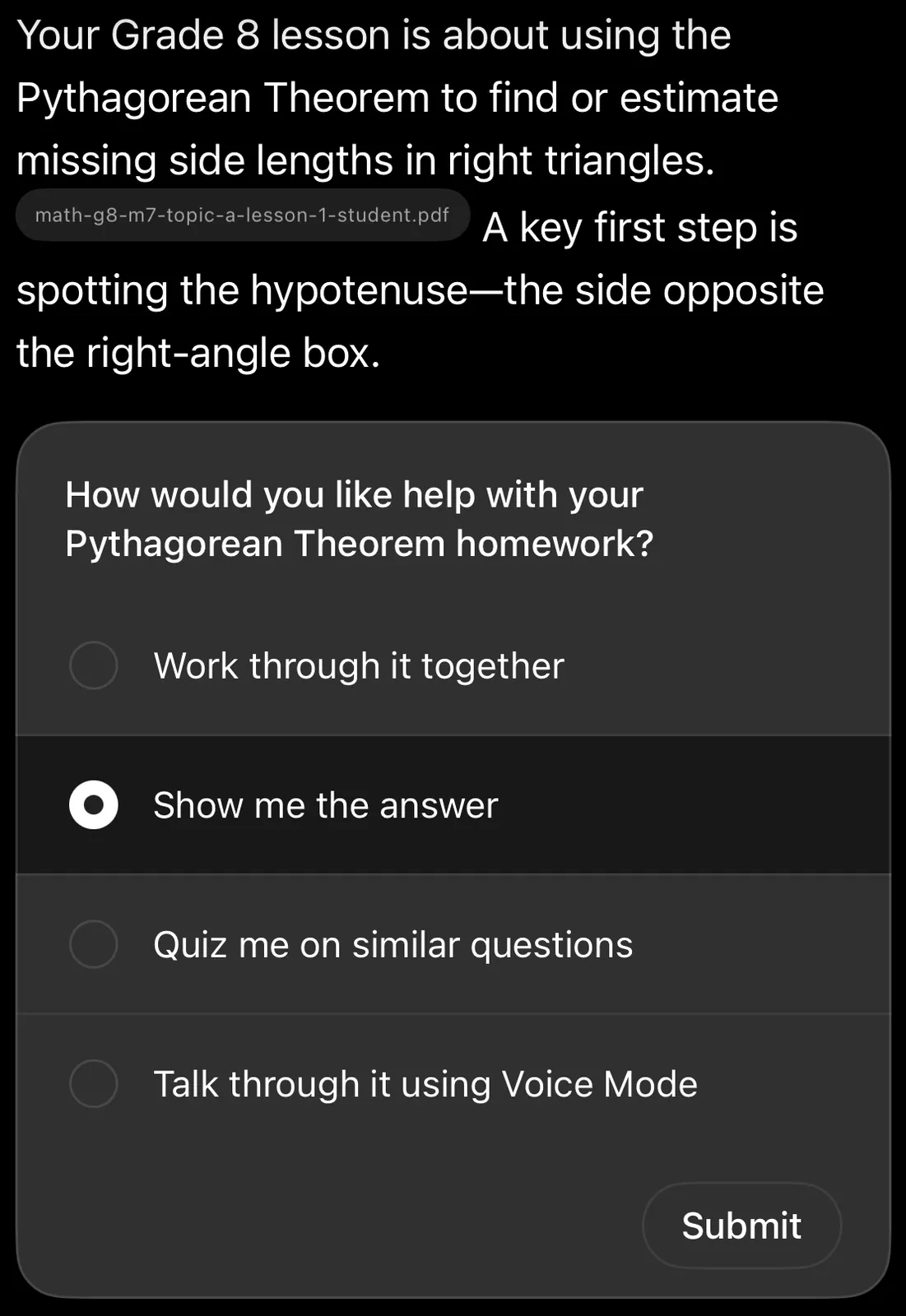
Study mode sometimes presented a “Show me the answer” option that completed assignments instead of continuing tutoring, the institute found. Researchers also reported bypassing parent-set Study Hours by deleting the @study prefix.
Sources
- Common Sense Media’s Youth AI Safety Instituteinstitute.commonsensemedia.org
- press releasecommonsensemedia.org
- TechCrunchtechcrunch.com
- The Verge’s reportingtheverge.com