Google has opened SynthID Detector to everyone worldwide, giving the public a standalone way to check images, videos, and audio for its imperceptible AI watermarks. The important limit is what the tool detects: a supported watermark, not every possible sign that a file was generated by AI.
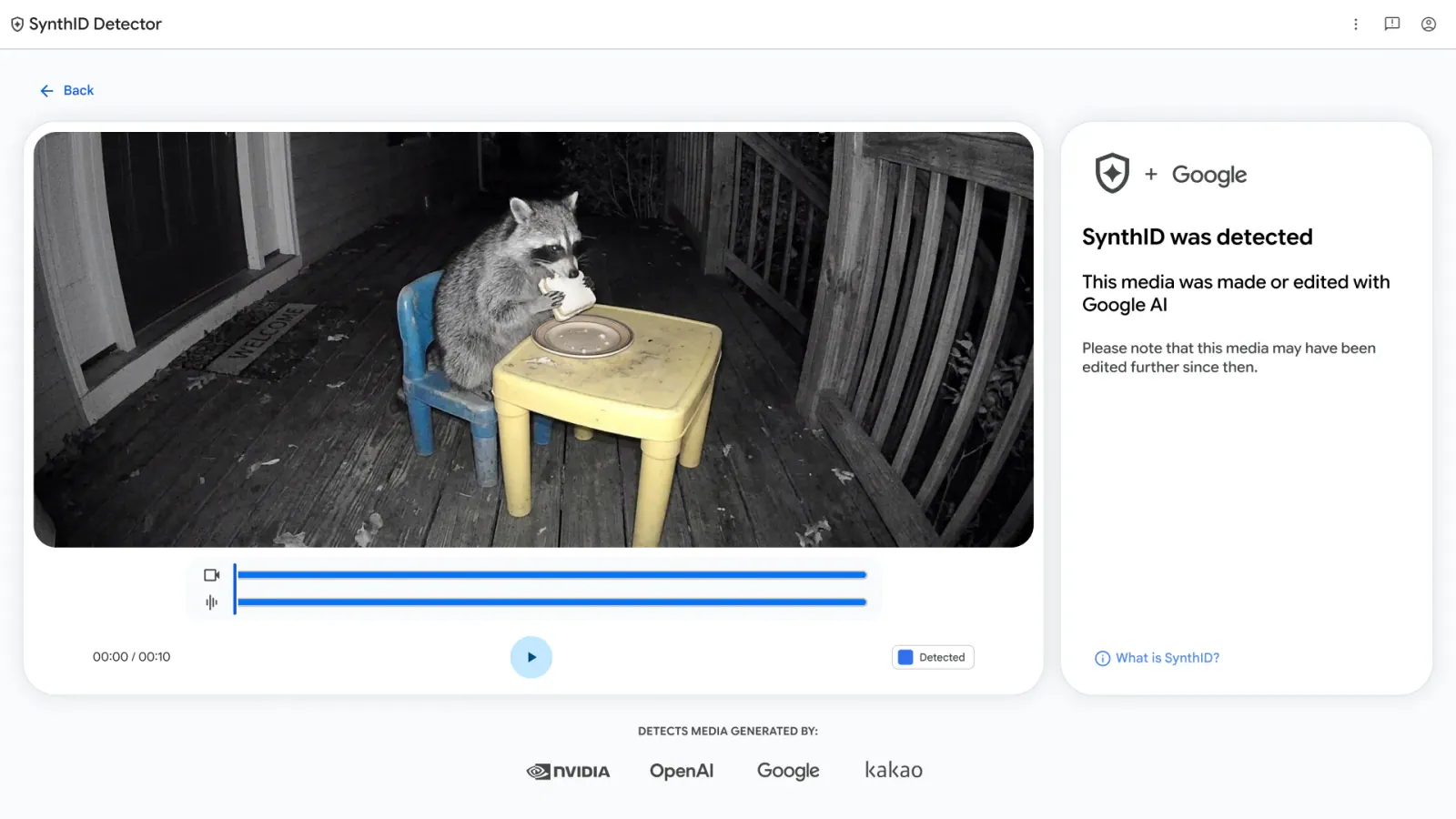
In its October 7, 2026 announcement, Google said the detector is available globally in English after an earlier restricted test with media professionals. It supports watermarked content from Google and participating providers, including OpenAI, NVIDIA, and Kakao. Apple support is forthcoming, without an announced availability date.
That makes the release useful for checking media from a growing group of AI providers. It does not make SynthID a universal authenticity test. Readers need to distinguish watermark detection from judgments about human authorship, factual accuracy, and whether an upload is appropriate for a third-party service.
What the Standalone Detector Supports
The public destination is SynthID Detector, a dedicated website for checking media files. Google says it can detect SynthID watermarks embedded in images, videos, and audio produced by Google AI or participating partners.
According to TechCrunch’s launch coverage, the website accepts the following formats:
| Media type | Supported file formats |
|---|---|
| Images | JPG, JPEG, PNG, BMP, WEBP, AVIF, HEIC, HEIF, TIFF, TIF, GIF |
| Video | MP4, MOV, WEBM |
| Audio | WAV, MP3, OGG, FLAC, AAC, M4A |
The file-format list answers whether the site accepts a particular upload. It does not establish whether that file contains a detectable watermark.
TechCrunch identifies Nano Banana, Veo, and Lyria, along with generation tools such as Gemini, Flow, ProducerAI, and Vids, as Google products that watermark generated media with SynthID. Google’s announcement names OpenAI, NVIDIA, and Kakao as supported partners, but does not provide a model-by-model compatibility matrix.
Readers therefore shouldn’t interpret a partner’s name as a guarantee that every file ever produced by every product from that company is covered. The relevant question is whether the particular output carries a supported SynthID watermark.
Apple belongs in a separate category for now. Google says support is coming soon, which is a roadmap statement rather than confirmation that Apple-generated media can already be verified.
A Watermark Check Is Not a Generic AI Detector
SynthID’s approach differs from a generic AI-content classifier. Rather than trying to infer origin solely from characteristics of a finished file, the detector looks for a signal deliberately embedded by a participating generation system.
That distinction changes how a result should be interpreted.
A detected watermark provides evidence that the file carries the supported signal associated with AI generation. It does not, by itself, establish who created the file, what prompt they used, whether they had permission to depict someone, or whether a claim accompanying the media is true.
An AI-generated illustration can be accurately labeled and used honestly. A genuine photograph can be paired with a false location or date. Watermark detection addresses one part of the provenance question, not the truth of an entire post.
A negative result is even narrower. It means the detector did not find the watermark it was checking for. It does not establish that a person created the media without AI assistance, nor does it exclude generation by an unsupported tool.
Consider a video circulating with a claim that it shows a real event. If SynthID detects a watermark, that is a reason to investigate its origin and the accompanying claim. If it finds none, the video still needs ordinary verification: locating an earlier publication, checking the source, and comparing the claimed event with other evidence.
The practical mistake would be turning “no supported watermark detected” into “authentic.” The public launch makes a useful provenance signal more accessible, but the signal remains bounded by participation and detectability.
Google’s Scale Figures Show Adoption, Not Accuracy
Google says it has watermarked more than 180 billion images and videos, along with 240,000 years of audio content. It also says built-in verification features in Search, Gemini, and Chrome regularly handle more than one million requests daily.
Those figures help explain why a standalone detector could matter. A watermark is more useful when it appears in a substantial body of media and people have accessible ways to check for it.
But the numbers describe different things. The watermark totals measure the volume of content Google says it has marked. The daily requests describe verification activity through existing products, not usage of the newly opened standalone website.
Neither figure measures detection accuracy. A large watermarking footprint does not reveal how often the detector misses a marked file, incorrectly identifies an unmarked one, or succeeds after a file has passed through editing and distribution.
The launch post does not provide independent accuracy, false-positive, or false-negative rates. It also does not break down performance by provider or media type. That leaves readers without a published basis in the announcement for assigning a precise level of confidence to any individual result.
Google’s scale claims are meaningful evidence of deployment. They should not substitute for a performance evaluation.
Sign-In and Upload Privacy Are Separate Questions
Public availability does not necessarily mean anonymous access. In a Hacker News discussion, commenters reported that the detector requires authentication and debated why a public verification tool should require sign-in.
Those reports are community observations, not findings from an independent access audit. They nevertheless identify a practical distinction: opening eligibility to everyone is different from allowing anyone to submit a file without an account.
Some participants suggested authentication could support rate limiting or discourage attempts to defeat the watermark. Others raised concerns about linking verification activity to an account. These are proposed explanations and concerns, not confirmed statements about Google’s implementation or motives.
Upload privacy deserves its own assessment, regardless of whether sign-in has a defensible security purpose.
Google’s launch announcement does not explain upload retention, access to submitted files, or whether uploads may be used to improve other systems. The announcement alone therefore cannot answer whether the detector is suitable for confidential newsroom material, unpublished commercial work, or sensitive recordings.
Before submitting such files, users should examine the service’s current upload disclosures and applicable terms. Organizations may also need approval under their own data-handling policies.
There is no basis in the supplied reporting to conclude that Google uses detector uploads for advertising, or that SynthID secretly encodes personal identifiers. Forum speculation does not establish either claim. The actionable concern is narrower: users need clear information about what happens to a file and how verification activity relates to their account.
Sources
- October 7, 2026 announcementblog.google
- SynthID Detectorsynthid.com
- TechCrunch’s launch coveragetechcrunch.com
- Hacker News discussionnews.ycombinator.com