
A transit-like signal associated with Kepler target KIC 5689121 reportedly returned in four observing quarters withheld from the initial search. Its recurrence supports a pattern that persists beyond the data used to find it, though it does not prove that a planet caused the dips.
Developer Kuber Mehta credits OpenAI’s Codex and ChatGPT Work with assisting the project. His Planethunt report describes a dip in starlight repeating every 13.769448 days and identifies an unresolved stellar companion as a remaining concern.
The project’s modeled false-positive probability is approximately 6.9%, and the host’s identity remains uncertain. The Zenodo evidence record explicitly describes an unconfirmed transit candidate whose novelty remains provisional. The work offers an inspectable example of AI-assisted research, but no established exoplanet discovery.
What Mehta Credits to Codex and ChatGPT Work
Mehta credits Codex and ChatGPT Work with helping develop the idea, conduct the search and perform follow-up analysis. He dates the start of the search to October 9, the identification of the candidate to October 10 and continuing validation work to October 11, 2026.
His account describes assistance across a research workflow. It neither establishes that an AI system independently discovered a planet nor quantifies how much each tool contributed relative to Mehta’s decisions, existing software and the underlying astronomical data.
The announcement’s wording was stronger than the scientific record. An October 11 post reproduced in Mehta’s October 12 follow-up said:
Found a new planet with Codex this weekend
The detailed project page and archived record support a narrower description: a potentially planetary transit signal requiring further investigation.
For readers evaluating OpenAI’s tools, the account leaves several questions unanswered. It cannot show which suggestions were correct, which required correction or whether the same result would have emerged without AI assistance.
The resulting work gives readers more to examine: dated scripts, measurements, query provenance and documented limitations. Those artifacts provide more substantial evidence than a claim about an assistant’s scientific ability.
The Signal Is a Small, Repeating Loss of Starlight
The project reports dips approximately 0.18% to 0.24% deep, lasting about 2.1 to 2.4 hours. The reported depth varies with how the light is extracted from the observations.
A transit occurs when an object passes in front of a star and blocks some of its light. A regular sequence of shallow dips can therefore suggest an orbiting planet. The observations initially establish only a brightness pattern, however, leaving the object’s identity unresolved.
Planethunt combines measurements on a roughly 13.77-day clock. This process, called folding, aligns observations by their position within the proposed cycle. Repeated dips accumulate around the same point, making a weak pattern easier to see.
The source of the light needs particular care here. The project describes KIC 5689121 as an M dwarf with a brighter neighbor only 7.1 arcseconds away. Its measurements come from Kepler Bonus data that recovered the target’s light from pixels downloaded for the neighboring star.
Because the stars’ images overlap, simply adding the light within a region can mix their signals. The project also uses point-spread-function photometry, which models overlapping stellar images to separate their contributions.
According to the project’s source checks, the transit-like dip is deeper on the target than on the nearby star. That favors KIC 5689121 as the source, without eliminating every possible contaminating object. An unresolved companion too close to distinguish in the available data remains a concern.
The Held-Out Test Is Stronger Evidence Than the Plot Alone
The most informative reported check is the recovery in observations excluded from the original search.
Searching a dataset for recurring patterns gives an analysis many opportunities to find something that looks interesting. Testing the selected period against withheld observations asks a harder question: does the proposed clock predict additional dips without being selected to fit those observations?
The project says it reserved the final four Kepler quarters, each an observing segment usually lasting about three months. Using the fixed ephemeris, meaning the period and reference time used to predict future dips, it reports recovering the signal at 5.84 sigma in aperture photometry.
The stricter selection accepted 22 events in the reserved quarters, with no single event dominating the result. A pattern distributed across multiple predicted events is more persuasive than a combined signal driven largely by one unusual measurement.
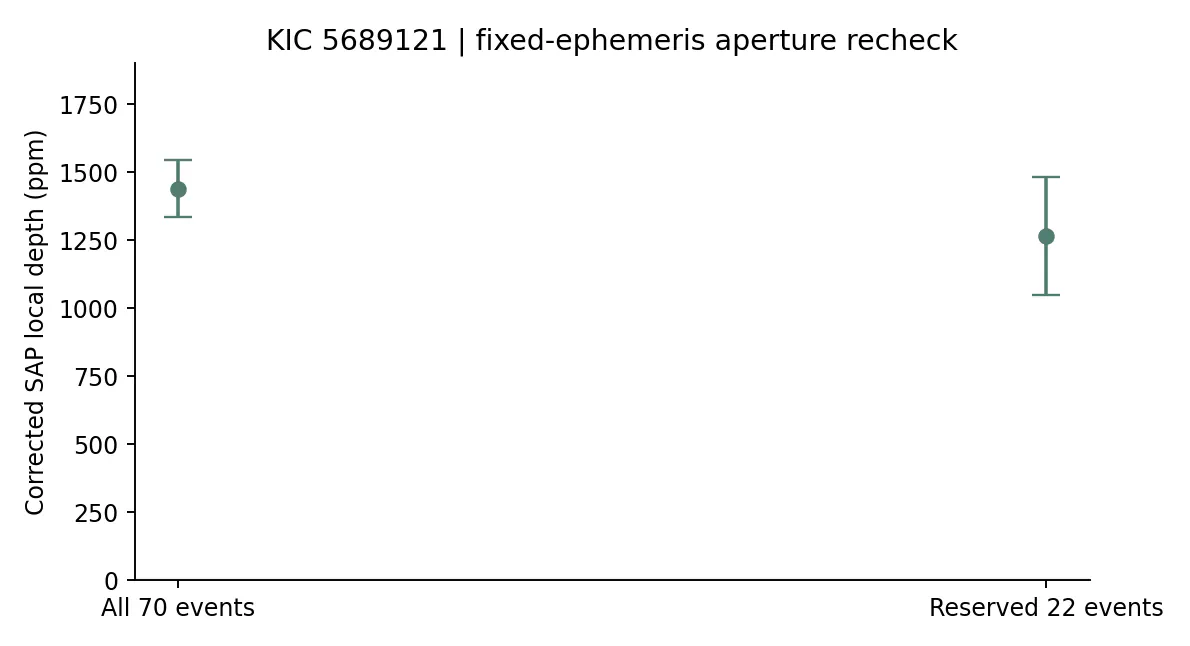
Image: KIC 5689121 — A world hidden in Kepler’s archive.
The newer full-baseline fit uses all available quarters. The prominent folded light curve therefore summarizes the broader dataset after the search; it is not itself the held-out test.
The measurement notes explicitly distinguish those uses. The displayed fold, its residuals and the event-depth histogram summarize overlapping observations, so they do not count as three independent confirmations.
Source checks that reuse the same photons require the same caution. Different analyses can expose different weaknesses, but their significance cannot simply be multiplied together as though each came from an unrelated experiment.
Taken at face value, the held-out result supports a persistent transit-like signal. Its astrophysical explanation remains unsettled.
Why 5.84 Sigma Does Not Confirm a Planet
A detection statistic and a false-positive probability answer different questions.
The reported 5.84-sigma recovery describes how strongly the reserved observations support the fitted signal under the test’s assumptions. It is not a probability that a planet exists.
An astrophysical false-positive calculation considers competing explanations for a transit-like pattern. A real, repeating dip could arise from a stellar eclipse or blended system rather than a planet crossing the assumed target star.
The project reports a modeled false-positive probability of 6.9%, above its cited 1.5% validation threshold. The archived description independently preserves the approximately 6.9% figure and flags unresolved host identity.
That number should not be inverted into a definitive “93.1% chance of a planet.” It depends on the scenarios, assumptions and inputs included in the calculation. An inadequately constrained companion can change both the interpretation of the signal and the properties inferred from it.
The estimated radius of roughly 2.5 to 3 Earth radii is conditional on the signal belonging to the target. If the dip comes from another star contributing light to the measurement, the size estimate could change.
The reported equilibrium temperature near 417 kelvin is also a model estimate, not a measured surface temperature. The page specifies assumptions of no reflected light and full heat redistribution. Neither the transit nor that calculation measures composition.
“Warm sub-Neptune candidate” is therefore a conditional interpretation. Claims about a confirmed planet, a measured atmosphere or a known interior would go beyond the evidence.
A DOI Makes the Evidence Citable, Not Validated
The Zenodo record provides a stable identifier, DOI 10.5281/zenodo.23325261, for the project’s archival package: scripts, measurements, query provenance, limitations and an author-review manuscript.
Another researcher can inspect that defined evidence package without relying solely on a changing webpage or a social announcement. The archive also preserves qualifications that could disappear when the finding is compressed into a headline.
A DOI does not confer scientific approval. The record explicitly says the manuscript is a draft, not a journal submission or accepted publication. Its displayed version is evidence-20261013-r2; the project page separately labels its evidence snapshot October 11, 2026. Those are different documentation milestones.
The archive also distinguishes included files from large bulk-data archives referenced through a manifest. A linked dataset is not automatically contained in the deposited package.
Reproducibility and astronomical validation remain separate goals. Rerunning an analysis, even with a different codebase, can expose programming errors or sensitivity to processing choices. It cannot by itself resolve every ambiguity in what the telescope observed.
The Next Evidence Must Address the Host
The reported candidate still lacks confirmation through high-resolution imaging, spectroscopy or a ground-based transit observation. Follow-up should address the remaining uncertainties, beyond producing another version of the same folded curve.
High-resolution imaging could help constrain close companions, while spectroscopy could improve the characterization of the stellar system. Recovering a predicted transit with another instrument would provide an additional observational check, although the source of the dip would still need scrutiny.
Catalog and literature checks also remain incomplete, so the claim that this is a new candidate should stay provisional.
For AI research, the defensible significance is narrower and more useful than “Codex found a planet.” Mehta reports using AI assistants to investigate archival data and has published evidence that others can challenge. Whether that workflow produced a previously unknown planet remains an astronomical question, and the current record leaves it open.
Sources
- Planethunt reportkuber.studio
- Zenodo evidence recordzenodo.org
- https://x.com/kuberwastaken/status/2109626161160659143x.com