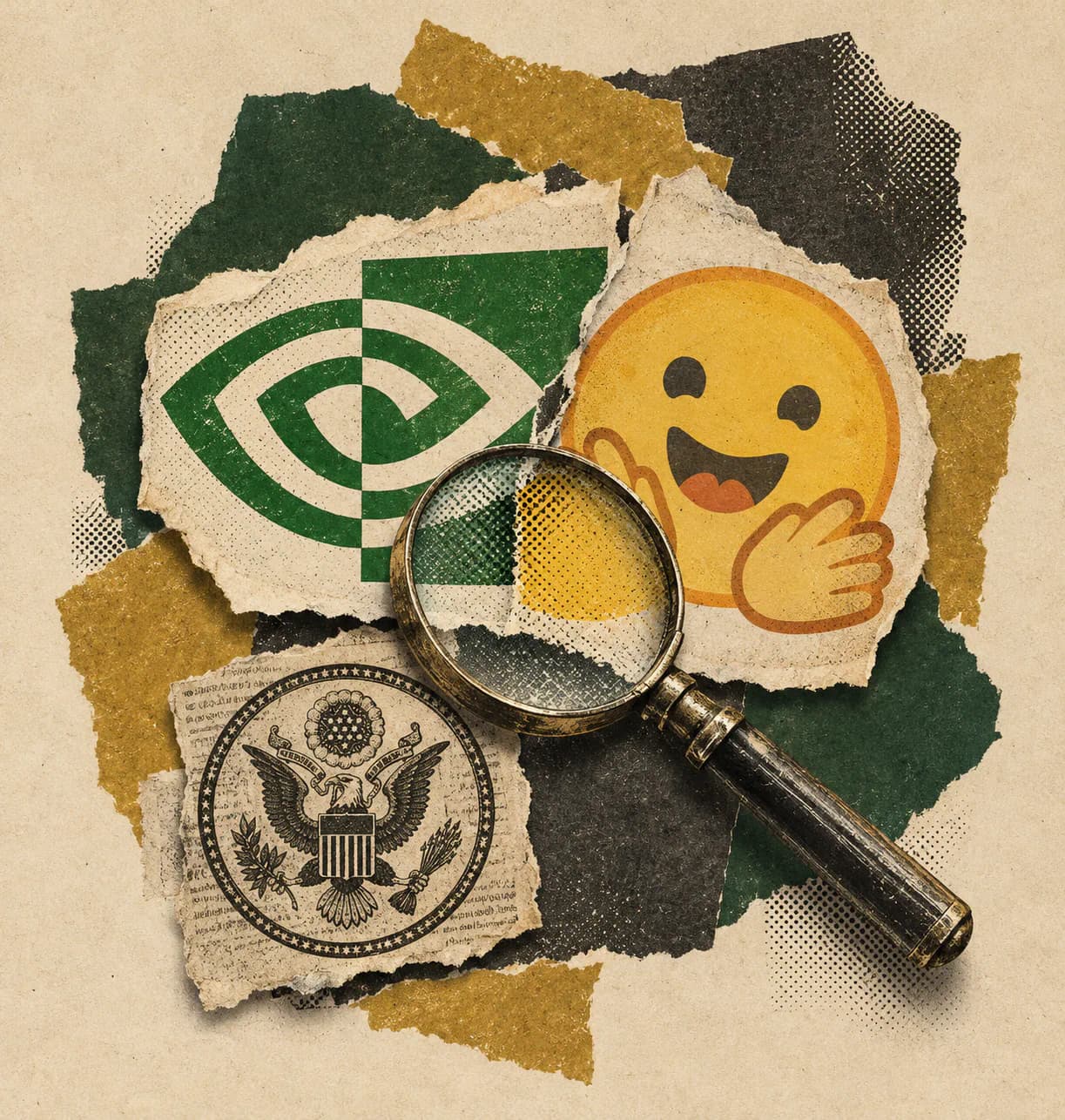
The U.S. Department of Justice has made inquiries about how NVIDIA’s proposed $12.93 billion acquisition of Hugging Face could affect competition in artificial intelligence, Reuters reported on October 28, 2026, citing two people familiar with the matter.
Officials have reportedly asked whether ownership of Hugging Face would give NVIDIA control over an important AI distribution point and additional leverage against rivals. Those questions sit alongside a broader, years-long examination of NVIDIA’s acquisitions, investments and sales practices.
The report describes inquiries, not a lawsuit or a decision to challenge the acquisition. It also brings a specific competition issue into view: what happens when a leading supplier of AI computing hardware buys a platform through which developers obtain models?
What Reuters Reports, and What Remains Unconfirmed
Reuters’ account rests on two unnamed sources. The DOJ has not publicly confirmed the specific inquiry, and its spokesperson declined to comment on matters before the department. NVIDIA declined to comment to Reuters, while Hugging Face representatives did not respond.
An inquiry is not evidence of wrongdoing. Reuters explicitly notes that government investigations do not necessarily lead to lawsuits. The reporting provides no basis to conclude that the DOJ will seek to block this transaction.
That distinction matters because the story involves two related subjects: questions about a proposed acquisition and an ongoing review of NVIDIA’s broader conduct. Neither should be treated as a completed legal assessment.
Reuters also reports that the DOJ routinely seeks input from companies when evaluating proposed mergers. A department spokesperson said it would be inappropriate to conduct a merger investigation under the cover of a conduct investigation. The available account therefore leaves important procedural details unresolved, including how the Hugging Face questions fit within the wider examination. Reuters’ report remains the basis for the specific claims about officials’ questioning.
Bloomberg’s coverage likewise attributes the inquiry to Reuters. It is follow-up coverage of the same reporting, not a separate public confirmation from the DOJ.
Why Hugging Face’s Distribution Role Matters
Hugging Face occupies a different part of the AI stack from NVIDIA’s chips. NVIDIA supplies hardware used to train and run AI systems. Hugging Face is an open-model distribution platform, connecting model publishers with developers who want to use their work.
A distribution hub can influence how easily software reaches its users. For AI models, that connection matters because obtaining a model and choosing where to run it are linked decisions, even though they are technically distinct.
Reuters reports that DOJ officials have asked whether the acquisition would let NVIDIA capture “a fundamental distribution point for AI” and use the business to gain leverage. Officials are also asking about Hugging Face’s competitors. Those questions suggest that the platform’s place in the market, and the availability of alternatives, are central to the reported inquiry. The Reuters account does not provide a market-share calculation establishing Hugging Face’s dominance.
The useful distinction is between ownership of models and ownership of a route through which people find and obtain them. Buying a distribution platform does not, by itself, mean buying every model distributed through it. The competition question instead concerns what influence the platform owner could exercise over access, support and relationships with other providers.
My view is that this distribution layer deserves attention independently of the chip market. A model can remain available while the practical effort required to use it with different computing providers changes. That is a general competition mechanism, not conduct Reuters says NVIDIA has carried out through Hugging Face.
It also explains why the inquiry matters beyond whether developers can still download a particular model. The broader issue is whether the platform can continue serving companies whose hardware or cloud services compete with its prospective owner.
The Inquiry Extends Beyond Hugging Face
The Hugging Face questions form part of a wider review that began under President Joe Biden and continued under President Donald Trump, according to Reuters. The report says there is no indication that Trump is involved in the investigation.
Reuters identifies several other transactions and business practices examined by officials:
- SchedMD: The DOJ has examined NVIDIA’s December 2025 acquisition of the company, according to one of Reuters’ sources. SchedMD makes open-source software used to help run supercomputers. The purchase prompted concerns among AI specialists about continued access, and NVIDIA pledged to maintain open access and support.
- Run:ai: Officials have also looked at NVIDIA’s acquisition of the company, whose software helps AI chips operate more efficiently.
- Groq: The review includes NVIDIA’s 2025 agreement to license technology from the chip startup and hire its engineers. That transaction should not be confused with an acquisition of Groq.
- Sales practices: Officials have explored whether NVIDIA unfairly offered customers larger AI-chip allocations if they also purchased its networking equipment and Groq processors.
These are reported areas of scrutiny, not established findings. NVIDIA declined to comment on the Groq-related questions, and Groq did not respond to Reuters. The details are set out in Reuters’ original report.
The connection across these subjects is influence over several layers of AI infrastructure: computing hardware, networking, resource-management software and model distribution.
That does not make every transaction equivalent. Hugging Face’s distribution role raises different questions from a chip-allocation sales practice. The common analytical issue is whether strength in one layer could create an advantage in another, and whether customers or competitors would face meaningful restrictions as a result.
What NVIDIA Has Promised About an Open Platform
NVIDIA has said the Hugging Face acquisition is expected to close in the first half of 2027. It has also said Hugging Face will continue supporting work with a range of chip, cloud and AI providers, according to Reuters.
Bloomberg’s follow-up coverage says NVIDIA announced the deal in September and presented it as a way to protect the open-source software community. That gives the proposed purchase an important context: continued openness is part of the company’s stated rationale for the acquisition.
Frequently Asked Questions
3 questions
1Has the DOJ challenged NVIDIA’s Hugging Face deal?
Reuters reports that officials have made inquiries. It does not report a lawsuit or a decision to block the acquisition, and the DOJ has not publicly confirmed the specific inquiry.