
NVIDIA has lowered Rubin’s published per-GPU memory bandwidth from 22 TB/s to 19.2 TB/s and NVLink bandwidth from 3.6 TB/s to 3.0 TB/s, according to ServeTheHome’s October 31, 2026 report. Scale-out networking moved in the opposite direction, rising from 400 GB/s to 450 GB/s per GPU.
The revisions matter for buyers sizing expensive Vera Rubin deployments around memory-bound inference or communication-heavy multi-GPU workloads. The headline theoretical compute figures remain intact, but the bandwidth available to feed those compute units and exchange data between GPUs is lower than initially advertised.
October 31 is the report date, not an announced specification-change date. ServeTheHome says NVIDIA updated its pages and architecture datasheet in September, and that the earlier figures were explicitly preliminary.
What Changed in Rubin’s Shipping Specifications
ServeTheHome’s comparison shows three bandwidth revisions alongside unchanged GPU memory capacity and theoretical compute ratings.
| Per-GPU specification | Preliminary target | Shipping specification | Change |
|---|---|---|---|
| HBM4 capacity | 288 GB | 288 GB | Unchanged |
| HBM4 bandwidth | 22 TB/s | 19.2 TB/s | −12.7% |
| NVLink scale-up bandwidth | 3.6 TB/s | 3.0 TB/s | −16.7% |
| Scale-out networking | 400 GB/s | 450 GB/s | +12.5% |
| Theoretical NVFP4 inference | 50 PFLOPS | 50 PFLOPS | Unchanged |
| Theoretical NVFP4 training | 35 PFLOPS | 35 PFLOPS | Unchanged |
Percentage changes above are calculated from the listed preliminary and shipping figures. The memory-bandwidth reduction is approximately 13%, using 22 TB/s as the baseline.
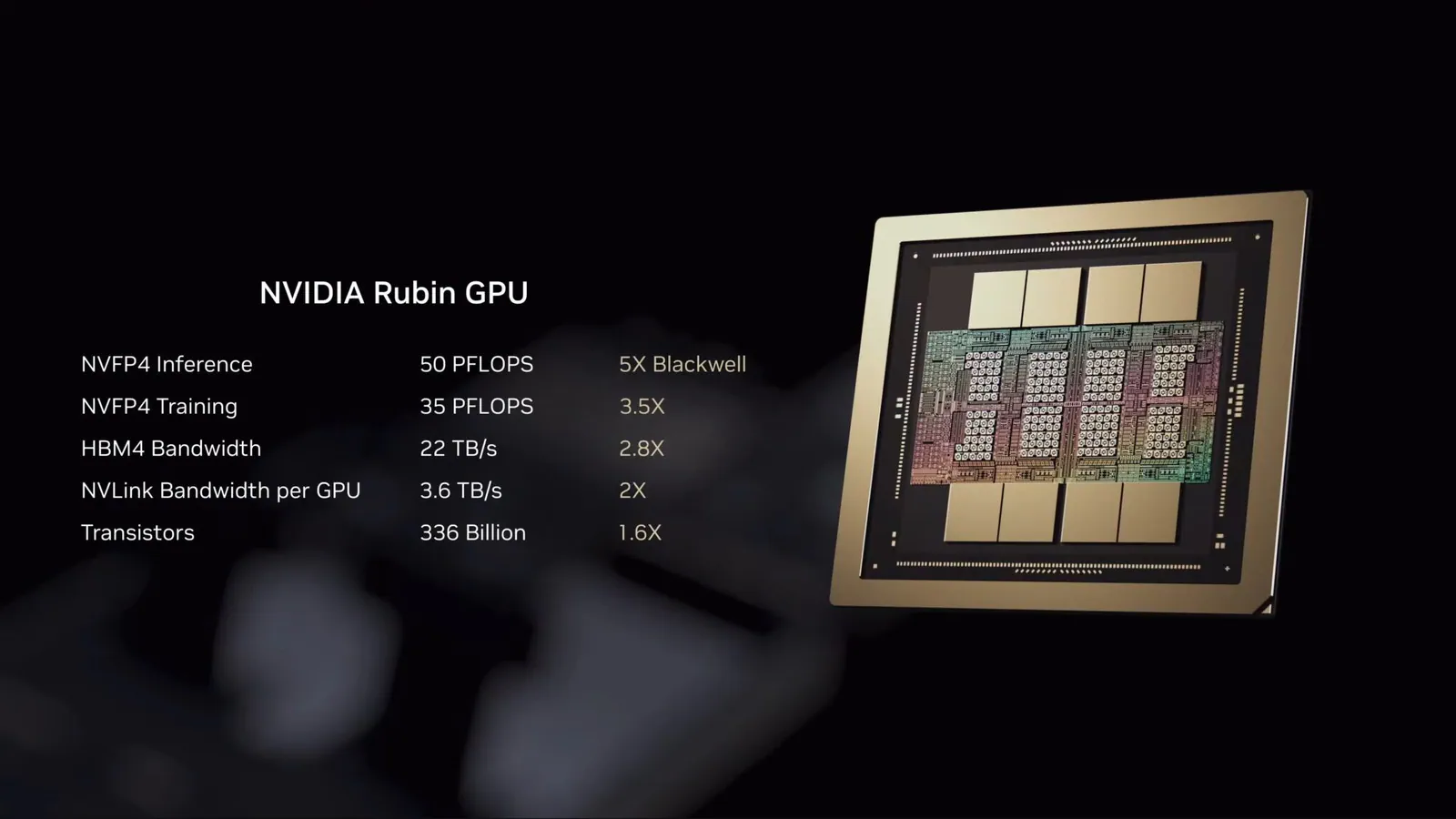
These units describe different resources. TB/s means terabytes transferred per second; PFLOPS means quadrillions of floating-point operations per second. A GPU can retain its arithmetic throughput rating while having less bandwidth available to move data into and out of that arithmetic hardware.
The compute numbers are also NVIDIA’s theoretical ratings, not independent application measurements. TechRadar identifies the 50-PFLOPS inference figure as sparse NVFP4 throughput, so buyers should preserve that qualification when comparing it with other accelerators or dense-compute specifications.
I’d use the shipping bandwidth figures as the procurement baseline. Preliminary targets explain the change in expectations, but they are a poor foundation for a new capacity plan once more concrete specifications are available.
NVL72, NVL8 and Superchip Have Different Revisions
The per-GPU changes carry through to larger systems, but the reductions are not uniform across NVIDIA’s lineup.
| Product | Preliminary aggregate HBM bandwidth | Revised aggregate HBM bandwidth | Approximate reduction |
|---|---|---|---|
| Vera Rubin NVL72 | 1,580 TB/s | 1,400 TB/s | 11.4% |
| HGX Rubin NVL8 | 176 TB/s | 130 TB/s | 26.1% |
| Two-GPU Vera Rubin Superchip | 44 TB/s | 38.5 TB/s | 12.5% |
These are published system totals, with their own rounding. The NVL72 figures come from ServeTheHome; TechRadar reports the NVL8 and Superchip changes.
NVL72 Keeps Capacity but Loses Bandwidth
The NVL72 rack retains 20.7 TB of aggregate HBM4 capacity. Its published aggregate NVLink bandwidth falls from 260 TB/s to 216 TB/s, while scale-out networking rises from 28.8 TB/s to 32.4 TB/s.
Capacity and bandwidth answer different buying questions. Unchanged capacity means the published space available for model weights, caches and other GPU-resident data has not shrunk. Lower bandwidth reduces the peak rate at which those resources can be accessed.
Rack-level totals also need care: adding the bandwidth of 72 GPUs does not make that total available to a single GPU accessing its local memory.
HGX Rubin NVL8 Has Additional Cuts
The eight-GPU HGX Rubin NVL8 shows a larger revision. SiliconReport reports that system memory capacity falls from 2.3 TB to 2.0 TB, alongside the bandwidth reduction from 176 TB/s to 130 TB/s. NVLink Switch bandwidth drops from 28.8 TB/s to 24 TB/s.
Its dense training ratings also decline: NVFP4 moves from 280 to 270 PFLOPS, and FP8 from 140 to 130 PFLOPS. Consequently, “compute unchanged” accurately summarizes the main per-GPU comparison, but not every product configuration.
TechRadar also flags inconsistent HGX documentation, with older per-GPU figures appearing beside revised system totals. Buyers should request a configuration-specific specification from their supplier before assuming an NVL8 offers eight times the memory resources listed for another Rubin configuration. The system totals alone cannot establish the physical memory-stack arrangement.
The HBM4 Change Is a Lower Data Rate
Rubin’s main per-GPU comparison retains eight 36 GB HBM4 stacks, totaling 288 GB. The published memory interface remains eight stacks wide, with 2,048 bits per stack. The revision lowers the data rate from approximately 10.75 gigabits per second per pin to 9.375 Gbps per pin, according to ServeTheHome’s technical breakdown.
The bandwidth calculation is straightforward:
8 stacks × 2,048 bits × 9.375 billion transfers per second ÷ 8 bits per byte = 19.2 TB/s.
That explains how capacity can stay unchanged while bandwidth falls. The GPU still has the same published amount of memory and interface width; data moves across that interface at a lower rate.
ServeTheHome puts the original HBM4 specification’s target at 8 Gbps per pin. NVIDIA’s revised 9.375-Gbps figure remains above that baseline, although it falls short of the preliminary target.
NVIDIA has not publicly explained the revision in the supplied reporting. Memory-stack yields, controller limits and thermal constraints are possible explanations raised in coverage, not confirmed causes. The documented result is a changed balance of bandwidth resources; it does not establish why NVIDIA made the changes or prove a particular engineering failure.
Why Faster Scale-Out Networking Cannot Cancel the Cuts
HBM, NVLink and scale-out networking serve different data paths:
- HBM bandwidth moves data between a GPU and its attached high-bandwidth memory.
Frequently Asked Questions
3 questions
1How Much Did Rubin’s Memory Bandwidth Fall?
The main per-GPU specification fell from 22 TB/s to 19.2 TB/s, a reduction of approximately 12.7%. HGX Rubin NVL8’s published system bandwidth fell more sharply, by about 26%.