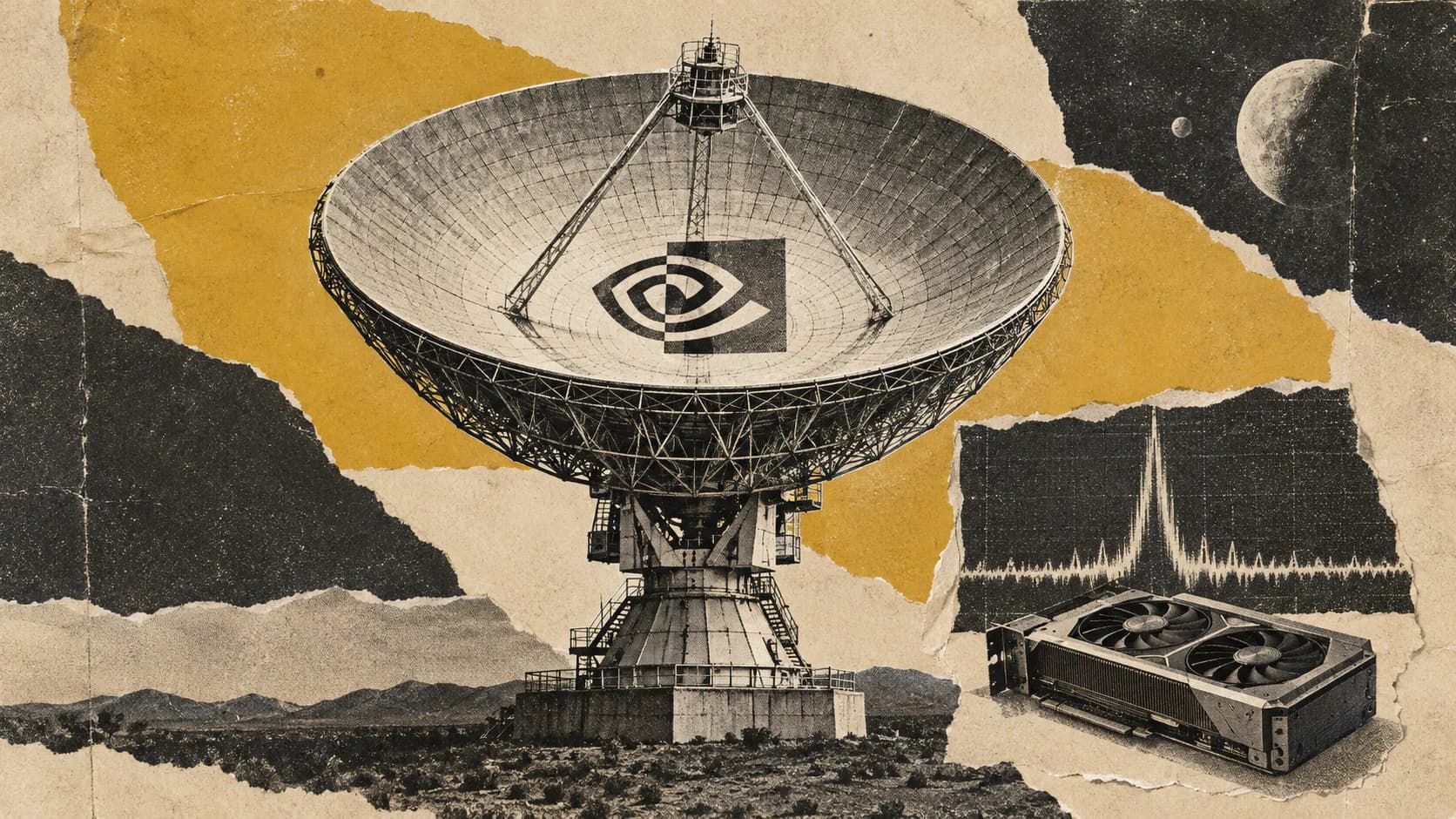
NVIDIA says an AI pipeline at the Allen Telescope Array in Northern California has detected a pulsar in the Crab Nebula in real time. Its October 30, 2026 announcement describes a deployment involving Breakthrough Listen and the SETI Institute, with NVIDIA Holoscan processing live telescope data beside the instrument.
The reported detection concerns a known astrophysical object, not evidence of extraterrestrial intelligence. The more consequential engineering detail is what surrounds that detection: agents can act on an operating observatory, from steering antennas and calibrating observations to correcting incoming data and modifying the processing pipeline.
That makes this a useful example of agentic AI connected to scientific equipment. It also calls for separating three things: the documented workflow, NVIDIA’s claimed detection milestone and the system’s advertised data capacity.
How the Agentic Observatory Works
NVIDIA describes a stack with distinct responsibilities for data acquisition, mathematical processing and agent coordination. A natural-language request provides the interface, but several specialized components carry out the work.
| Component | Role in the reported pipeline |
|---|---|
| Holoscan and DAQIRI | Bring high-rate sensor streams into GPU memory for processing as observations arrive. |
| CyberEther | Performs signal-processing calculations using NVIDIA CUDA-X libraries, including cuFFT and cuBLAS. |
| Nexus | Coordinates instrument state, compute resources and processing pipelines, providing the harness through which agents operate. |
| RTX PRO 6000 Blackwell GPUs | Supply the local GPU hardware for the reported system, with inference running on premises. |
According to NVIDIA’s description, DAQIRI pulls sensor data directly into GPU memory. This supports processing observations in flight, instead of first accumulating the entire stream on disk for later analysis.
CyberEther, developed at the SETI Institute, handles the numerical work. Its named libraries are building blocks: cuFFT performs Fourier transforms, which help express signals in terms of their frequency content, while cuBLAS supplies linear-algebra routines. These are computational tools, separate from the agent interface.
Nexus is where the observatory becomes actionable for an agent. It provides a shared view of the instrument, available computing resources and running pipelines. Researchers can monitor packet loss, inspect live spectrograms and request changes to signal-processing blocks through natural language.
Those capabilities connect several parts of an observation:
- Instrument control: Steer the antennas and calibrate the instrument.
- Data handling: Identify and correct incoming data errors.
- Analysis: Apply AI models to the live stream.
- Pipeline modification: Rewrite signal-processing blocks.
- Output: Plot results for inspection.
The important distinction is between processing a stream and changing how an observation proceeds. A conventional automated pipeline can perform predefined calculations continuously. NVIDIA describes agents that can also alter the instrument and processing workflow in response to a request.
I’d treat that integration as the central development. A detector produces a result; an agent-enabled observatory can connect an observing request to equipment settings, data preparation and analysis. The practical value depends on how reliably those steps work together.
Instrument permissions and validation become particularly important when an agent can change both hardware settings and processing code. NVIDIA’s announcement gives no detailed approval policy or validation procedure for those changes, leaving that operational question open.
What 2.4 Terabits per Second Means
NVIDIA rates the system at 2.4 terabits per second, using RTX PRO 6000 Blackwell GPUs with inference running next to the telescope. The post does not specify the GPU count, a detailed workload configuration or an end-to-end latency measurement.
The units matter. Using eight bits per byte, 2.4 terabits per second equals approximately 300 gigabytes per second. If sustained and fully retained, that stream would amount to about 18 terabytes per minute, using decimal units.
Those are conversions of NVIDIA’s stated capacity, not measurements of stored observations. They help explain the architecture: processing near the instrument can reduce the need to retain or transport every incoming byte before extracting useful information.
Throughput also differs from response time. A system’s ability to handle 2.4 terabits each second does not tell readers how quickly an agent completes a calibration request or how long a detection takes to appear. NVIDIA describes live processing, but provides no numerical latency target for the full workflow.
For an observatory evaluating this approach, I’d want sustained throughput for a specified pipeline alongside packet-loss and detection-quality measurements. Ingest capacity is useful, but the scientific workload determines whether the complete system can keep pace.
The Pulsar Result and the Earlier Detection Report
NVIDIA calls the result “the first real-time AI detection of a pulsar,” identifying the object as a pulsar in the Crab Nebula. A pulsar is a rapidly spinning stellar remnant whose radiation can appear as repeated pulses, making a known pulsar a useful target for checking a live detection pipeline.
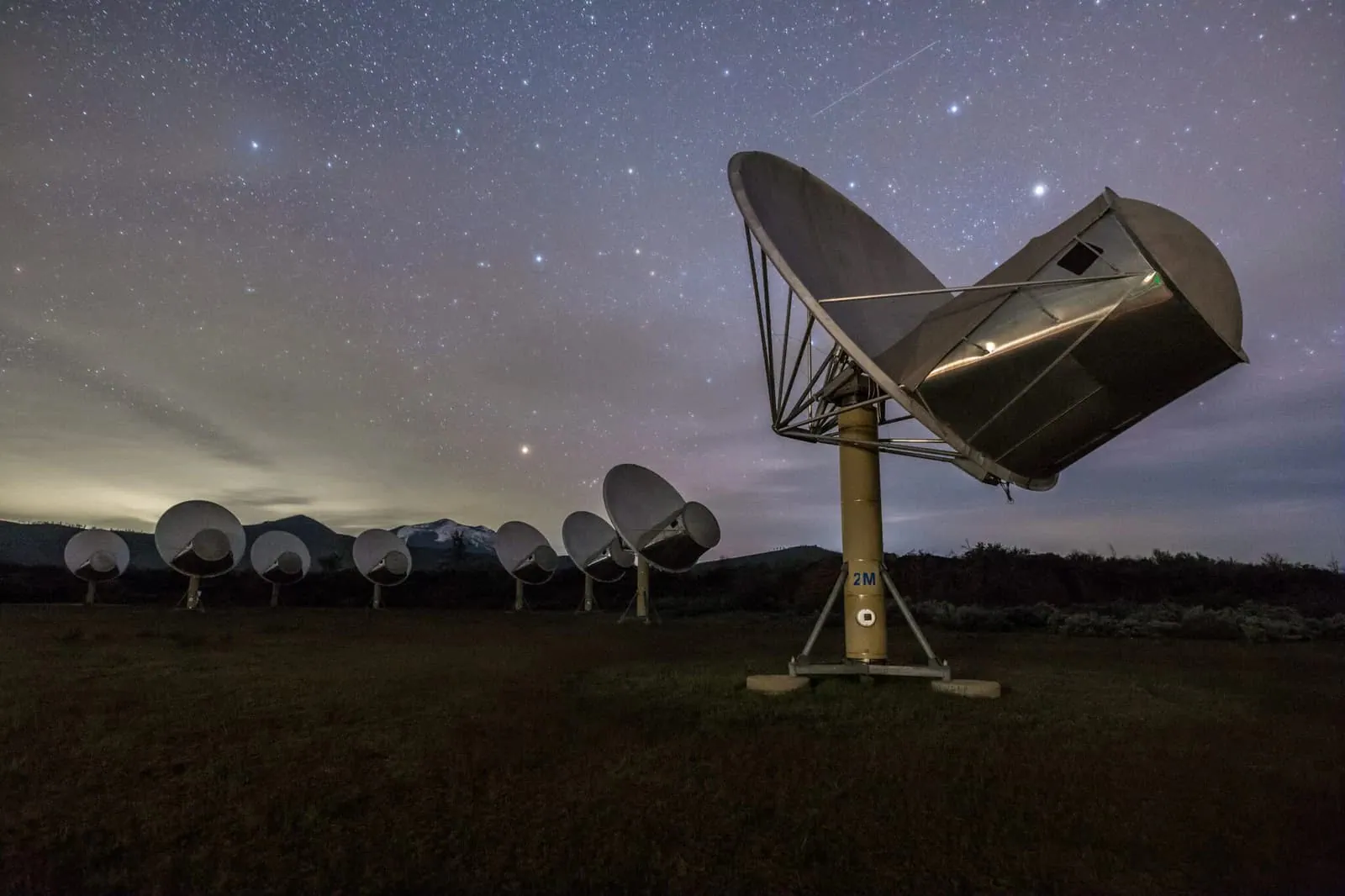
The announcement does not give the detection date, model details, sensitivity or false-positive measurements. Its priority claim therefore needs attribution to NVIDIA.
An earlier account complicates the chronology. TechShooked’s October 31 coverage says the SETI Institute reported in November 2025 that a Holoscan-based AI system at the same array detected giant pulses from the Crab Pulsar in tests at up to 86 gigabits per second. That earlier account, as summarized by TechShooked, made no mention of agents.
The published descriptions support this comparison:
| Detail | Earlier test, as reported by TechShooked | NVIDIA’s October 2026 announcement |
|---|---|---|
| Report timing | November 2025 | October 30, 2026 |
| Reported result | Detection of giant pulses from the Crab Pulsar | Real-time AI detection of a pulsar in the Crab Nebula |
| Agent capabilities | No agents mentioned in the earlier account | Steering, calibration, data correction and pipeline changes |
| Published data rate | Up to 86 gigabits per second in tests | System capacity of 2.4 terabits per second |
| Evidence available here | Secondary description of a SETI Institute report | NVIDIA’s primary announcement |
The earlier SETI Institute document is not among the opened sources, and NVIDIA does not date the detection described in its newer post. Those gaps prevent resolving whether the accounts describe separate demonstrations, successive stages of the same project or different uses of “real-time AI detection.” also attributes the detection to NVIDIA; it adds no independent measurement.
Frequently Asked Questions
4 questions
1Did the system detect extraterrestrial intelligence?
No. NVIDIA reports detecting a known pulsar in the Crab Nebula. The announcement contains no reported detection of extraterrestrial intelligence.