Anthropic has aggressively expanded Claude’s capabilities, introducing tools for meeting transcription, spreadsheet creation, whiteboard collaboration, data analytics, and personal finance management. By integrating features like real-time meeting documentation and direct bank account analysis via Plaid, Anthropic is directly challenging specialized startups like Otter.ai, Miro, and various budgeting apps. While these new features threaten single-purpose AI tools, they currently lack the advanced functionality of enterprise-grade software like Excel. This rapid rollout, occurring just before Anthropic’s massive IPO, signals a strategic shift toward becoming an all-in-one workplace ecosystem rather than just a chatbot.
Ahead of its much-anticipated IPO, Anthropic released some huge features that could kill hundreds of startups offering similar products. In case you missed it, Claude can now join your online meetings, create spreadsheets and whiteboards, build data dashboards, and look through your bank accounts to tell you where your money went.
All of this came out within eight days.
Personal Finance launched on November 5, Sheets, Whiteboards, and Data followed on November 10, and Claude Meetings went into beta on November 12.
Given the number of users Claude currently has, it’s no surprise how fast the adoption is going to be. Based on one study of AI tool traffic, it is estimated that Claude got 3.4 billion web visits in the twelve months to April 2026, which is 250% more than the year before.
Every one of these features already exists as a standalone startup, and a few of those startups are worth more than a billion dollars.
I went through the announcements, the documentation, the numbers, and what people are saying online. Some of these startups should be very worried. Others are probably going to be fine.
Claude Meetings
Claude Meetings is the feature I find most interesting out of the three launches because I do a bunch of online meetings every week, so I’ll start with it.
Yes, Claude can now join your video calls as a virtual participant. It follows the conversation, takes notes, and writes down the action items. Anyone in the call can ask it a question out loud or in the chat, and by default it replies in writing.
Up to this point it sounds like every other AI notetaker. Here are some popular ones:
Gemini
Otter
Granola
Fireflies
Fathom
Rob mentioned a good list of startups that are affected by Claude Meetings.
What makes it different is that Claude can do the work while the meeting is still going. For example, you can see in the demo someone says “Claude, start a doc for this plan,” and Claude builds the document or the whiteboard live while the rest of the team edits it.
When the call ends, the notes, action items, plan, and whiteboard are saved on a meeting page in claude.ai. You can go back later and ask Claude what was decided in a meeting from three weeks ago.
This looks so cool to me and incredibly helpful.
Most AI notetakers send you a summary after the call, and I doubt most people open them. If the plan already exists as a document by the time everyone hangs up, there’s a good chance you won’t need a second meeting to talk about next steps.
But hey, before you cancel your notetaker subscription, take note of the following limitations.
It’s in beta and only available on Team and Enterprise plans. If you’re on Pro or Max, you can’t use it yet.
It only works on Google Meet. Anthropic says other platforms are coming soon. It hasn’t named Zoom or Microsoft Teams.
By default, Claude stays out of calls with people from outside your company, and it leaves if an outside guest joins halfway. An admin has to allow those calls.
It saves a transcript, a summary, and descriptions of what was on screen. It doesn’t save the audio.
Notes and transcripts are free during the beta. Documents and whiteboards made during meetings are free through February 10, 2027, and Anthropic hasn’t said what happens to pricing after that.
The startups that should be worried
AI meeting notes is one of the most crowded categories in AI right now. Otter says it has 40 million users and it crossed $100 million in annual recurring revenue last year.
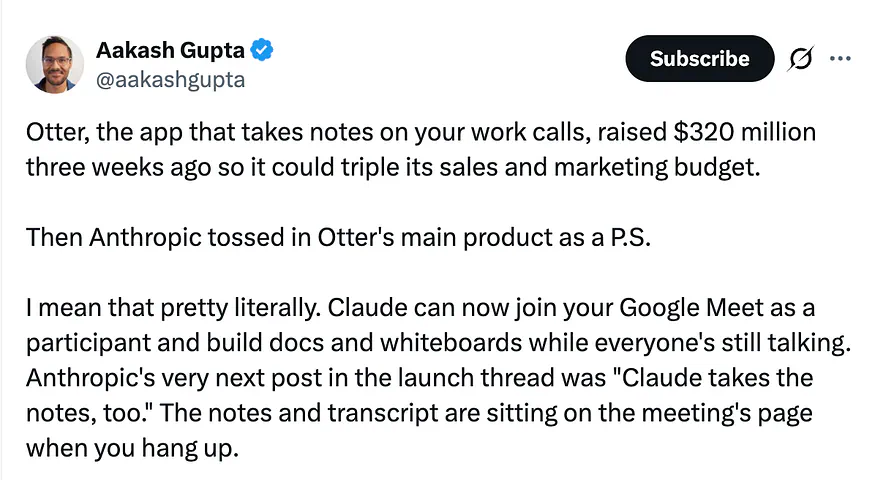
The timing is rough for Otter in particular. On October 20, the company raised $320 million from General Catalyst to spend on enterprise growth and go-to-market. Three weeks later, Anthropic launched the same core product as part of a plan many companies already pay for.
Then Anthropic tossed in Otter’s main product as a P.S.
Not everyone wants Claude Meetings, though.
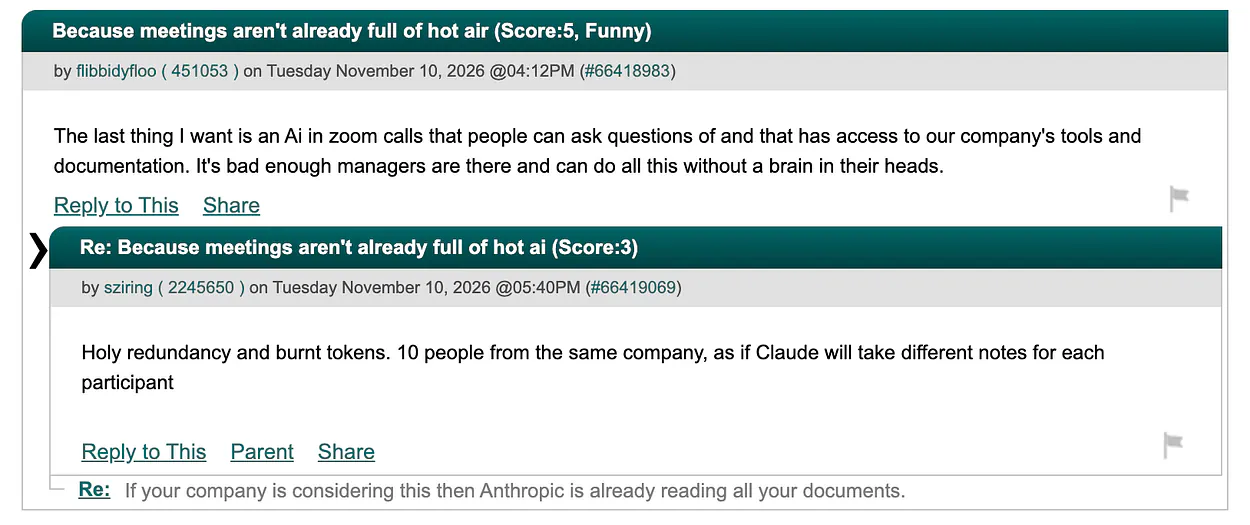
On Slashdot’s thread about the launch, one of the top comments was simply “The last thing I want is an Ai in zoom calls.” Another commenter pointed out that in their testing, AI sometimes gets confused about who is being talked about, so someone still has to review the transcript.
A notetaker that assigns a task to the wrong person in a board meeting creates more work than it saves, and Anthropic hasn’t shown that Claude is better at this than the tools that have been doing it for years.
Claude Whiteboard, Sheets, and Data
Two days before Meetings, Anthropic launched Sheets, Whiteboards, and Data on its paid plans. Claude already got Docs and Slides in September, so with this release it now covers most of what people open Microsoft Office or Google Workspace for.
Claude Sheets builds a spreadsheet from a prompt. You ask for a budget or a content tracker and you get a sheet with tabs, formulas, formatting, and drop-down menus. Claude shows you each cell it edits, your teammates can work on the same sheet, and you can export it as an Excel or CSV file.
Claude Whiteboards is a shared board where your team brainstorms with Claude. Anthropic’s example is talking through a messy, unfinished plan and having Claude lay it out as a timeline with owners and dates. In a retrospective, it can group everyone’s notes by theme and draft action items per person.
Claude Data is the new name for Claude Dashboards, which came out as a beta in October. It connects to company data sources like Snowflake, BigQuery, Databricks, and Salesforce, and builds dashboards and data stories from them.
What I like about Data is that each chart shows the query behind it, so you can see exactly what it’s counting and when the data was last refreshed. It matters a lot because sometimes, I dont trust the numbers in an AI-generated chart.
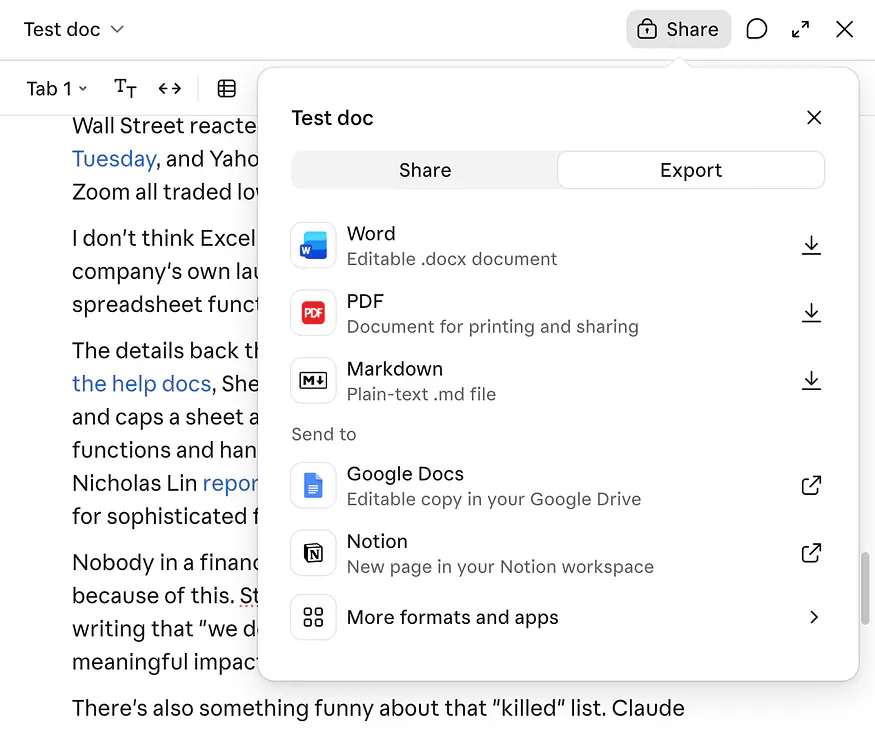
When you create docs, you can export the file into various formats. Click on the Share button and choose the Export tab. For now, I can only see Google Doc format file.
So, what are the tools and companies affected?
Google Sheets
Excel
Airtable
Miro
Lucidchart
Tableau
Power BI
Let me know what other tools you think are affected.
Wall Street reacted too. Microsoft’s stock was down 2.2% that Tuesday, and Yahoo Finance reported that Monday.com, Asana, and Zoom all traded lower on the Anthropic news.
I don’t think Excel is dead, no, far from it. Neither does Anthropic.
Anthropic product leader Nicholas Lin reportedly told Bloomberg that Sheets isn’t designed for sophisticated financial modeling.
Claude Sheets supports 144 functions, has no pivot tables, and caps a sheet at 100,000 cells. Excel has several hundred functions and handles over a million rows.
Additionally, Claude Whiteboards works with similar tools instead of working against it. It can send a board directly to Miro, Lucid, or Zoho Vani. And according toUnite.AI, Claude Data’s partners include Sigma and Omni, two of the analytics tools that were supposedly just killed. A company that wanted to replace Miro wouldn’t add a button that sends your work to Miro.
So who should be worried here?
I’d say it’s the small startups like an “AI spreadsheet generator” or a “chat with your data” tool built on top of someone else’s model. If your whole product is a prompt box that outputs a table or a chart, Claude now does that for people who are already paying for it.
Claude Personal Finance
The first launch of the three was Personal Finance, which is the official name for what a lot of people are calling Claude Finance.
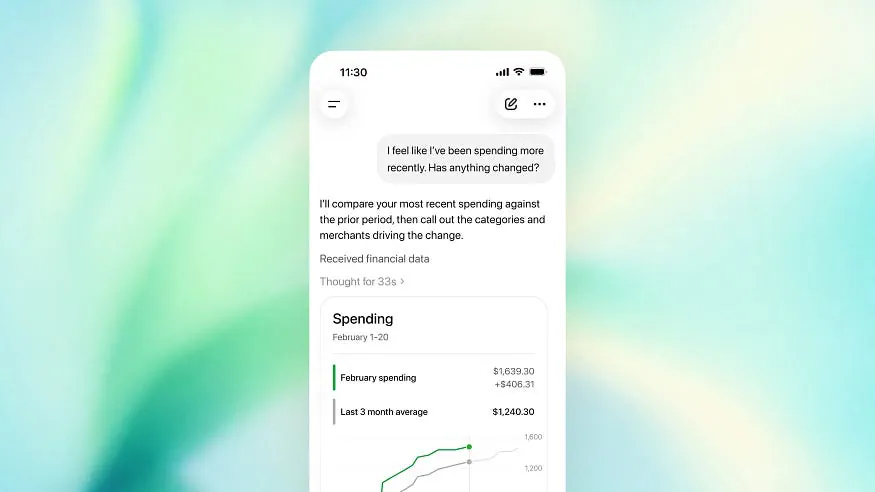
You connect your bank and credit card accounts through Plaid, and then you ask Claude questions about your own money.
The example Anthropic uses is “Where did my money go this month?” Claude adds up your spending by category, like rent and utilities, food and drink, and shopping.
It also flags duplicate charges, unexpected fees, and bills that keep going up. It can explain what APR means and then calculate how much interest you paid over the past year.
I think this is a good use of a chatbot. Budgeting apps make you learn their interface, set up categories, and check dashboards. Most people don’t want a dashboard. They want to ask one question, like why their card bill was so high this month, and get a clear answer.
But there’s important thing you need to know before using it: Claude can’t manage your money.
Anthropic says the access is read-only, which means Claude can’t move, manage, or invest anything. It sees your balances, credit limits, and up to two years of transactions.
Anthropic also says conversations in the Personal Finance hub aren’t used to train its models, and that the feature “has no ads or sponsored recommendations.” It’s a beta for U.S. subscribers on the Pro, Max, and Ultra plans.
What this does to budgeting apps
The obvious targets are apps like Monarch, YNAB, Copilot Money, and Rocket Money. Finding forgotten subscriptions and rising bills is basically Rocket Money’s selling point, and now it’s a side feature of a chatbot.
I don’t think Anthropic is the one these apps should fear most, though. OpenAI launched the same kind of bank connection in ChatGPT back in May, and it has since opened it to free users.
Claude’s version is also limited right now.
Anthropic warns that balances can be a day or two old and that an account linked twice may get counted twice. For investment accounts it sees balances but not your actual holdings.
PYMNTS also points out that ChatGPT’s version builds budgets and debt payoff plans from your goals, and it describes Claude’s as having fewer features.
A note to developers here in the Philippines
I’m a member of a handful of developer groups online here in the Philippines, and there’s one thing I keep noticing: A lot of devs and vibe coders are building finance apps.
Expense trackers, budget planners, and “where did my money go” dashboards show up in those groups all the time, and many of the people building them are focused on that one app and nothing else.
If that’s you, you should know about Claude’s Personal Finance feature and what ChatGPT has been doing since May.
Personal Finance is only available in the U.S. for now, and it connects through Plaid, so it isn’t competing with your app today. But the core of what most of these apps do, which is reading transactions, sorting them into categories, and telling the user where the money went, now comes included in a chatbot that a lot of people already pay for.
I’m not saying you should stop building. I’m saying it’s risky to put all your time into an app whose main feature can be added by Anthropic or OpenAI in one release.
If you’re going to keep working on a finance app, build the parts they’re unlikely to bother with, like support for local banks and e-wallets, or a specific group of users whose needs you understand better than a company in San Francisco does.
What I can say is that this is how a lot of founders feel right now.
You build on top of a model, or you talk to a model company as a potential customer, and a few months later that company ships your product as a feature.
Are These Startups Really Dead?
Every time a big AI lab ships a feature, someone posts a list of companies it “killed.” Most of the time those companies are still around a year later. So I looked for data on what happens to products after chatbots start doing their job.
The best numbers I found come from a study by OneLittleWeb, which tracked estimated web visits for more than 9,500 AI and online tools.
It compared the twelve months to April 2026 against the twelve months before.
Chegg went from 281.2 million visits to 108.4 million, a drop of 61%.
Quizlet fell 29%.
QuillBot fell 25%.
Grammarly fell 15%.
Chatbots as a category grew 91% over the same period, and Claude grew 250%.
The study measures web visits, so it doesn’t tell us about revenue or app usage. But the pattern is clear enough. Homework answers, paraphrasing, and grammar fixes are all things a chatbot now does as a side effect of being a chatbot, and the products that only did those things are the ones losing visitors.
None of them disappeared overnight either.
Grammarly lost 15% of its visits in a year and still got almost 700 million. The decline is slow, and I expect the same thing to happen to notetakers and budgeting apps.
When I look at the three Claude launches together, I see the same approach each time. Anthropic ships a basic version of a popular product, puts it inside a subscription people already have, and then offers to connect to the specialists.
Meetings works on one platform and sends transcripts to Otter and Granola. Sheets has no pivot tables and exports to Excel. Whiteboards sends boards to Miro. Personal Finance is read-only and built on Plaid.
Based on that, here’s how I’d split the startups.
The ones in real trouble sell a single feature to individuals or small teams, and that feature is mostly a prompt on top of someone else’s model. Their customers are the exact people who already pay for Claude or ChatGPT. A basic version that costs nothing extra is good enough for most of them.
The ones that are safer have something Claude’s version doesn’t. Granola works on every meeting platform without a bot. Excel has decades of features that finance teams depend on. Companies in healthcare can’t even turn on Meetings or Sheets yet, because Anthropic says they aren’t available to organizations with HIPAA-ready setups during the beta.
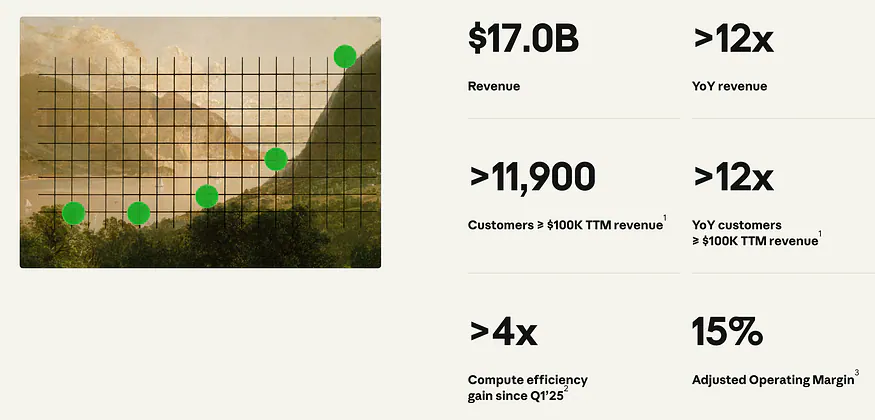
There’s one more thing I think explains the timing. According to figures from Anthropic’s IPO filing, only about 21% of its revenue in the first nine months of 2026 came from subscriptions. The other 79% was usage-based, which I take to be mostly developers and companies paying for the API.
Anthropic launched Sheets and Whiteboards on November 10, the same day it started its IPO roadshow.
My prediction is that these features exist partly to show investors that regular office workers, and not only programmers, will pay for Claude. That would also explain why so much of it shipped as a beta with obvious gaps.
The goal was to have it out before the listing. Do you agree?
So did Anthropic kill hundreds of startups this month?
I don’t think so, at least not yet. Every one of these features launched with limits that keep the specialists alive for now. Meetings only works on Google Meet, Sheets can’t do a pivot table, and Personal Finance can only read your accounts.
If you’re paying for one of these tools today, I wouldn’t cancel anything yet.