Gemini 4 Hydrogen: Google's fast model, its costs and Search | Zeniteq
Loading
Zeniteq is now available on mobile for iPhone, iPad and Apple Watch.Download nowLearn more
Gemini 4 Hydrogen: Google's fast model, its costs and Search
Google's new everyday Gemini 4 model now answers every Google search, prices at $1.50 in and $7.50 out per million tokens, and claims to beat its bigger sibling.
Google launched Gemini 4 Hydrogen on November 12, 2026, as a high-speed, cost-efficient model for agentic workflows. Priced at $1.50 per million input tokens and $7.50 per million output tokens, it features adjustable reasoning levels and a 1-million-token context window. While Google claims it outperforms the larger Gemini 4 Argon on key benchmarks, independent testing highlights significant verbosity, which can inflate actual operational costs. This model now powers Google Search globally, replacing Gemini 3.8 Flash as the primary fast-tier option, though developers should note that older model pricing remains cheaper until January 2027.
Google released Gemini 4 Hydrogen on November 12, 2026: a fast, cheaper member of the Gemini 4 family that now answers in Google Search for every user, runs in the Gemini app, and is sold through the Gemini API at $1.50 per million input tokens and $7.50 per million output tokens. Google says it beats the larger Gemini 4 Argon on a widely used independent index, 51 to 50.
That combination matters for two groups at once. Developers get a model priced well below Google's frontier tier that Google pitches for everyday coding and agent work. Everyone else gets it whether they ask or not, because Google calls it the biggest model upgrade to Search yet.
This piece explains what Hydrogen is, how its thinking levels and the new Orchestrator feature work, what the benchmarks do and don't show, what it costs next to the rest of the Gemini lineup (including a pricing quirk that makes the older model cheaper until January), how it changes Search answers and the traffic they send, and what is still unproven.
Key takeaways
Gemini 4 Hydrogen is Google's fast, everyday Gemini 4 model, released November 12, 2026 and positioned under the frontier models Gemini 4 Carbon and Gemini 4 Argon.
It costs $1.50 per million input tokens and $7.50 per million output tokens across its full 1 million-token context window, with batch jobs at half price.
Google says Hydrogen scores 51 on the Artificial Analysis Intelligence Index at its default setting, one point above Argon; Artificial Analysis' own listing shows 54 at the top xhigh setting.
Hydrogen now runs in Google Search for all users globally, in every language AI Mode supports, with more tables, maps, images and a wider spread of links.
Against Gemini 3.8 Flash, Google claims 2.5 times faster task completion and a jump on Terminal-Bench 4.1 from 18.2% to 57%; those are Google's own numbers.
Independent testing found Hydrogen very verbose: 304 million output tokens to run the index, about four times the median, which raises real costs.
Until December 31, 2026, the older Gemini 3.8 Flash costs half as much per token as Hydrogen; on January 1, 2027 the two prices match.
What is Gemini 4 Hydrogen?
Gemini 4 Hydrogen is a speed- and cost-focused model in Google's Gemini 4 family, built for quick everyday work rather than long, hard reasoning. Google DeepMind's Koray Kavukcuoglu introduced it on November 12, 2026, and the post was updated on November 13.
The family now has three tiers. In Google's own framing, the frontier pair handles the deep problems while Hydrogen does the fast execution. The launch post lays out that split directly, describing the two frontier models this way:
"While our frontier models, Gemini 4 Carbon and Gemini 4 Argon, excel at deep, long-horizon reasoning on your hardest problems, Hydrogen is built for rapid execution across diverse agentic workflows."
An agentic workflow is a task where a model plans, calls tools such as code runners or search, checks the results, and keeps going over several steps without a person approving each one. That is the work Google is aiming Hydrogen at.
Google shipped Hydrogen to almost every surface on day one:
Surface
Who gets it
Notes
Google Search
All users, globally
All languages AI Mode supports
Gemini app
Everyone
Free users get it only when auto model selection picks it
Gemini API and Google AI Studio
All developers
Free tier and paid tier
Android Studio
Developers
Via the Gemini API
Google Antigravity
Paid Google AI Pro and Ultra subscribers
Includes the new Orchestrator
Gemini for business
Business customers
API and model drop-down
Gemini in Google Sheets
Google AI Pro and Ultra first
Eligible business plans too
The free Gemini app caveat matters. A footnote in Google's announcement says free users get Hydrogen through automatic model selection "when it's the appropriate model for the prompt," which means free users can't count on it for every reply.
How does Gemini 4 Hydrogen work?
Gemini 4 Hydrogen works as one model with four adjustable amounts of reasoning, and it can either run alone or act as the fast worker beside a bigger model. Google hasn't published an architecture for Hydrogen in the pages reviewed here; its launch post points to a model card for those details.
What are Hydrogen's four thinking levels?
A thinking level is a setting that controls how much internal reasoning a model does before it answers; more thinking usually means better answers, longer waits and more billed tokens.
Hydrogen offers four: low, medium, high (the default) and a new xhigh tier. Google says the levels scale "in a smooth, predictable progression so you only wait and pay for the reasoning depth a task requires."
The billing detail is the part to remember. The Gemini API pricing page notes that every processed token is billed, thinking tokens included, so moving from high to xhigh raises the cost of each request, not just its quality.
What does Orchestrator do in Google Antigravity?
Orchestrator is a new feature in Google Antigravity, Google's agent-based coding environment, that switches between models inside one session instead of running a single model from start to finish.
The idea is a division of labor:
Carbon plans and coordinates. The frontier model makes the architectural calls and untangles subtle bugs.
Hydrogen executes. The fast model writes code, runs tests and verifies changes.
Parallel agents split the work. For larger jobs, Carbon can coordinate while several Hydrogen workers and verifiers build and test changes in isolated workspaces at the same time.
Google reports that on Terminal-Bench 4.0, Orchestrator reached near-Carbon task success while using 24% less quota on average and finishing 19% faster. That is a vendor result on one benchmark; "near-Carbon" is not a number, and Google didn't publish the gap.
What do the Gemini 4 Hydrogen benchmarks show?
The benchmarks show a large step up from Gemini 3.8 Flash and rough parity with the bigger Gemini 4 Argon, but nearly all of the detailed figures come from Google itself. One independent source, Artificial Analysis, confirms the headline index score and adds a less flattering finding about verbosity.
What does Google claim?
Google's launch post lists these results, all self-reported:
Benchmark or measure
Gemini 4 Hydrogen
Comparison
Artificial Analysis Intelligence Index (default high)
51
Gemini 4 Argon: 50
Artificial Analysis Intelligence Index (xhigh)
54
Not given
Terminal-Bench 4.1
57%
Gemini 3.8 Flash: 18.2%
HLE-Diamond
58.8%
"Leads its class"
Vals Tax Agent Bench
52.3%
Ranked #1 overall
Vals Legal Research Bench
55.8%
Tied for #1
Multimodal Knowledge Agent (MKA)
53.4%
"Outperforms other models"
Agents' Last Exam v1.1
71.6%
"Outperforms other models"
Agent Arena (arena.ai)
Ranked #5
Live leaderboard
The Terminal-Bench jump is the sharpest claim. Going from 18.2% to 57% is a gain of 38.8 percentage points, or about 3.1 times the old score, on a benchmark that measures whether a model can complete real tasks in a command-line environment.
Google also says Hydrogen finishes tasks 2.5 times faster than 3.8 Flash at its default setting and cuts fabricated claims by more than five times. Unnamed partners reportedly saw Hydrogen run 2 to 2.8 times faster while using 12% to 23% fewer tokens than 3.8 Flash on graph, SQL and data-heavy work.
Note what's missing from that table: head-to-head numbers against named rival models from OpenAI or Anthropic. Google says Hydrogen "matches or outperforms competing models in its class" but doesn't list them.
Verbosity: Hydrogen generated 304 million output tokens while running the index, against a median of 77.3 million. That's about 3.9 times the typical model.
Speed per task: It took 14.7 minutes per index task, slower than the 13.3-minute median for comparable models.
Raw speed: It produced about 175 tokens per second, with a time to first answer token of 42.26 seconds.
Cost per task: About $3.16 per index task at xhigh.
These numbers aren't a contradiction of Google's "2.5 times faster" claim. Google compared Hydrogen with 3.8 Flash at the default high setting; Artificial Analysis measured the xhigh setting against a wider field. But they show the trade at the top setting: Hydrogen streams tokens quickly and then writes a lot of them.
How much does Gemini 4 Hydrogen cost?
Gemini 4 Hydrogen costs $1.50 per million input tokens and $7.50 per million output tokens on the paid tier of the Gemini API, flat across the whole 1 million-token window. The free tier in Google AI Studio is free of charge, but Google's terms let it use free-tier data to improve its products.
The official price list shows how that sits next to the rest of the lineup, and both of the other models have dated price changes coming:
Model (paid tier)
Input / 1M tokens
Output / 1M tokens
Price change
Gemini 4 Hydrogen
$1.50
$7.50
None listed
Gemini 4 Hydrogen, batch
$0.75
$3.75
None listed
Gemini 4 Carbon
$2.00
$10.00
Rises to $4.00 / $20.00 on December 1, 2026
Gemini 4 Argon
$2.00
$10.00
Rises to $4.00 / $20.00 on December 1, 2026
Gemini 3.8 Flash
$0.75
$3.75
Rises to $1.50 / $7.50 on January 1, 2027
Hydrogen's cached input costs $0.075 per million tokens, and only implicit caching is supported, so developers can't explicitly pin a prompt into the cache.
What does that mean for a real workload?
Take a hypothetical app that sends 1 billion input tokens and 200 million output tokens a month. At list prices, the monthly bill looks like this:
Gemini 4 Hydrogen: $1,500 for input plus $1,500 for output, or $3,000.
Gemini 3.8 Flash in December 2026: $750 plus $750, or $1,500.
Gemini 3.8 Flash from January 2027: the same $3,000 as Hydrogen.
Gemini 4 Argon in November 2026: $2,000 plus $2,000, or $4,000.
Gemini 4 Argon from December 2026: $4,000 plus $4,000, or $8,000.
So from December 1, Hydrogen costs 62.5% less per token than Argon while scoring about the same on the Intelligence Index. That is the strongest economic case for it.
The 3.8 Flash comparison is the quirk. Through December 31, 2026, the older model is half the price of its replacement. A team that's happy with 3.8 Flash's quality has a six-week window where switching doubles its per-token bill, after which the prices converge.
Verbosity cuts the other way. If Hydrogen writes far more output tokens than the model it replaces, as Artificial Analysis found at xhigh, the per-token price understates the real bill. Teams should measure tokens per task on their own prompts before switching, not just compare the rate card.
What about grounding with Google Search?
Grounding, where the model runs live Google searches to support its answer, is billed separately. The paid tier includes 5,000 free search requests a month, shared across Gemini 3 and newer models, then charges $14 per 1,000 requests, with a daily cap of 1,500 requests. One user request can trigger several searches, and each one is billed.
What changes in Google Search with Gemini 4 Hydrogen?
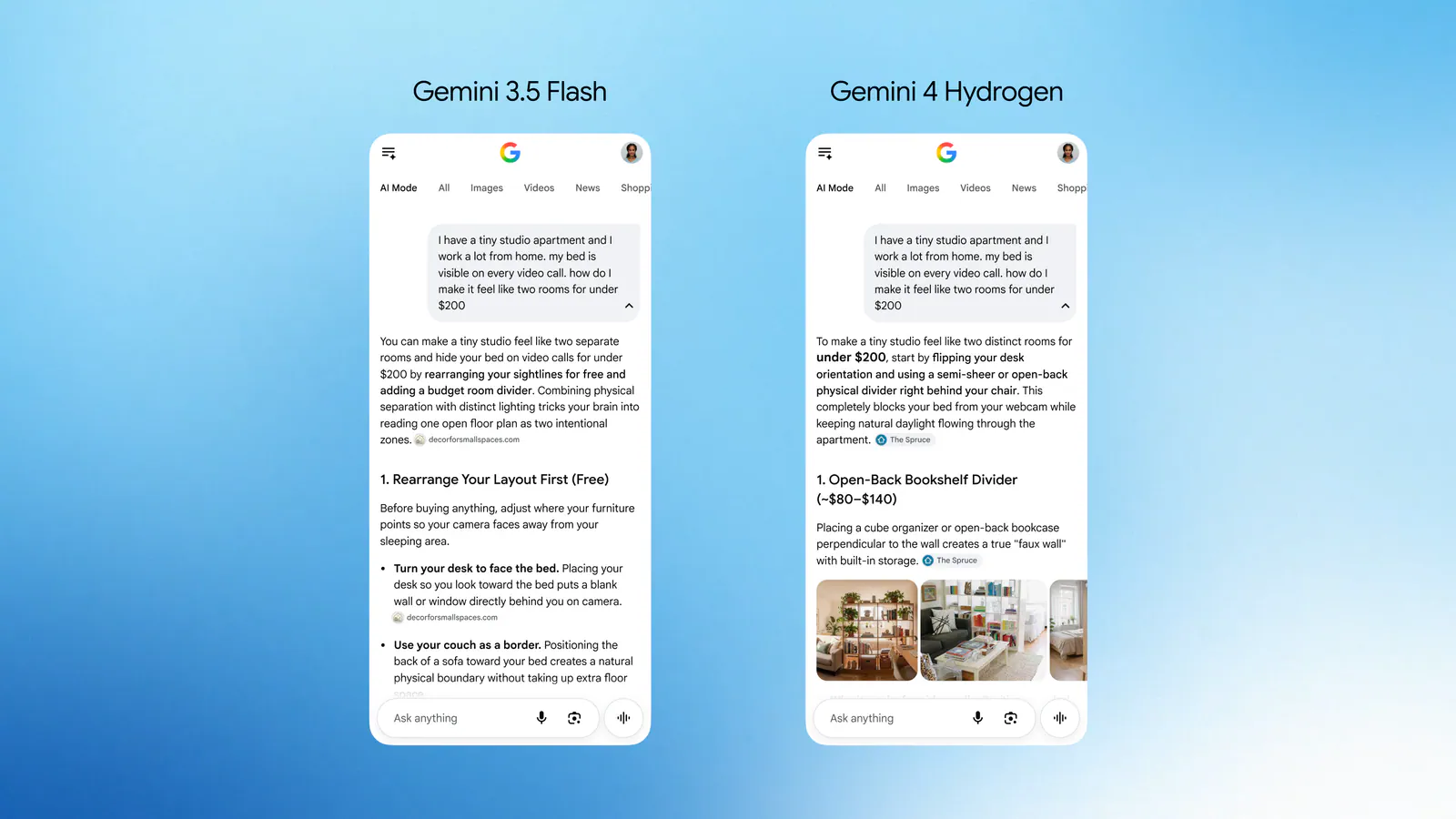
Image: Google's side-by-side of AI Mode answers before and after Hydrogen for a studio-apartment question. Image: Google. Source: blog.google.
Gemini 4 Hydrogen now generates AI answers in Google Search for all users worldwide, which Google's head of Search product calls the biggest model upgrade Search has had. Robby Stein, Vice President of Product for Google Search, describes three changes in Google's Search announcement, along with broader language coverage.
Messier questions. Search should handle questions with several parts, hard-to-read typos or very specific constraints, and follow instructions more closely, thanks to better tool calling.
More links. Hydrogen powers an upgraded query fan-out, the technique in which Search splits one question into many sub-questions, runs them at the same time, and draws on the results. Google says this connects people to "a broader range of helpful links than before."
More visual answers. Expect more images, structured responses, comparison tables and custom tools inside the answer itself.
More languages. Stein says the improvements apply across all languages AI Mode supports.
Google's launch post illustrates the change with paired screenshots. For a question about making a studio apartment feel like two rooms for under $200, the older answer is mostly text and tips; Hydrogen's answer leads with a concrete, priced option (an open-back bookshelf divider at roughly $80 to $140) and adds photos.
One detail in those images doesn't line up with the text. The screenshots label the "before" model as Gemini 3.5 Flash, while Google's post frames Hydrogen as the upgrade from Gemini 3.8 Flash. Google doesn't say which model was answering in Search just before the switch, so treat the screenshots as illustrations, not a controlled before-and-after.
How could Hydrogen change which websites get traffic from Search?
Image: Hydrogen answers with a map and a comparison table where the older model wrote a list. Image: Google. Source: blog.google.
Hydrogen could spread Search clicks across more websites while also answering more of each question on Google's own page, and Google hasn't published data on which effect wins. Both changes come from the same announcement.
On one side, the wider query fan-out is designed to surface sites people "previously might not have discovered," which could help smaller publishers who rank for narrow sub-questions.
On the other side, richer answers keep more of the work on the results page. In Google's Boston example, a question about where a 28-year-old should live for a new downtown job gets a map with pinned neighborhoods and a comparison table with columns for vibe, transit line and a star-rated social score. The older answer was a bulleted list with a link to a local site.
For publishers and businesses, the practical effects to expect:
Comparison content gets absorbed. If Search builds the table itself, a page whose main value is a comparison table competes directly with the answer.
Specific, sourced facts get cited. The Hydrogen screenshots attach small source chips to specific claims, such as a design site next to a furniture tip.
Product queries get personal. In Google's sneaker example, Hydrogen's answer references the user's earlier shoe purchases before recommending products.
None of this is measured yet. Google has given no figures on click-through rates, the number of sites linked per answer, or traffic changes since the November 12 rollout.
What are Google's safety claims for Gemini 4 Hydrogen?
Google says Gemini 4 Hydrogen is safer in agent work than Gemini 3.8 Flash, with fewer actions that go beyond what the user asked and fewer cases of quietly doing less. All of the numbers are from Google's internal evaluations.
Two terms carry the claims. Overreach is when an agent does more than it was asked, such as changing files outside the task. Under-service is when it does less than asked while implying it finished.
Google's reported figures:
Safety measure
Google's reported result
Overreach in agentic tasks
Down by up to 81%
Under-service
Down by up to 79%
Misaligned actions and task shortcutting
Cut by 12 times
Bypassing permission boundaries on blocked tasks
Up to 2 times less likely
Internal agent honesty evaluation
94% honesty rate
Chain-of-thought legibility
99.9% over more than 200,000 audited turns
Gray Swan indirect prompt injection benchmark
More than 2.3 times more resilient
False refusals on HealthBench Pro
Under 0.4%
Indirect prompt injection is an attack where instructions hidden in a web page, document or tool result try to take over an agent that reads them. It is the main security risk for an agent that browses and calls tools, so the Gray Swan figure is the one security teams will look at first.
Most of these are relative claims ("up to," "times less likely") without the underlying base rates. A 12-fold cut matters a lot if the old rate was 10% and much less if it was 0.1%.
What is still unproven about Gemini 4 Hydrogen?
Image: A shopping query before and after Hydrogen. Google's comparisons are curated examples, not a measured sample. Image: Google. Source: blog.google.
Most of what Google says about Gemini 4 Hydrogen is plausible but still rests on Google's own testing, and a few basic facts aren't public yet. Here's what's confirmed, what's vendor-reported, and what's unknown.
Confirmed by sources outside the launch post: the API prices and specs, which appear in Google's developer documentation, and the Intelligence Index score of 54 at xhigh, which Artificial Analysis lists independently.
Vendor-reported only: the 2.5-times speed gain over 3.8 Flash, the Terminal-Bench 4.1 jump, the "near-Carbon" Orchestrator results, every safety figure, and the fivefold cut in fabricated claims.
Not yet known:
Architecture and size. Google's pages reviewed here don't describe Hydrogen's design, parameter count or training data. The launch post links a model card, which this article didn't review.
Rival comparisons. Google names no competing models in its "matches or outperforms" claim.
Search quality at scale. The before-and-after screenshots are hand-picked examples, labelled against an older model than the one Google says Hydrogen replaces.
Traffic effects. No data yet on whether wider fan-out or richer answers dominate for websites.
Regional rollout. Google calls the Search launch global but names no countries or dates by region.
3.8 Flash retirement. The models page still lists 3.8 Flash as a stable model, and Google hasn't announced a shutdown date.
There is also a cost unknown. Artificial Analysis found Hydrogen very verbose at xhigh; nobody has published how verbose it is at the default high setting, which is what most API users and Search will run.
What should you watch next for Gemini 4 Hydrogen?
The next few weeks bring dated price changes and the first independent results, so there are concrete checkpoints:
December 1, 2026: Gemini 4 Carbon and Argon prices double to $4.00 input and $20.00 output per million tokens, widening Hydrogen's price advantage to 62.5%.
Through December 2026: Independent leaderboards such as Artificial Analysis, Terminal-Bench and arena.ai's Agent Arena should fill in Hydrogen's results at the default high setting and against named rivals.
January 1, 2027: Gemini 3.8 Flash rises to $1.50 and $7.50, the same as Hydrogen, removing the cheaper fallback.
Search traffic data: Watch for publisher analytics and third-party studies on click-through from AI answers after the November 12 switch.
The Hydrogen model card: Check it for architecture, evaluation methods and the base rates behind the safety claims.
Antigravity's Orchestrator: Look for independent tests of whether Carbon-plus-Hydrogen sessions really get close to Carbon alone at lower cost.
Frequently Asked Questions
6 questions
1
What is Gemini 4 Hydrogen?
Gemini 4 Hydrogen is Google's fast, lower-cost model in the Gemini 4 family, released on November 12, 2026. It is built for everyday coding, agent tasks and quick answers, while Gemini 4 Carbon and Gemini 4 Argon handle harder, long-running reasoning. It powers AI answers in Google Search, runs in the Gemini app, and is available to developers through the Gemini API and Google AI Studio.
2
How much does Gemini 4 Hydrogen cost in the Gemini API?
Gemini 4 Hydrogen costs $1.50 per million input tokens and $7.50 per million output tokens on the paid tier of the Gemini API, flat across its 1 million-token context window. Batch processing costs half that, $0.75 and $3.75. Thinking tokens are billed as output. The free tier in Google AI Studio is free of charge, but Google may use free-tier data to improve its products.
3
Is Gemini 4 Hydrogen better than Gemini 4 Argon?
Yes, narrowly, on one independent index, but it isn't better at everything. Google says Hydrogen scores 51 on the Artificial Analysis Intelligence Index at its default setting versus 50 for Argon. Google still positions Argon and Carbon for the hardest long-horizon reasoning. From December 1, 2026, Hydrogen is also 62.5% cheaper per token than Argon.
4
Is Gemini 4 Hydrogen used in Google Search?
Yes. Google says Gemini 4 Hydrogen now powers AI answers in Google Search for all users globally, in every language AI Mode supports. Google calls it the biggest model upgrade to Search yet, with better handling of multi-part questions and typos, more tables, maps and images, and a wider range of linked websites through an upgraded query fan-out.
5
Can free users use Gemini 4 Hydrogen in the Gemini app?
Yes, but only some of the time. Google says free Gemini app users get Gemini 4 Hydrogen through automatic model selection when the system decides it's the right model for a prompt. Free users can't count on Hydrogen answering every message. Paid Google AI Pro and Ultra subscribers can also use it in Google Antigravity.
6
Should developers switch from Gemini 3.8 Flash to Gemini 4 Hydrogen now?
Not necessarily before January 2027. Through December 31, 2026, Gemini 3.8 Flash costs $0.75 and $3.75 per million tokens, half of Hydrogen's price; on January 1, 2027 the prices match. Google claims Hydrogen is 2.5 times faster with far better coding scores, so teams should test quality and tokens per task on their own prompts before deciding.