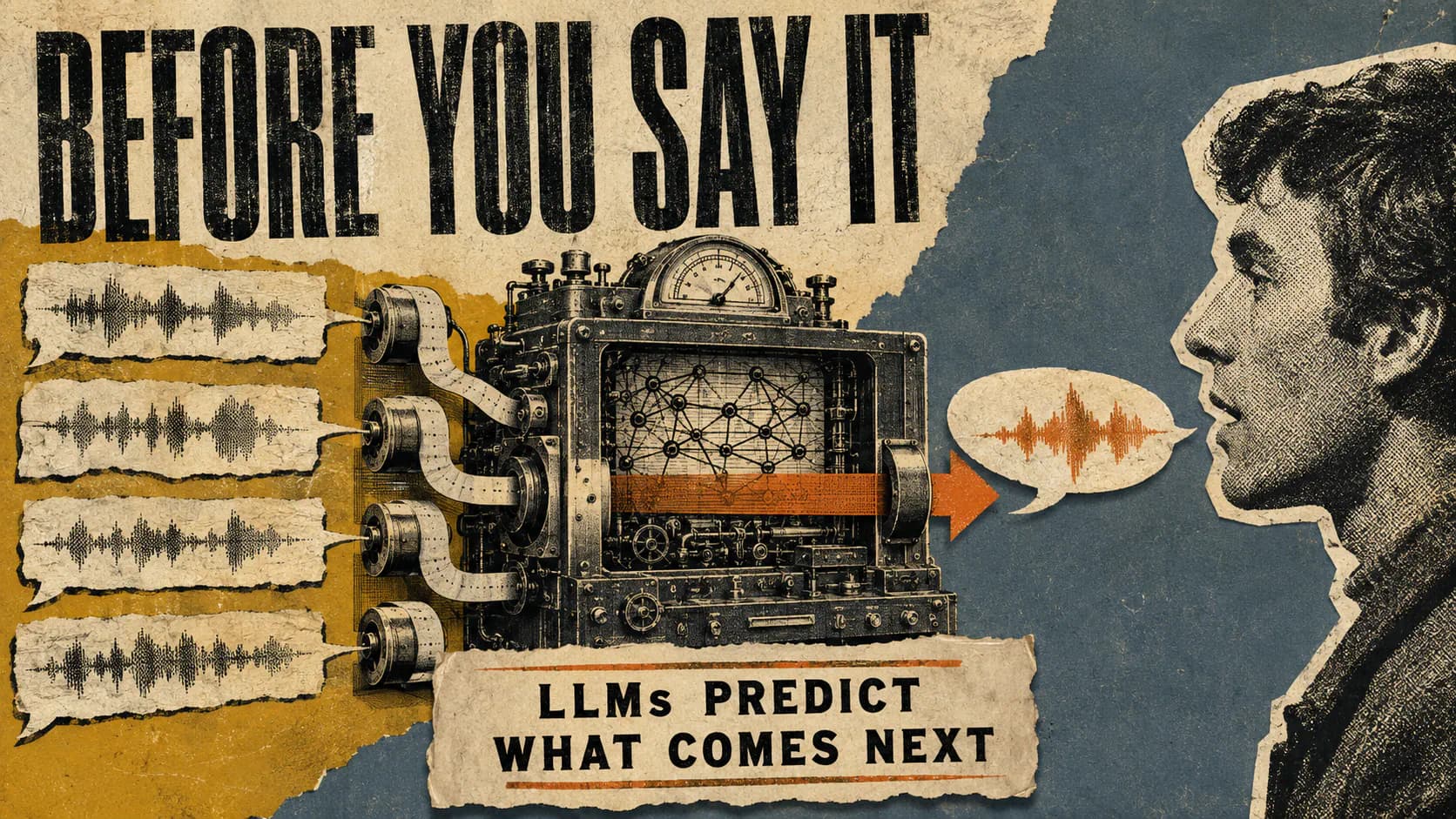
An AI assistant that remembers your preferences is useful. One that recognizes you are about to repeat an unwanted behavior, before the behavior fully unfolds, would represent a more consequential form of personalization.
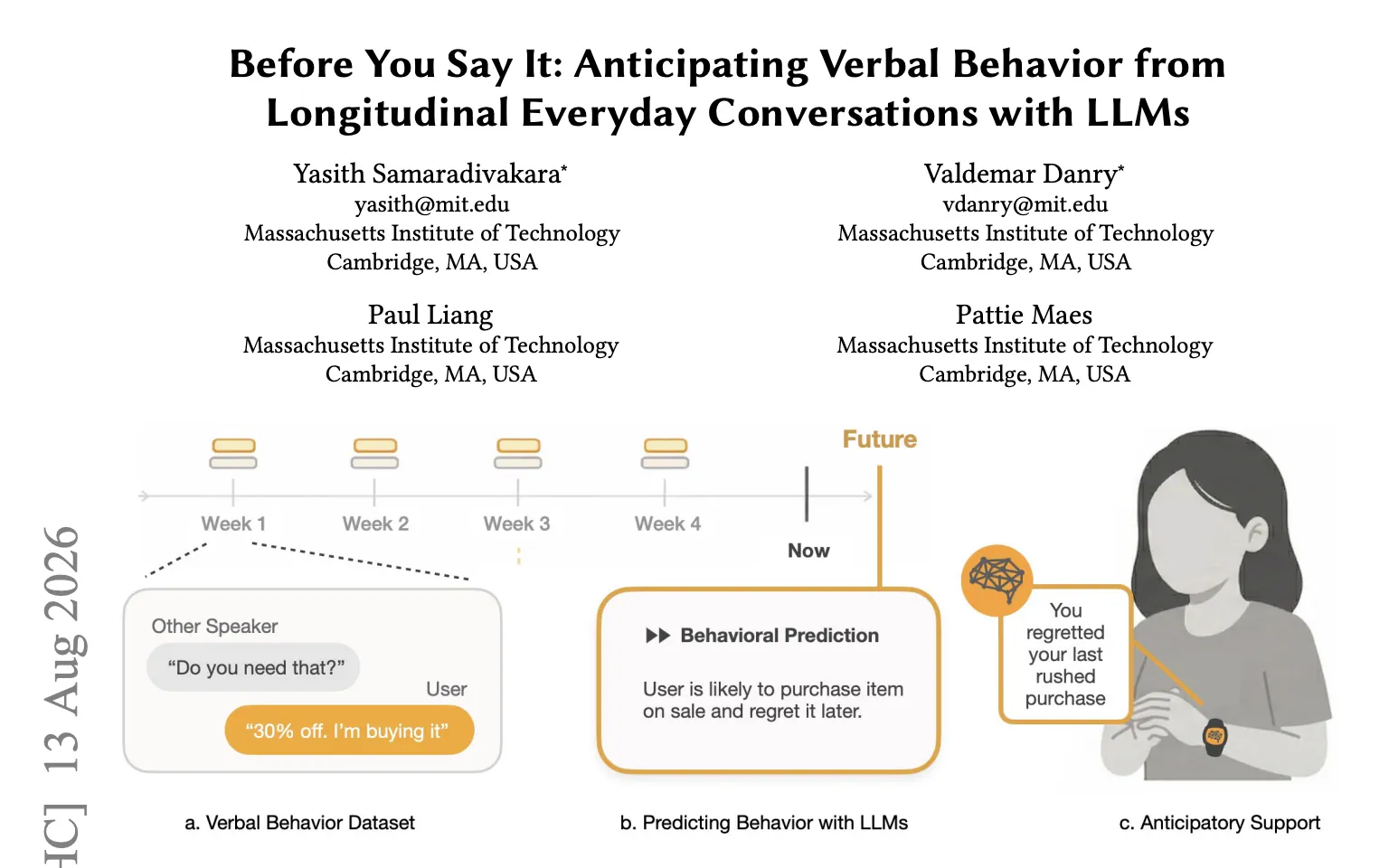
That possibility drives Before You Say It, an AI research paper from Yasith Samaradivakara, Valdemar Danry, Paul Liang, and Pattie Maes. Submitted to arXiv on August 13, 2026, the study asks whether an LLM can anticipate a person’s verbal behavior by learning situation-specific patterns from their everyday conversations.
The Research Targets Intent, Not Exact Words
The paper does not try to predict a participant’s next sentence word for word. Its target is the communicative function of the next response: whether someone is likely to disclose information, ask a question, offer advice, confirm another person’s statement, deflect, or combine several conversational actions.
The researchers ground this task in Verbal Response Mode theory, a taxonomy that categorizes speech according to what an utterance does within a conversation. A prediction might therefore say that someone will minimize their distress and redirect the discussion toward practical details, rather than attempting to reconstruct the actual sentence they will use.
This distinction makes the problem more tractable, but it also limits the headline claim. The system is predicting a generalized behavioral tendency, not reading a person’s mind or generating a reliable transcript of the future.
A Smartwatch Turned Daily Speech Into a Dataset
The researchers recruited 14 English-speaking adults who wore an always-on smartwatch during normal activities for seven to ten days. On-device voice activity detection identified speech and sent two-to-three-minute audio clips into the study’s processing pipeline. Participants were instructed to notify nearby people and obtain consent before recording interactions.
The pipeline used Deepgram’s Nova-3 Meeting model for transcription and diarization. A speaker-verification model, initialized with a 20-second voice sample, separated the participant’s speech from other speakers. SpaCy’s named-entity recognition system then replaced detected personal information with labels such as [PERSON] and [ORGANIZATION].
According to the full research paper, raw audio was deleted after processing, while transcripts were encrypted with AES-256-GCM. Participants could review the material, correct speaker labels, and remove conversations. The resulting corpus contained 15,066 utterances before cleaning and 9,901 afterward, drawn from more than 1,000 hours of naturalistic conversational data.
Situational Rules Beat Raw Long-Context Memory
The study compared four LLM-based approaches, all built around Gemini 2.5 Pro:
- Zero-shot prediction used only the current conversation.
- All-in-context prediction added the participant’s previous conversations, truncated to the most recent 500,000 characters when necessary.
- Natural-language summary prediction replaced the raw history with a summary of recurring tendencies.
- Situational Reasoning extracted explicit behavioral rules and activated only those relevant to the current exchange.
Situational Reasoning is the paper’s main technical contribution. Rather than asking an LLM to discover useful evidence inside a massive transcript at prediction time, it incrementally converts observations into contrastive rules:
IF [situation], THEN [behavior], BUT NOT when [exception].
A hypothetical rule could state that a person tends to deflect when challenged by an authority figure, except when the challenge comes from a peer. Conditions can include the activity, physical setting, relationship, conversational move, time, or inferred emotional state.
The method collects both supporting and contradicting examples, updates each rule as more data arrives, and assigns qualifiers such as “sometimes,” “often,” or “always.” At inference time, the system finds rules whose conditions match the current conversation, checks whether any exception applies, and gives the activated evidence to the LLM.
This representation matters because more context is not automatically better context. Raw conversational history contains irrelevant exchanges, transcription errors, and patterns that do not apply to the present situation. Explicit rules compress that history while exposing the assumptions behind a prediction for inspection and correction.
The Results Improve With More Personal History
The researchers evaluated predictions against behavioral descriptions generated from the participants’ actual responses. A GPT-5 judge scored alignment on three dimensions: communicative function, behavioral specificity, and the ability to capture multiple functions within one response.
Situational Reasoning received a mean judge score of 0.597, compared with 0.502 for all-in-context prediction and 0.463 for the zero-shot baseline. That represents reported relative improvements of 18.9% and 28.9%, respectively. Its performance also increased by 23.6% as more conversational data accumulated, while the two baselines remained comparatively flat.
The 0.597 result should not be read as 59.7% exact prediction accuracy. It is an aggregated score on a zero-to-one scale, based on how closely a natural-language prediction matches the function and specificity of the observed response.
A cross-participant test provides stronger evidence that the model learned something personal. Replacing one person’s rules with patterns mined from another participant reduced the mean score to 0.460. The result suggests the advantage did not come only from broad conversational conventions that apply to almost everyone.
Human evaluation supported the automated findings, although on a smaller sample. Forty crowdsourced raters compared the methods across 200 scenarios. Situational Reasoning ranked first in 43% of comparisons, ahead of all-in-context at 24%, zero-shot at 18%, and natural-language summaries at 15%. Agreement among raters reached a reported Kendall’s tau of 0.83.
Self-Identified Habits Produced the Strongest Predictions
Participants reviewed inferred patterns and flagged 114 that represented behaviors they wanted to change. Across 912 moments where those patterns activated, Situational Reasoning achieved a mean score of 0.858. The zero-shot and all-in-context methods scored 0.607 and 0.619.
This is arguably the paper’s most practically relevant result. Recurring, personally salient habits may be easier to anticipate because they provide repeated evidence and occur under recognizable conditions. They are also the behaviors for which a timely intervention might be useful.
Seven participants later joined follow-up interviews. They described falling back on habits under stress, struggling with socially ambiguous situations, and failing to notice patterns early enough to change course. Some preferred private, nonjudgmental prompts, while others wanted reframing, alternative actions, or reminders of goals they had previously set. Participants also warned that poorly timed or overly directive assistance could misunderstand a nuanced situation and weaken their sense of agency.
Frequently Asked Questions
4 questions
1What Does the AI Predict in Before You Say It?
The AI predicts the likely communicative function of a person’s next response, not the exact words. It may anticipate that the person will disclose, confirm, advise, question, deflect, or combine several verbal behaviors. Predictions are expressed as short natural-language descriptions grounded in the current conversation and situation-specific patterns mined from the individual’s earlier interactions.
2
Sources
- Before You Say Itarxiv.org
- full research paperarxiv.org