Most enterprise AI projects don't fail at the model level. They fail when someone tries to actually run them. A pipeline that works in a notebook silently breaks in production. A multi-step process times out because there's no mechanism to pause and resume. An approval step gets skipped because the system has no way to wait for human input.
Mistral's answer to this is Workflows, the orchestration layer for enterprise AI that brings the durability, observability, and fault tolerance required to move AI-powered processes from proof of concept to production. The product is now in public preview, and it marks a clear shift in Mistral's strategy: from model releases to full production infrastructure.
Mistral's revenue growth is being driven primarily by enterprise adoption, with approximately 60% of revenue coming from Europe, according to CEO Arthur Mensch's public statements. Workflows is a direct investment in keeping those customers.
What Mistral Workflows Actually Does
Mistral Workflows is a platform for building production-grade AI workflows: multi-step processes that combine LLM calls, tool use, external APIs, and human input. They survive crashes, restarts, and failures of any individual step.
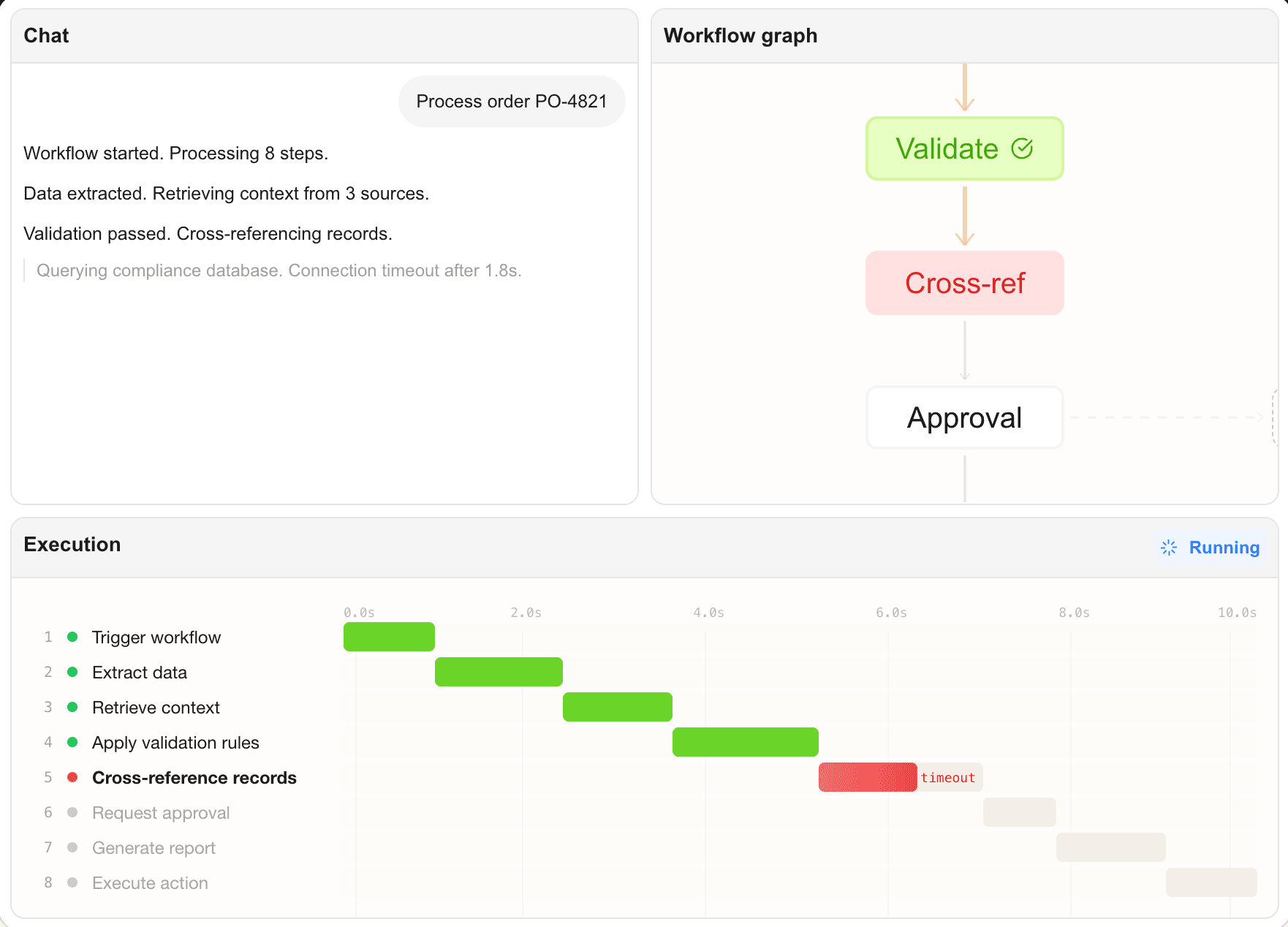
The failure modes Mistral is targeting are consistent across industries: pipelines that run in a notebook but fail silently in production with no trace, long-running processes that can't survive a network timeout, multi-step operations that need human approval mid-execution but have no mechanism to pause and resume, and systems that offer no way to verify they're still doing what they're supposed to after deployment.
At its core, Workflows provides a structured system for defining, executing, and monitoring multi-step AI processes, from simple sequential tasks to complex, stateful operations that blend deterministic business rules with the probabilistic outputs of large language models.
The Temporal Foundation
Workflows is built on Temporal's durable execution engine, the same infrastructure that powers orchestration at Netflix, Stripe, and Salesforce. Mistral extended it for AI-specific workloads by adding streaming, payload handling, multi-tenancy, and observability that the core engine does not provide out of the box.
Originally spun out of Uber's Cadence project, Temporal transparently handles retries, state persistence, and timeouts, providing durable execution across failures. Mistral didn't reinvent the wheel here. It took a proven engine and adapted it for the specific demands of AI workloads.
Elisa Salamanca, who leads go-to-market for Mistral's enterprise products, described the engineering rationale clearly:
"Workflows is built on top of Temporal. We added all the AI requirements to make these AI workflows reliable. It provides out of the box durability, retries, state management. Whenever there's a failure, it starts again wherever it stopped."
Key Technical Highlights
You write workflows in code. The platform handles execution: durability, retries, scheduling, streaming, observability, and integration with the rest of Mistral.
Here's what's included out of the box:
- Retry and timeout management: The Mistral SDK handles retry policies, tracing, timeouts, rate limiting, and human-in-the-loop through decorators and single-line configuration, so the only thing you write is the business logic itself.
- Human-in-the-loop: The human approval step is a single line of code:
wait_for_input(). The workflow pauses, waits for as long as it takes with no compute consumption, notifies the reviewer, and resumes exactly where it left off. - Observability by default: Events stream live, history is queryable, and OpenTelemetry traces work without extra wiring.
- Hybrid data handling: Workflow inputs and outputs flow through the platform, but you can keep them under your control. The SDK encrypts payloads before they leave your worker, and the platform offloads inputs and outputs above 2MB to your blob storage (S3, GCS, or Azure), keeping only references on its side.
- Python SDK v3.0: The Python SDK is how developers write and run workflows, and v3.0 is now publicly available.
Deployment Architecture
The control plane runs on Mistral. Workers and data processing run in your environment, right where your critical services are hosted: cloud, on-prem, or hybrid.
Mistral hosts the orchestration infrastructure: the Temporal cluster, the Workflows API, and Studio. You deploy workers on your own Kubernetes environment using a separate Helm chart, and they connect back to the central cluster via secure credentials. Your data and business logic stay within your perimeter.
For enterprises dealing with internal systems, regulated datasets, or regional control rules, that flexibility can remove a common blocker. Companies don't have to move every important action out of the environments they already govern tightly just to experiment with workflow automation.
How It Integrates with the Mistral Platform
Part of the Mistral Studio platform, Workflows lets developers build processes in Python, logs each step in Studio, and lets employees trigger them through the Le Chat chatbot.
Workspaces within Studio keep teams and projects separated, and role-based access control (RBAC) makes sure those rules are enforced consistently. That's the kind of governance detail that enterprise security teams actually ask about.
Supported use cases include scheduled or recurring AI tasks (cron-style or one-shot) and multi-agent orchestration with hand-offs and shared state. Workflows also exposes MCP (Model Context Protocol) servers for agent authoring, connecting AI systems to external tools through the emerging MCP standard.
Who Is Already Using It
Organizations like ASML, ABANCA, CMA-CGM, France Travail, La Banque Postale, Moeve, and many more are already running Workflows to automate critical processes.
One concrete example from the shipping industry shows the product's depth. The workflow validates every incoming shipping document against customs rules, checks for anomalies, flags anything that needs human sign-off, waits for approval, then releases the cargo.
The company said clients in financial services, energy, and healthcare had been beta testing it for customer service, workflow automation, and analyzing complex datasets. KYC reviews in banking are another explicit target. KYC reviews are manual, repetitive, and time-consuming. A single customer onboarding can require extracting identity documents, verifying them against sanctions lists and PEP databases, cross-referencing regulatory requirements across jurisdictions, and producing a structured risk assessment with supporting evidence.
What Comes Next
Mistral plans to release a more managed version of Workflows that abstracts deployment logic for developers who don't need granular control over worker placement. The company also intends to make Workflows accessible to business users, not just engineers.
Mistral will be hosting its inaugural AI Now Summit in Paris on May 27–28, where the company is expected to provide additional details on its platform roadmap.
Final Thoughts
What Mistral is doing with Workflows is less about competing on model benchmarks and more about owning the layer where enterprise AI actually lives or dies. The Temporal foundation is a smart call. It's a proven engine with a strong track record at companies like Stripe and Netflix, and building on top of it rather than from scratch means Mistral can focus engineering effort on the AI-specific additions that matter: streaming, payload handling, and human-in-the-loop primitives.
The split architecture is worth watching closely. Keeping the control plane on Mistral's infrastructure while workers run inside the customer's environment is a reasonable compromise for regulated industries, but it also means Mistral needs to maintain that trust boundary flawlessly. One data sovereignty incident would hurt adoption in exactly the verticals they're targeting. The roadmap toward a more managed, VPC-native version will matter a lot for regulated customers who can't tolerate even a hybrid model.
Mistral is moving beyond the model-release cycle into the harder enterprise problem of keeping multi-step AI software stable once it touches live business processes. That's the right problem to solve. Whether Workflows becomes the standard for enterprise AI orchestration or just one option among many depends on execution from here. What do you think? Drop your thoughts in the comments.
Frequently Asked Questions
5 questions
1What is Mistral Workflows?
Workflows is Mistral's orchestration layer for enterprise AI. It brings the durability, observability, and fault tolerance required to move AI-powered processes from proof of concept to production reliably.
2What engine powers Mistral Workflows?
Workflows is built on Temporal's durable execution engine, the same infrastructure that powers orchestration at Netflix, Stripe, and Salesforce.
3How do developers build workflows?
Once a business process is identified, developers write the workflow in Python. Every workflow can then be published to Le Chat so anyone in the organisation can trigger it, and every step is tracked and auditable in Studio.
4Does customer data leave the customer's environment?
You deploy workers on your own Kubernetes environment using a separate Helm chart, and they connect back to the central cluster via secure credentials. Your data and business logic stay within your perimeter.
5Is Mistral Workflows available now?
Workflows is now in public preview. The Python SDK for Workflows (v3.0) is publicly available, and developers can try the product in Studio and access documentation and demo templates immediately.