Tencent Hy4 AI Model Leaps From #31 to #5 on Code Arena
The open-weight 770B-parameter LLM posted a striking automated coding result, but independent hands-on evidence is still thin.
Last updated on
AI Summary
Tencent’s open-weight Hy4 preview jumped from roughly #31 for Hy3 to #5 on Arena’s WebDev AutoEval, scoring 1,633 points and ranking around third among open models.
Released August 28, 2026, the mixture-of-experts model has about 779 billion total parameters, activates 49 billion per token, and supports a roughly one-million-token context window. Its BF16 weights occupy about 1.56TB, while Tencent’s FP8 release is approximately 1.16TB; official serving examples require at least eight GPUs. Tencent integrated Hy4 into WorkBuddy, CodeBuddy, Yuanbao, ima, and Tencent Cloud. In an internal blind test using 163 experts and 203 engineering tasks, Hy4 averaged 2.99 versus 2.92 for GLM-5.3 and 2.94 for Kimi K3.
The Arena result is an automated web-development evaluation, not proof of broad coding supremacy. Independent repository-level and agent testing must verify reliability, long-context performance, deployment costs, and whether Tencent’s narrow internal wins generalize.
Tencent released Hy4 preview on August 28, 2026, and immediately supplied a better headline than its 770 billion parameters. The AI model reached roughly fifth place on Arena’s WebDev AutoEval with 1,633 points, up from about #31 for Hy3. Arena also placed it around third among models in its open category.
According to Tencent’s Hy4 announcement, the mixture-of-experts LLM activates 49 billion parameters per token and supports a context window of about one million tokens. Tencent has published the weights and integrated the model into WorkBuddy, CodeBuddy, Yuanbao, ima, and Tencent Cloud.
That combination makes Hy4 a credible new contender in the Chinese open-model race. It does not yet prove that Tencent has built the best coding model, particularly when the strongest external result comes from an early automated evaluation rather than broad, reproducible testing.
The 26-place jump from Hy3 matters more than the raw parameter count. Large models are easy to announce; moving sharply up a third-party coding leaderboard suggests Tencent’s additional pre-training, post-training, and engineering data produced a measurable capability gain. Arena reported the new position in its launch-day post.
Reuters independently reported that Hy4 sat around fifth overall and third among open models. That is a useful external signal, especially because Tencent’s previous generation had not occupied the same competitive tier.
The evaluation still has a narrow scope. WebDev AutoEval is an automated web-development test, not a comprehensive study of software engineering performance. It cannot establish how reliably Hy4 patches mature repositories, navigates an unfamiliar terminal, recovers from failed tool calls, writes tests, or maintains a long agent workflow.
Leaderboard positions can also change as Arena adds models or modifies an evaluation. Claims that Hy4 has definitively surpassed every GPT, Claude, or other frontier coding system therefore go beyond the evidence. The result says Hy4 deserves independent testing. It does not settle the broader coding-model ranking.
Hy4 Activates 49B Parameters, but Stores Far More
Tencent rounds Hy4’s size to 770 billion parameters, while the technical table in the official Hy4 model card lists approximately 779 billion in total. Its mixture-of-experts architecture has 144 layers, 256 routed experts, and two shared experts. Around 49 billion parameters participate in processing each token, and the advertised context length reaches roughly one million tokens.
Activating a fraction of the model reduces the arithmetic required for each token compared with a similarly sized dense model. It does not turn Hy4 into a conventional 49B model. A deployment must still store and route an enormous collection of experts, which affects memory capacity, communication between GPUs, and serving complexity.
The BF16 weights occupy approximately 1.56TB, while Tencent’s self-dequantizing FP8 release is about 1.16TB. The official serving examples start with at least eight GPUs for BF16 or FP8 inference, before accounting for the additional memory needed by very long prompts and concurrent users. Hy4 is open to download, but it is not a practical local model for mainstream workstations.
Tencent says it developed training data with internal software engineers, game developers, finance analysts, and security specialists. Hy4 was also co-designed with products such as CodeBuddy and WorkBuddy, giving Tencent a direct route from model development to production use. That product connection can expose real failure modes faster than benchmark development alone.
“Open Source” Comes With Important License Limits
Tencent describes Hy4 as open source, and the company has made the model weights available for downloading, modification, and redistribution. The release nevertheless uses the custom Tencent Hy Community License, not a permissive license such as Apache 2.0 or MIT. “Open-weight” is the more precise description for many technical and commercial discussions.
The license grant excludes the European Union, United Kingdom, and South Korea. It also says products or services with more than 100 million monthly active users must request a separate commercial license from Tencent. Those conditions do not erase the value of publishing the weights, but they materially affect where the model can be deployed and which companies can use it without additional negotiations.
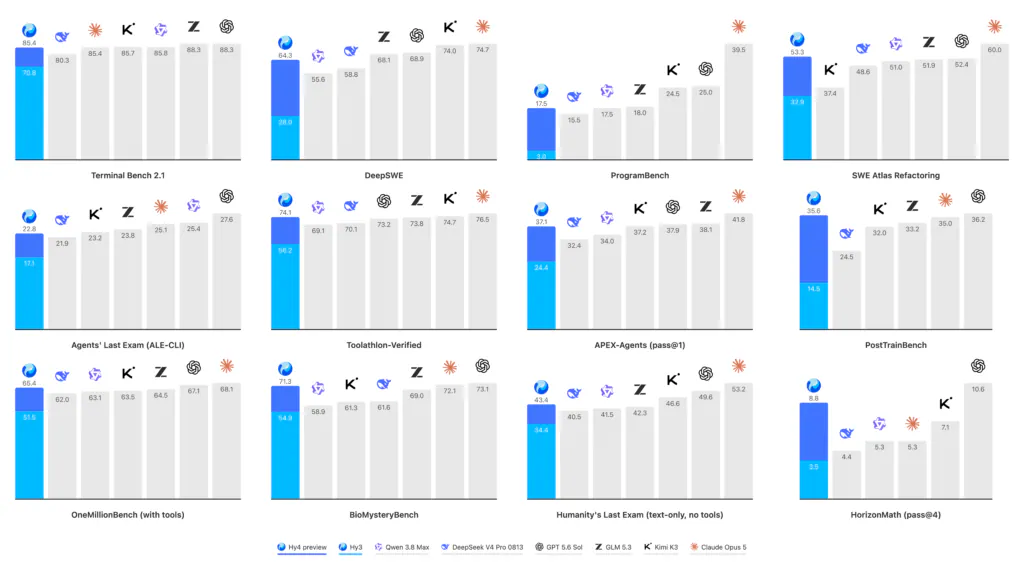
Tencent conducted a blind comparison involving 163 internal experts and 203 engineering tasks. Hy4 received an average rating of 2.99, compared with 2.92 for Z.ai’s GLM-5.3 and 2.94 for Moonshot AI’s Kimi K3. These are two of the strongest Chinese open-weight model families, so Tencent did not select weak baselines.
Against GLM-5.3, Tencent reported that Hy4 won 46.8% of comparisons, tied 12.8%, and lost 40.4%. Against Kimi K3, Hy4 won 51.2%, tied 7.9%, and lost 40.9%. The model finished ahead in both matchups, but the average-score margins were only 0.07 and 0.05.
Those numbers support competitive parity more strongly than dominance. The evaluators came from Tencent, and the tasks were built around engineering work inside the company. Blind comparisons reduce brand bias, but internal task selection, scoring rubrics, and product priorities can still influence the result.
Combined with the Arena placement, however, the test suggests that Tencent has moved much closer to Z.ai and Moonshot AI than Hy3’s ranking implied. Independent reproduction would determine whether Hy4 is broadly competitive or unusually well aligned with Tencent’s preferred tasks and Arena’s web-development harness.
The Real Test Starts With Independent Agent Runs
Hy4 now needs evidence that covers more than a single automated leaderboard. The most useful next evaluations would examine:
Repository-level coding: Hy4 should be tested on bug fixes and feature work in existing codebases, using disclosed prompts, tools, and agent settings.
Agent reliability: Independent testers need to measure whether the model can plan, call tools, inspect failures, and recover without repeatedly drifting off task.
Deployment efficiency: Quality must be considered alongside GPU requirements, latency, throughput, context scaling, and API cost.
The one-million-token context window also deserves scrutiny. Supporting a long input is different from retrieving the right detail deep inside it, reasoning across distant files, and preserving a coherent plan over hundreds of tool interactions. Long-context claims are especially valuable for coding agents, but only when retrieval accuracy and inference costs remain manageable.
Tencent’s immediate integrations give Hy4 a practical advantage. WorkBuddy, CodeBuddy, and Tencent Cloud can put the model in front of users while independent developers experiment with the downloadable weights. That distribution may help Tencent improve the model quickly, although product availability is not itself evidence that the #5 Arena result will transfer to every coding workflow.
Final Thoughts
Hy4 is significant because of Tencent’s rate of improvement, not because 770 billion is an unusually large number. Moving from roughly #31 to #5 on Code Arena, while posting narrow internal wins against GLM-5.3 and Kimi K3, puts Tencent back into the leading group of Chinese model developers.
The defensible verdict is “serious contender,” not “new coding champion.” A transparent, independently reproduced agent evaluation could strengthen that assessment quickly. Until then, Hy4’s debut shows that Tencent has closed much of the visible gap, while leaving the most important question unanswered: whether the jump survives outside Arena and Tencent’s own engineering tests.
Frequently Asked Questions
4 questions
1
What is Tencent Hy4?
Tencent Hy4 preview is a mixture-of-experts LLM with about 770 billion total parameters, 49 billion active per token, and a context window of roughly one million tokens. Tencent has released the weights and integrated Hy4 into WorkBuddy, CodeBuddy, Yuanbao, ima, and Tencent Cloud. The model targets coding, office productivity, scientific research, and other agentic tasks.
2
How did Hy4 rank on Code Arena?
Hy4 entered Arena’s WebDev AutoEval at roughly #5 with 1,633 points on August 28, 2026. Arena said this was up from approximately #31 for Hy3 and placed Hy4 around #3 among models in its open category. Because AutoEval is automated and the leaderboard can change, the result is an early performance signal rather than a permanent ranking.
3
Is Tencent Hy4 really open source?
Hy4 has publicly downloadable weights, but Tencent distributes them under the custom Tencent Hy Community License rather than a standard permissive license. The license grant excludes the European Union, United Kingdom, and South Korea, while products exceeding 100 million monthly active users require separate commercial permission. For that reason, “open-weight model” is a more accurate description.
4
Did Hy4 beat GLM-5.3 and Kimi K3?
Hy4 narrowly led both models in Tencent’s internal blind evaluation. It averaged 2.99 across 203 engineering tasks, compared with 2.92 for GLM-5.3 and 2.94 for Kimi K3. Tencent used 163 internal experts, so the result is relevant but not independent. The small margins suggest competitive parity more clearly than definitive superiority.