Anthropic released Fable 5 as its most capable publicly available AI model, with leading performance in software engineering, knowledge work, vision, and long-running agentic tasks. Corporate buyers have responded with considerably less enthusiasm than its benchmark results might suggest.
According to a Financial Times report based on Ramp data, Fable 5 represented only 11.4% of spending on Anthropic models during its first full month of availability. It accounted for an even smaller 6% of the Claude tokens purchased by businesses.
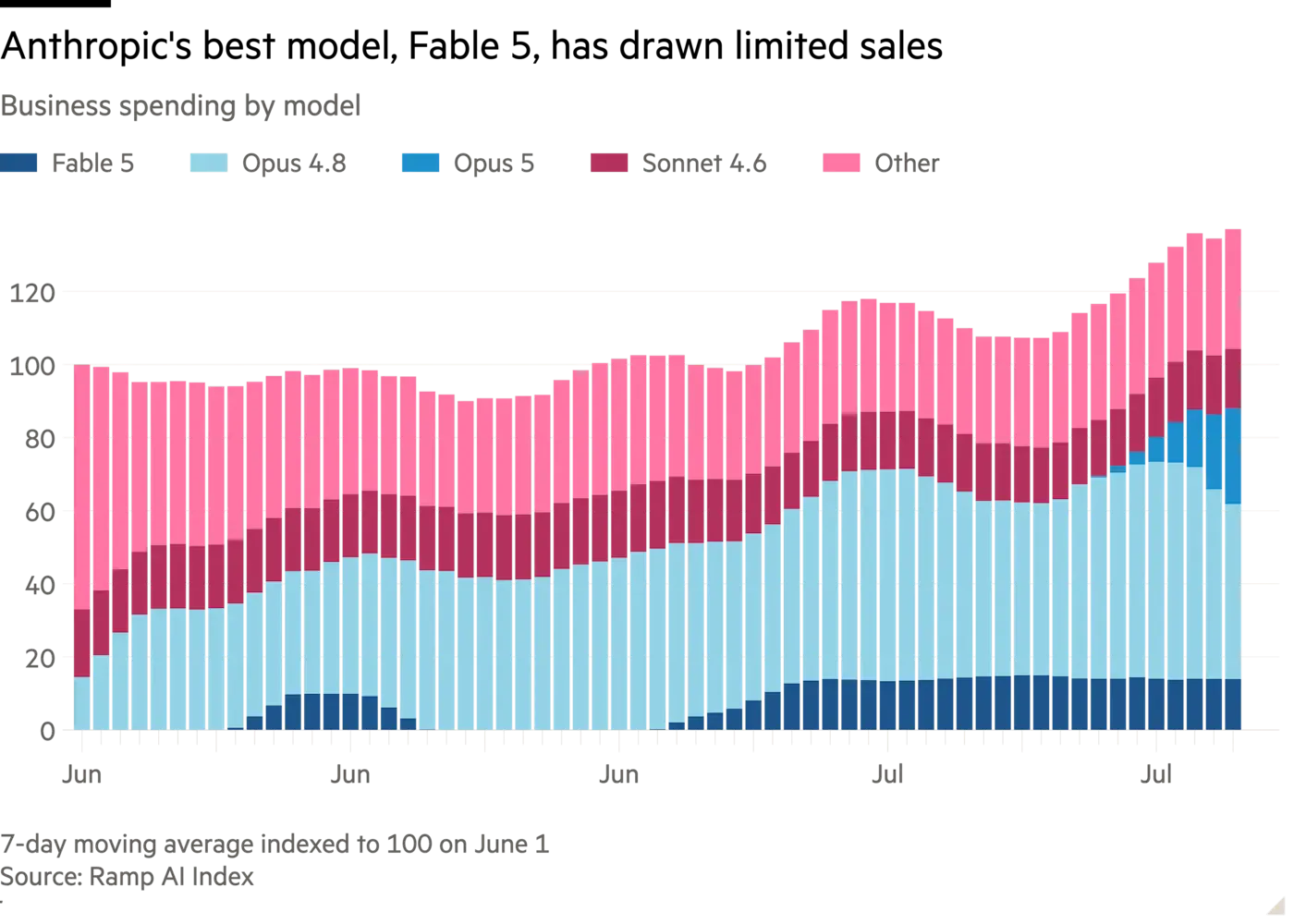
The result does not show that Anthropic is losing the enterprise AI market. It does reveal something potentially more important: being the best model is no longer enough to make a model the default choice. Fable 5 has reached the point where incremental intelligence must compete against a large and increasingly visible price premium.
Ramp’s 11.4% Figure Is Narrow but Important
The 11.4% statistic needs to be described precisely. It is not Fable 5’s share of all corporate AI spending on Ramp. It is the model’s share of spending attributed to Anthropic models among companies using Ramp’s token spend management product. The sample also leans more heavily toward technology companies than Ramp’s wider business dataset.
Within that sample, Fable 5 generated 11.4% of Anthropic model spending while handling 6% of token volume. OpenAI’s GPT-5.6 Sol, by comparison, represented 23% of OpenAI model spending and 25% of its tokens. Ramp estimated that Fable 5 produced approximately three-quarters as much model-attributed revenue as GPT-5.6 Sol in July 2026.
This is only an early snapshot, not a final judgment on the product. Even so, the imbalance between Fable 5’s technical position and commercial uptake provides evidence of a pricing ceiling. Businesses appear willing to reserve the best model for difficult work, but not to pay for it across every workflow.
Fable 5 Is Priced for Rare, Difficult Work
Claude Fable 5 costs $10 per million input tokens and $50 per million output tokens. Anthropic says its advantage grows as tasks become longer and more complex, particularly in autonomous software engineering, scientific research, analytical work, and other projects that require sustained reasoning.
That can justify the price when a failed answer would cost more than the model call. A successful code migration, security investigation, or specialist research task may save days of professional work. Routine document classification, extraction, summarization, customer support, and drafting rarely offer the same economics.