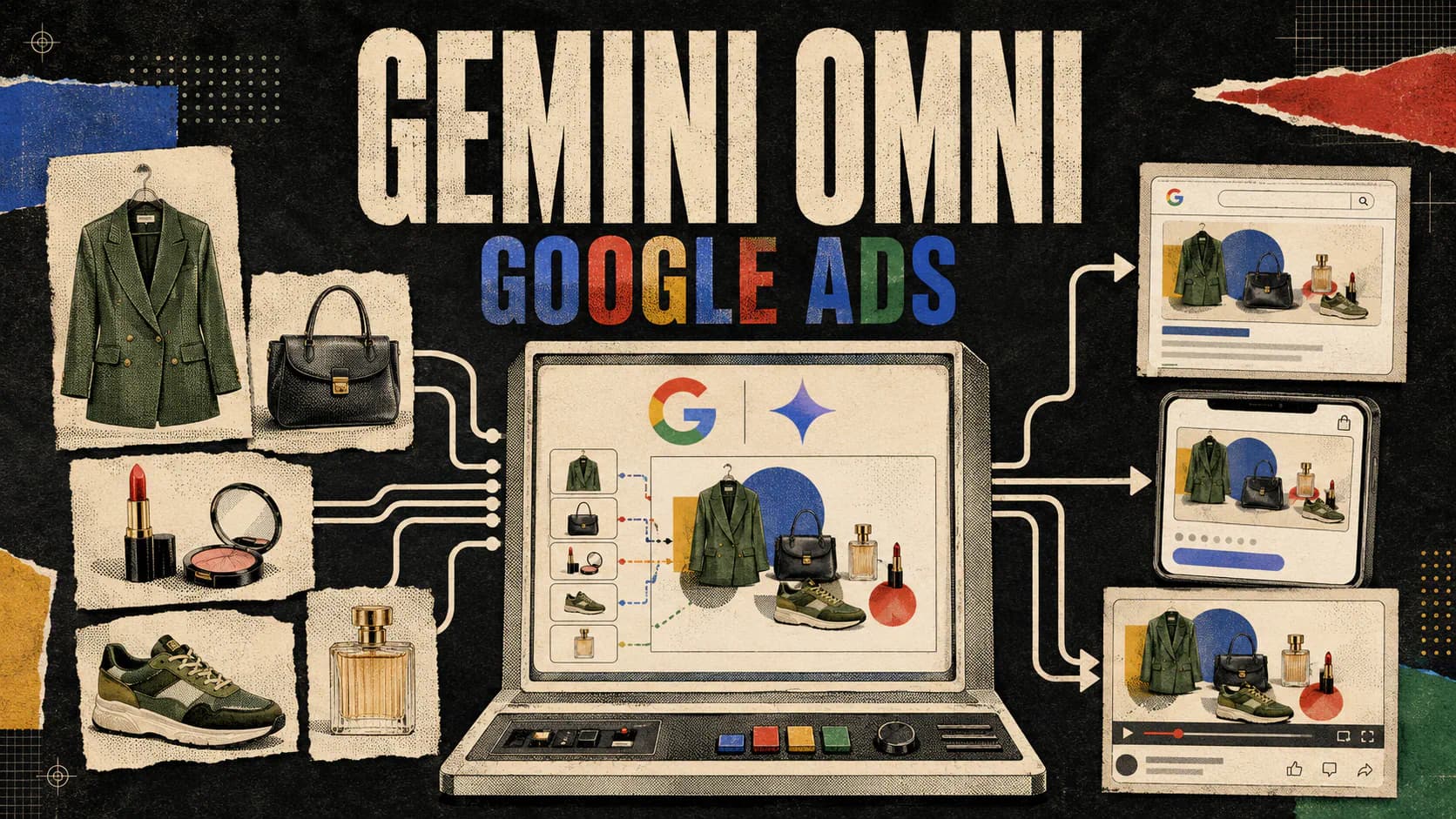
Google released Gemini Omni in Google Ads on August 26, 2026, moving more of the video advertising workflow into Asset Studio. Advertisers can generate storyboards and motion scenes, edit individual elements with natural-language prompts, create multiple aspect ratios, and send finished videos directly into supported campaigns.
The launch completes a rollout Google previewed in May, when it positioned Asset Studio as a central workspace for producing, managing, testing, and deploying creative. Gemini Omni is rolling out globally as a free Google Ads feature, although the company has not documented every usage limit or account requirement.
Gemini Omni Turns Asset Studio Into a Video Workspace
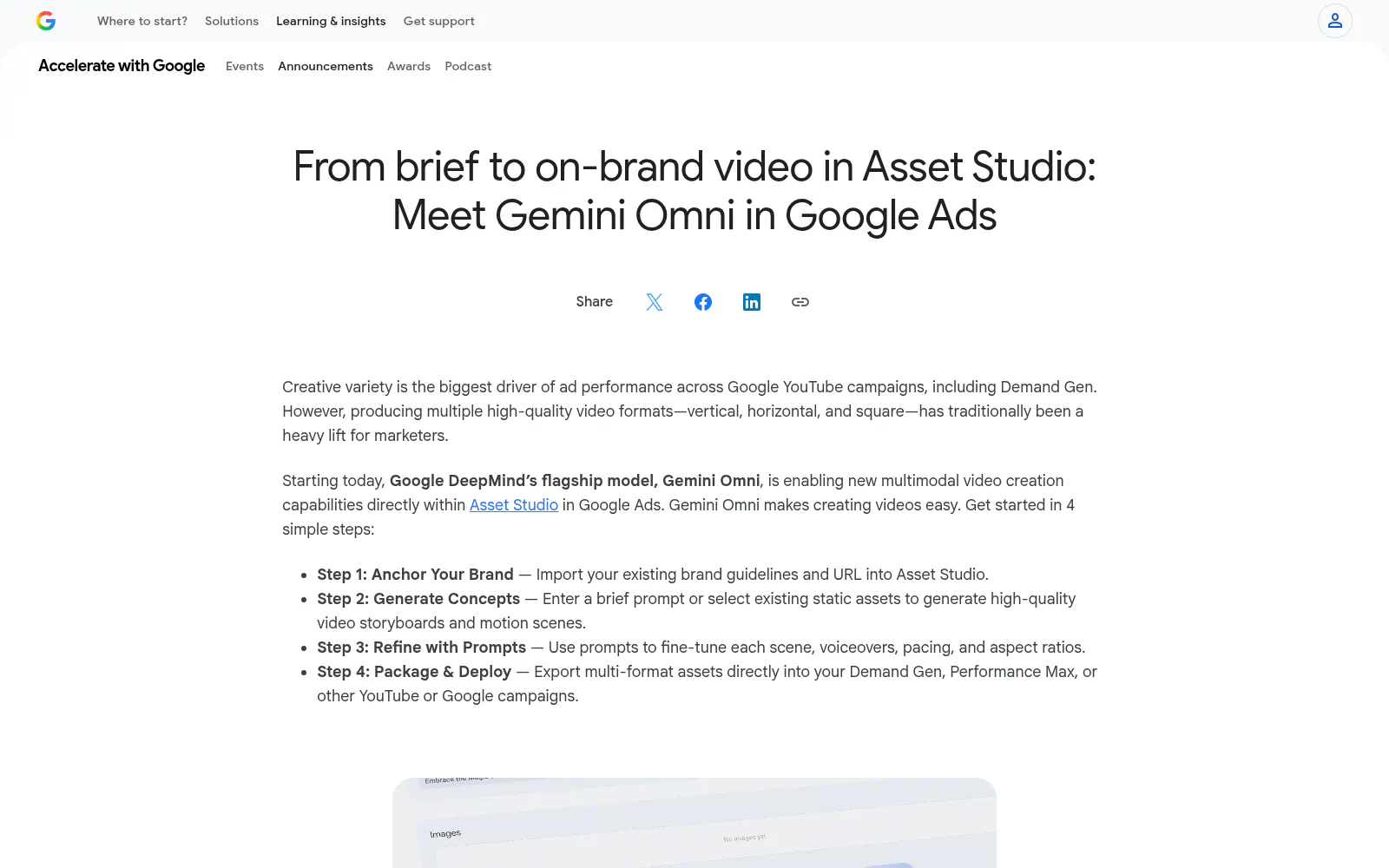
Screenshot: Unlock creative variety across YouTube & Google Ads with Gemini Omni.
Asset Studio already provides an account-level library, video templates, image editing, voice-over tools, trimming, imports, previews, and creative recommendations. Gemini Omni expands that toolkit from assembling ads out of existing components to generating and editing complete video concepts within the same interface.
Google describes a four-stage workflow:
- Anchor the Brand: Import the company’s existing brand guidelines and website URL.
- Generate Concepts: Enter a brief or select static assets to produce storyboards and motion scenes.
- Refine the Video: Adjust scenes, backgrounds, styling, voice-overs, pacing, and aspect ratios through prompts.
- Package and Deploy: Export the resulting assets into Demand Gen, Performance Max, and other Google or YouTube campaigns.
That sequence is more important than the raw generation feature. Advertisers can move from a source brief to campaign-ready variations without repeatedly exporting files between an AI generator, editing software, approval system, and Google Ads. The value will depend on how well Gemini Omni retains previous instructions during revisions.
The Real Upgrade Is Conversational Video Editing
Gemini Omni accepts combinations of text, images, audio, and video. Its defining feature is multi-turn editing: each instruction builds on the previous version instead of forcing the user to regenerate a clip from the beginning. A marketer could change a background, revise the camera angle, remove an object, and alter the visual style through successive prompts.
That approach is particularly useful for advertising, where a concept often requires several small revisions before approval. Google says Asset Studio users can also refine voice-overs, pacing, scene details, and formatting, making Gemini Omni closer to an interactive editor than a conventional text-to-video button.
The quality claims still require perspective. DeepMind reports leading instruction-following and overall preference results in some human evaluations, but several comparisons are internal. Its Gemini Omni Flash model card also acknowledges continuing problems with complete consistency, complex motion, and perfectly accurate text. Google has not identified the exact Omni serving variant used by Asset Studio or published independent ad-production tests for this integration.
Brand Inputs Matter More Than Clever Prompts
Google says Gemini Omni uses uploaded guidelines and website context to preserve a Brand’s visual and tonal identity. That should reduce the risk of every variation drifting toward the same generic AI aesthetic, but “on-brand” remains a system output rather than a guarantee.
Teams should give Asset Studio specific, current source material:
- Approved logos, colors, fonts, and product imagery
- Tone-of-voice rules and prohibited language
- Verified prices, claims, offers, and disclaimers
- Examples of both acceptable and unacceptable creative
- Usage rights for uploaded images, audio, and likenesses
A vague Brand guide will produce vague constraints. The strongest workflow will treat Gemini Omni as a production layer beneath an established creative system, not as the system responsible for defining the Brand. Marketing teams still need to decide what the campaign should communicate and which elements cannot be changed.
Multi-Format Output Targets a Real Ads Bottleneck
Google specifically lists horizontal 16:9 and vertical 9:16 output for Google and YouTube placements. Its announcement also discusses the demand for square creative, but the detailed feature description does not explicitly confirm a square export ratio. Advertisers that depend on square placements should verify the available options inside their accounts.
The larger opportunity is creative variation. Google says more than half of small and medium-sized businesses using Google Ads employed Google AI to create or optimize creative between January and June 2026. The company’s separate Asset Studio roadmap also includes one-click A/B testing, although the Gemini Omni announcement does not say that testing is part of this specific release.
A sensible initial test could compare:
- The same concept in horizontal and vertical formats
- Product-led openings against lifestyle-led openings
- Different pacing while retaining the same offer
- An AI-generated variation against an existing human-produced control
Gemini Omni could make these experiments cheaper to produce, but Google has not published campaign-lift data for the Asset Studio integration. Better generation benchmarks do not automatically translate into higher conversion rates or stronger Brand recall.
Free Access Leaves Important Product Questions Open
Google says the multimodal capabilities are rolling out globally as a free feature within Google Ads. “Free” appears to mean that advertisers do not pay a separate generation fee, not that video production has no cost. Review time, creative strategy, rights management, campaign testing, and advertising spend still remain.
The announcement does not specify generation quotas, maximum clip length, output resolution, processing times, supported voice-over languages, or detailed eligibility rules. Google’s May preview described a global English rollout, while the August release says global without restating language coverage. Availability may therefore vary by account, market, language, or advertising category.
For larger advertisers, these details will decide whether Gemini Omni becomes a primary production tool or a rapid prototyping option used before assets move into an external editing and approval pipeline.
Human Review Still Determines Whether the Ads Are Usable
Google says videos generated through Asset Studio receive an imperceptible SynthID watermark. SynthID embeds a detectable signal into AI-generated media and is designed to survive common changes such as cropping, filtering, compression, and frame-rate adjustments. The watermark provides provenance, but it does not confirm that an ad is accurate, lawful, or suitable for a Brand.
Before deployment, reviewers should check:
- Product appearance, packaging, and logo accuracy
- Prices, promotional terms, and factual claims
- Captions, onscreen text, and voice-over pronunciation
- Character, object, and background continuity
- Permissions for people, music, trademarks, and uploaded assets
- Required disclosures and market-specific AI labels
Google’s generative AI guidance warns that generated assets can contain inaccuracies and are not guaranteed to receive Ads Policy approval. Its AI labeling requirements also note that advertisers may face disclosure obligations in jurisdictions including the European Union, India, and New York. Using Google’s labeling controls does not by itself guarantee legal compliance.
The safest setup keeps generation and publication separate. Gemini Omni can create options quickly, but a named reviewer should approve the final script, visuals, claims, format, and destination before the asset enters a live campaign.
Final Thoughts
Gemini Omni’s most consequential feature is not that it can generate video. The model places iterative video production inside the platform where advertisers already manage their assets and campaigns.
That could make creative variety practical for smaller teams and accelerate testing for larger ones. It also increases the risk of publishing plausible-looking mistakes at scale. The advertisers that benefit most will use Gemini Omni to shorten production cycles while keeping Brand strategy, factual verification, policy review, and performance measurement firmly under human control.
Frequently Asked Questions
4 questions
1What Can Gemini Omni Do in Google Ads?
Gemini Omni can generate video concepts from prompts, Brand guidelines, website context, and existing static assets inside Google Ads Asset Studio. Advertisers can refine scenes, backgrounds, voice-overs, pacing, styling, and aspect ratios with natural-language instructions, then export approved videos into supported Google and YouTube campaigns.