NVIDIA Announces GR00T 2, Code Due in December | Zeniteq
Loading
Loading article
Zeniteq is now available on mobile for iPhone, iPad and Apple Watch.Download nowLearn more
NVIDIA Announces GR00T 2, Code Due in December
NVIDIA’s new world-action model predicts future video alongside robot actions, with reported gains in skill transfer and few-shot learning ahead of a December code release.
NVIDIA recently unveiled GR00T 2, a world-action model that jointly predicts future video and robot motor commands. By training on over 400,000 hours of human video alongside teleoperation data, the model enables cross-embodiment skill transfer, allowing robots to learn tasks from human or handheld demonstrations without requiring target-specific training. While the model shows promise in zero-shot tasks, its true utility lies in its integration with reasoning models that can direct physical execution. Teams should prepare for the December code release by auditing their own data pipelines and defining rigorous, repeatable evaluation criteria for reliability.
NVIDIA introduced GR00T 2 at the Conference on Robot Learning in Austin, Texas, on November 9, 2026. Built on NVIDIA Cosmos, the robot foundation model jointly predicts how a scene will change and which actions a robot should take. NVIDIA reports that it transfers skills from human demonstrations to robot bodies and adapts to new tasks with a handful of examples. (NVIDIA announcement)
The announcement is not a public code release. NVIDIA calls GR00T 2 an open model, but its research page says “Code Available in December.” Teams can examine the architecture, demonstrations and published results now; they should not treat the model as already downloadable. (NVIDIA research page)
The most consequential detail is how NVIDIA connects predicted outcomes to actions. That connection could make human video more useful for robot training, while giving a separate reasoning model a way to direct physical skills.
How GR00T 2 Predicts Outcomes and Actions Together
GR00T 2 takes recent video, a task instruction and the robot’s current state as inputs. One diffusion transformer jointly denoises future video and a chunk of robot actions. The robot executes that action chunk, receives fresh observations and repeats the process. Small, robot-specific output heads translate the shared representation into motor commands for different bodies. (NVIDIA’s architecture description)
“Denoising” describes the model’s generation process: it progressively refines noisy representations into predicted video and actions. Joint generation ties an action sequence to an anticipated visual result.
For example, a manipulation model needs to connect a movement toward an object with the object’s expected position afterward. GR00T 2’s training explicitly includes both sides of that relationship. Its future video is generated prediction, however, not footage confirming that the action actually succeeded.
That distinction also explains the shift from a vision-language-action model toward a world-action model. A conventional VLA framing maps visual observations and language instructions to actions. GR00T 2 additionally learns to generate the visual consequences alongside those actions.
My view is that the useful advance is this shared training objective. Human video contains many examples of physical outcomes without corresponding robot motor commands. Predicting those outcomes provides a route for that video to contribute to a robot policy. The reported transfer experiments are evidence to examine; generated video alone is insufficient evidence of reliable physical control.
NVIDIA’s announcement highlights 100,000 hours of open human egocentric video. Its research page describes a substantially larger pretraining mixture:
Data source
NVIDIA-reported training volume
First-person video of people working
402,730 hours
Handheld UMI gripper demonstrations
10,184 hours across 2,897 tasks
Robot teleoperation
23,500 hours
The robot data covers YAM and Franka gripper arms, Sharpa and Wuji dexterous hands, and the Unitree G1 humanoid. The openly available 100,000-hour Human-1M-100K dataset is a subset of the human-video component, not the entire pretraining collection. (NVIDIA research page)
NVIDIA also reports an experiment varying the amount of human video used during pretraining. Across 72 downstream Dexter tasks, real-robot task progress rose from 50% without that video to 70% with the full human-video component. Generated-video task progress rose from 64% to 77%.
These are task-progress measurements, not task-completion success rates. Even with that distinction, the experiment is useful: it directly tests whether adding human video improves the robot’s downstream behavior. That is stronger support for the training strategy than the dataset’s size alone.
All performance figures discussed here come from NVIDIA’s published research and announcement, not independent measurements.
How Skills Transfer Between Different Bodies
NVIDIA calls its cross-embodiment transfer approach X-Adapt. The target robot can learn a task demonstrated by a person or another embodiment without receiving a demonstration of that task on its own body.
The research page gives three examples:
Human to dexterous robot: A robot with two five-fingered hands lines a laboratory funnel with filter paper and wets it with a wash bottle. NVIDIA reports 65% success after learning the task from human demonstrations.
Handheld gripper to robot arm: Demonstrations recorded with a handheld UMI gripper transfer to a YAM arm using a different gripper. NVIDIA reports 60% success on an end-to-end toy dump-truck assembly taking up to four minutes.
Wearable hand to robot hand: Demonstrations collected through DexUMI, a wearable device that mirrors robot fingers, transfer to dexterous tasks such as preparing banana yogurt and striking a match. (NVIDIA transfer examples)
The shared model learns from multiple kinds of demonstrations, while the per-robot output heads handle differences in motor commands. This separates some of the knowledge about a task’s visual progression from the mechanics of a particular robot.
The qualification is important: no target-robot demonstration of a task does not mean no robot training data. GR00T 2’s pretraining mixture already contains extensive teleoperation data.
For a robotics team, the practical opportunity is cheaper task collection. If a human or handheld device can demonstrate a workflow, the team may need less task-specific teleoperation on its final hardware. The published examples support investigating that possibility; they do not yet establish consistent transfer across arbitrary robots or tasks.
The Success Numbers Measure Two Different Things
NVIDIA’s headline says GR00T 2 completed 40 of 50 evaluated tasks at least once without task-specific demonstrations. Its research page separately reports 40% average zero-shot success on those tasks.
Both numbers can be true. Completing 40 tasks at least once measures the breadth of tasks with some success. Average success measures how consistently the robot succeeds across attempts.
40% average success; 40 of 50 tasks completed at least once
One demonstration per task
71% average success
Five demonstrations per task
95% average success
The research page describes these as 50 tasks unseen on the target robot, though encountered in human video or on other robots. For the five-demonstration setting, NVIDIA reports under three minutes of robot data per task and a 30-minute fine-tune on one RTX 5090. (Research results; announcement)
I would pay more attention to the average success rate than the “40 of 50” headline when planning an evaluation. A workflow that occasionally completes many tasks can still require frequent intervention.
The five-demonstration result is encouraging for adaptation cost, but its conditions matter. A 30-minute fine-tune is a reported result for NVIDIA’s setup, not a guaranteed turnaround for every robot, camera arrangement or task. Teams will need to measure demonstration collection, training and operational reliability separately.
A Reasoning Model Can Direct the Skills
NVIDIA describes GR00T 2 as a skill model that a separate reasoning model can direct through a WAM API and supporting tools.
In one reported experiment, a reasoning model controlled a YAM arm through the API. NVIDIA says the system completed at least 97 of 100 consecutive assemblies for each of three toys, recovering from stalls and errors along the way.
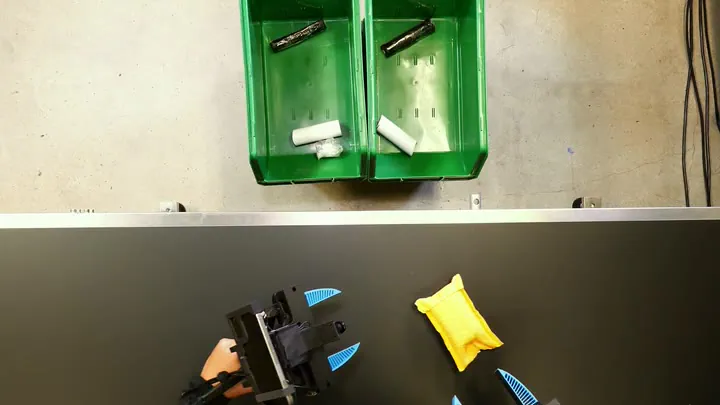
Another experiment used visual steering: the reasoning model supplied step instructions and marked grasp and release locations on the camera view. NVIDIA reports 92% compliance with these what-and-where instructions, compared with 40% using the task instruction alone. The system also completed 17 of 20 long-horizon trash-sorting runs. (NVIDIA research page)
The practical architecture is a division of labor. A reasoning model selects or guides steps; GR00T 2 handles the associated physical behavior. An LLM in that arrangement is a coordinator, not the model directly generating every motor command.
These results also suggest that the control interface deserves its own evaluation. Better outcomes may depend on how precisely an agent specifies a skill, where it directs attention and how it detects failure.
GR00T 2 Turbo Targets Onboard Humanoid Execution
NVIDIA also introduced GR00T 2 Turbo, a speed-focused variant using a smaller transformer and a more compact video representation.
The company reports that Turbo runs on a Unitree G1’s onboard Jetson Thor, taking 124 milliseconds per prediction. Through the SONIC whole-body controller, it coordinates walking, bending, reaching and carrying. NVIDIA reports successful popcorn scooping and serving in all 48 trials, plus 93% success clearing tables containing varied objects. (NVIDIA research page)
The 124-millisecond figure describes model prediction latency, not the frequency of every motor-control update. Keeping those measurements separate matters when comparing systems: generating an action chunk and executing stable whole-body motion are different jobs.
What Robotics Teams Can Evaluate Now
The December schedule leaves room for preparation, but not for assuming public access to GR00T 2 inference code.
Teams can work on three useful fronts:
Inspect the evidence and data fit. NVIDIA’s research page provides architecture details, demonstrations and an explorer for its openly available human-video subset. Compare those activities and viewpoints with the intended workflow.
Prepare a repeatable evaluation. Define completion criteria, intervention rules, object variations and recovery tests before trying the model. Record every attempt so task coverage cannot be confused with reliability.
Assess simulation and benchmark workflows. NVIDIA introduced Isaac Lab 3.0 alongside GR00T 2, including PhysX and Newton solver options and reinforcement post-training support. The Robot Report describes an Isaac Lab-Arena 0.4 developer preview and DexBench partner early access, so access status should be checked component by component. (NVIDIA announcement; The Robot Report)
NVIDIA says Foxconn is applying GR00T 2 to server-manufacturing automation, Siemens is evaluating industrial use cases, and Nexuni is testing laundry handling. Those descriptions indicate partner application and evaluation; the announcement provides no production uptime or fleet-scale reliability figures.
For public adoption, the next checkpoint is the December release itself. Teams should verify the available weights, license, supported robot interfaces and training requirements before committing hardware or integration time.
Frequently Asked Questions
3 questions
1
Is GR00T 2 available to download?
NVIDIA announced it on November 9, 2026, but its research page schedules code availability for December. The announcement should not be treated as a downloadable code release.
2
Does GR00T 2 need robot demonstrations?
Some reported tasks transfer without demonstrations on the target robot. The model still uses substantial robot data during pretraining, and NVIDIA reports better success after task-specific demonstrations.
3
Can GR00T 2 run onboard a humanoid?
NVIDIA says the Turbo variant runs on a Unitree G1’s Jetson Thor, with 124 milliseconds per prediction and a separate whole-body controller handling execution.