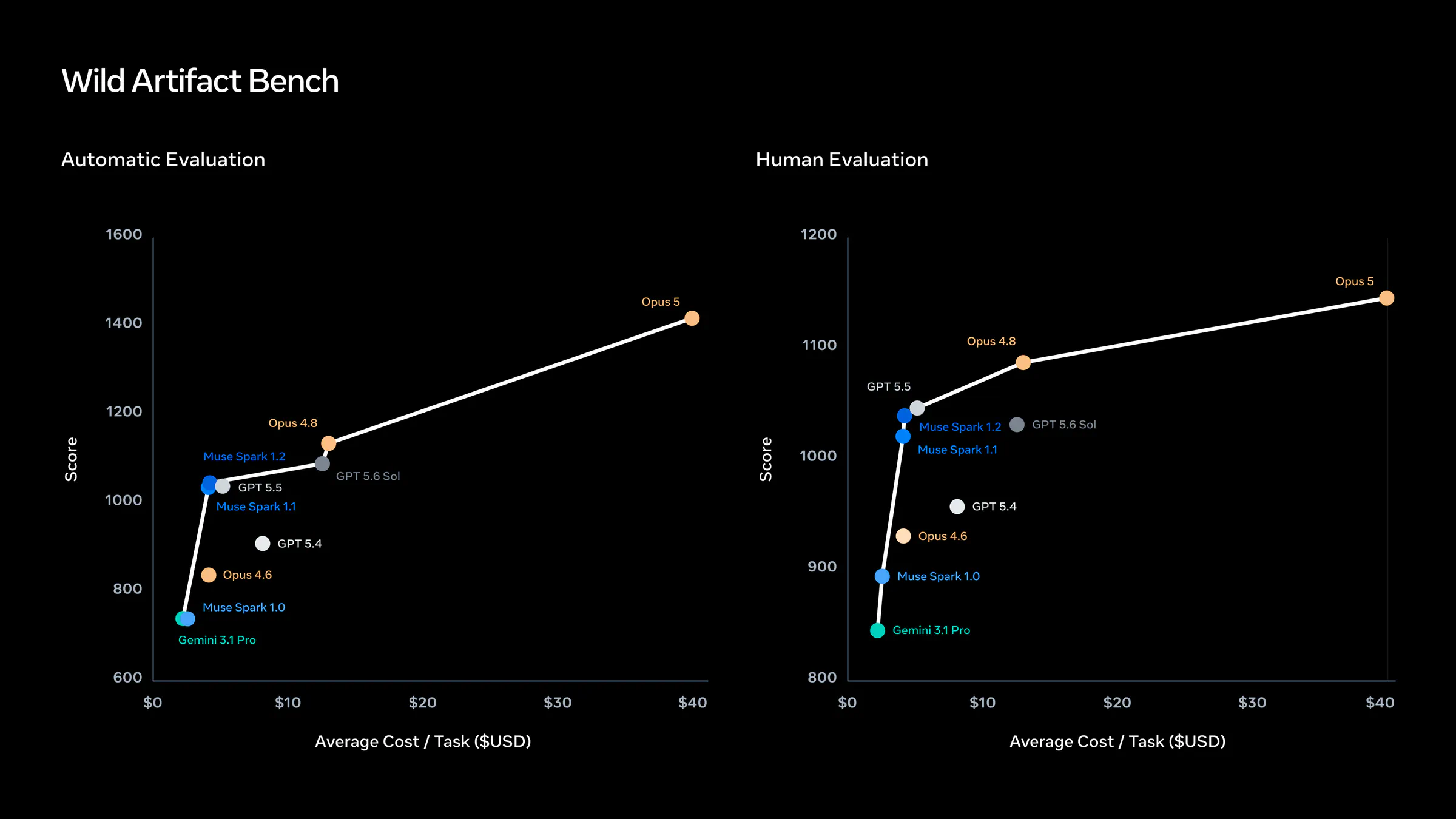
Anthropic released Opus 4.8 on Thursday, the newest version of its most advanced publicly available model, arriving just 41 days after Opus 4.7. That's a compressed cycle by any measure, and context matters here: the fast turnaround may partly reflect a chilly reception to Opus 4.7, while the interval also saw significant new releases from OpenAI's Codex and Google's Gemini Flash, increasing pressure on Anthropic to keep pace.
The upgrade isn't a ground-up rebuild. Anthropic itself characterizes the model as "a modest but tangible improvement on its predecessor." But the improvements are pointed, covering agentic coding performance, alignment quality, and a substantially cheaper fast mode tier that changes the economics of running Opus at scale.
Anthropic logged two major milestones today: it released its latest AI model and surpassed the financial value of OpenAI, its biggest competitor. The company announced a $65 billion Series H round, pushing its valuation to $965 billion.
What Changed in Claude Opus 4.8
Anthropic describes Claude Opus 4.8 as having "sharper judgement, more honesty about its progress, and the ability to work independently for longer than its predecessors." Three concrete areas stand out.
Honesty and uncertainty flagging. Anthropic says it trains all its models to be honest, but a general problem with AI models is that they sometimes jump to conclusions. Early testers report that Opus 4.8 is more likely to flag uncertainties about its work and less likely to make unsupported claims, and evaluations show that Opus 4.8 is around four times less likely than its predecessor to allow flaws in code it has written to pass unremarked.
Agentic coding. Opus 4.8 scores 88.6% on SWE-bench Verified (vs. 87.6% for Opus 4.7), 69.2% on the harder SWE-bench Pro (vs. 64.3%), and 74.6% on Terminal-Bench 2.1 (vs. 66.1%). Those deltas are incremental, but the SWE-bench Pro jump of nearly five points is meaningful for engineering teams running long autonomous sessions.
Knowledge work. On GDPval-AA, the knowledge-work eval, Opus 4.8 scores 1890, a clean lead over GPT-5.5 (1769) and a wide margin over Gemini 3.1 Pro (1314). Bridgewater Associates, an early customer, told Anthropic that Opus 4.8 proactively flags issues with the inputs and outputs of an analysis, something other models routinely miss.
Key Technical Highlights
Claude Opus 4.8 supports the 1M token context window by default on the Claude API, Amazon Bedrock, and Vertex AI, with 128k max output tokens, adaptive thinking, and the same set of tools and platform features as Claude Opus 4.7.
- Deployment: Claude.ai, Claude API, Amazon Bedrock, Google Vertex AI, Microsoft Foundry.