Google’s zero-shot robot-arm demonstration starts with substantial infrastructure already in place: a calibrated wrist camera, a visual coordinate grid, robot-state observations, and callable motion primitives. Gemini 4 Argon uses those tools to turn a fallen mug upright and place a crumpled napkin inside.
Published October 13, 2026, Google’s Gemini 4 Argon robotics guide provides representative prompts across robot control, Real2Sim, physical understanding, and research and self-improvement. It shows how a reasoning model can fit into a robotics system, including the observations, simulators, and verification steps surrounding it.
For robotics teams, the examples offer concrete workflows to evaluate, each with different requirements. Some use real robots, some depend on MuJoCo, and another steers a video world model. They are not interchangeable demonstrations of a model directly controlling arbitrary hardware. Those differences determine what each result establishes and what a team would need to reproduce it.
Robot Control Depends on the Surrounding Tools
The guide’s three control examples illustrate different relationships between model reasoning and execution.
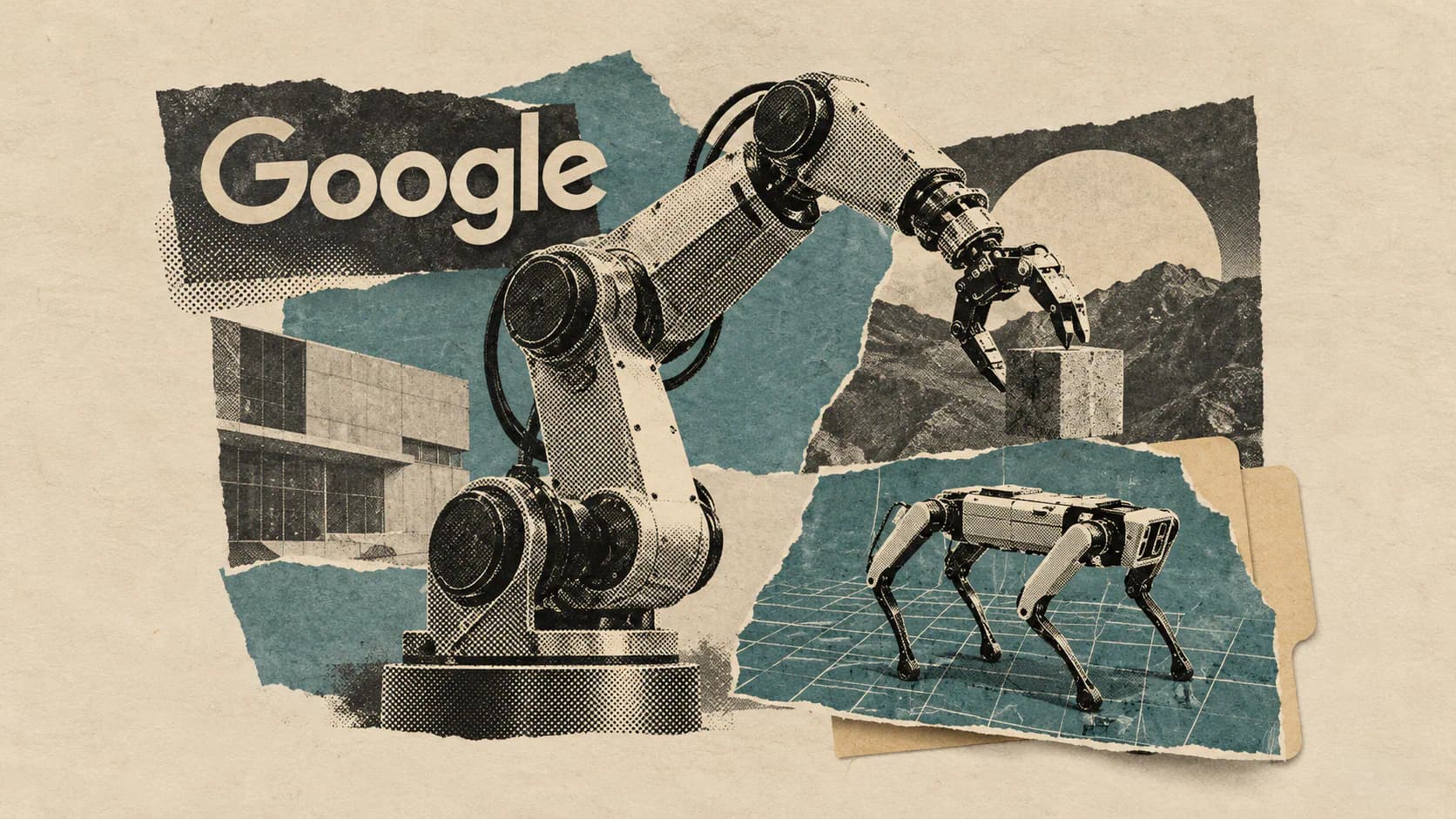
In the Boston Dynamics Spot demonstration, Google describes a quadruped with an arm disposing of soda cans in a foot-pedal trash bin. Argon creates an articulated MuJoCo twin of the bin and practices before attempting the physical task.
The prompt calls an existing mobile-manipulation skill and requests two verification agents: one checks the foot’s placement on the pedal, while the other checks the hand’s alignment inside the bin before release. This real-to-simulation-to-real workflow involves physical hardware, a simulator, cameras, and a task-specific skill interface.
The verification sequence is the transferable idea. A successful grasp does not establish that the robot can balance while opening the bin or release the can safely. The prompt separates those conditions and asks for checks at the relevant moments. Reproducing the sequence requires more than copying its natural-language instruction.
The Arm Example Makes Its Interface Explicit
The mug-and-napkin example specifies more of the execution harness. Argon receives an annotated wrist-camera image and a robot-state file. The image includes a two-centimeter world-coordinate grid, the gripper’s pinch center, and indicators showing its opening and orientation.
Through local endpoints, the model retrieves observations and submits plans. Available actions include looking at a location, grasping, moving to a pose, placing until contact, and opening or closing the gripper.
Google’s prompt offers different interaction granularities:
- Coarse control: two to four model calls using larger action primitives.
- Pre-grasp verification: four to seven calls, including a hover and alignment check.
- Fine visual servoing: eight to twenty calls with smaller movements and repeated observations.
These are prescribed workflow options, not measured latency or reliability results. Larger actions require fewer reasoning turns; finer control creates more opportunities to inspect and correct execution.
“Zero-shot” should therefore be read narrowly. The example still depends on camera calibration, coordinate conventions, implemented robot actions, and feedback after execution. It does not establish that Argon can generate reliable low-level motor control for an unfamiliar arm without that infrastructure.
Steering Generated Video Is a Different Result
The third example uses Argon to steer the Gemini Omni World Model, arranging five Scrabble tiles to spell “ARGON.” Argon examines intermediate frames and writes timestamped action prompts for subsequent video generation. The instructions encourage simple, single-direction motions, keeping inactive hands out of the way, and explicitly describing areas left empty after objects move.
This demonstrates an iterative visual-prompting workflow, not another physical robot success. A generated sequence can help explore action descriptions, but it does not measure real contact forces, actuator performance, or hardware reliability.
Real2Sim Requires More Than a Convincing Render
Google’s Real2Sim examples cover reconstruction from robot-camera recordings, egocentric human video, and hand-drawn sketches. The robot-recording example provides the clearest specification of physical verification.
Argon is asked to build a MuJoCo scene and replay logged robot trajectories using joint-space proportional-derivative control, which drives joints toward recorded positions. Reconstruction has two objectives: simulated camera views should resemble the real recordings, and simulated fingertip forces and torques should match logged tactile measurements in timing, magnitude, and direction.
Before simulation begins, the model can tune object geometry, collision shapes, mass, inertia, friction, joints, and initial poses. The prompt also allows bounded adjustments to robot commands near object contact.
Objects must move through MuJoCo’s contact simulation. Repositioning them to manufacture a convincing replay is prohibited, as are shortcuts such as applying external forces, changing object state during execution, disabling collisions, or substituting recorded tactile readings for simulated forces.
These constraints address a central weakness in evaluating digital twins: visual similarity alone does not establish that a scene behaves correctly. A simulation intended for policy testing needs to respond credibly when the robot pushes, grasps, or releases an object.
Reproducing this example requires synchronized camera observations, joint trajectories, tactile logs, robot assets, and a replay harness. A video-only reconstruction should not be assumed to provide equivalent contact calibration.
The requested interactive HTML viewer synchronizes real and simulated camera views, a 3D scene, and force visualizations. It is an inspection tool, not a robot-control environment or proof that a complete executable sandbox is available. Teams should distinguish a demonstration page, a generated viewer, and a runnable simulation package.
Physical Understanding Supports Evaluation and Improvement
The guide’s physical-understanding workflows include multimodal hindsight labeling, dexterity analysis, dense value functions, and progress estimation.
These tasks support evaluation without directly commanding motion. Hindsight labeling examines what happened during a recorded episode. Progress estimation assesses movement toward a goal, while a dense value function provides intermediate assessments instead of waiting for a final success or failure signal.
Such analysis could make robot trajectories more informative. A final failure label does not explain whether the problem began with an unstable grasp, an obstructed approach, or a poorly timed release. More detailed analysis could help a team decide what to change, although model-generated labels still need validation against observable outcomes.
Google also describes action improvement through simulation and iterative self-improvement on hardware. “Self-improvement” should not automatically be interpreted as the foundation model updating its own weights during deployment. Teams need to identify what changes between attempts: prompts, action sequences, policies, simulation assets, or model parameters. Without that distinction, an improvement claim is difficult to compare with another system.
Google’s Numbers Are Starting Points for Replication
Google reports a simulation curriculum exceeding 4,500 episodes, with real-world task success improving from 56% to 75% and completion time falling from 35 to 24 seconds.
Those are meaningful project outcomes if they hold under comparable evaluation conditions. They are also first-party results and do not, by themselves, establish equivalent gains on another robot, task, or deployment environment.
A replication should establish which tasks were evaluated, how success was defined, whether evaluation cases were separate from curriculum development, and what changed in the system. Completion-time comparisons also need consistent treatment of failures and retries.
Separately, the guide reports an 87% score on the Embodied Reasoning benchmark, ERQA, which Google describes as testing physical and spatial problem-solving. Google claims Argon outperforms other frontier models on that evaluation using pure reasoning.
Reasoning about a physical situation does not measure whether a robot can execute a grasp under noisy sensing and uncertain contact, so the benchmark claim is distinct from robot-control performance. The cited material does not establish independent replication of either the ERQA result or the project improvements.
Model Access Is Only One Part of Availability
The guide lists Google AI Studio for Ultra users, the paid Gemini API, and Antigravity as access routes for Argon. That model-access statement does not confirm that every demonstration’s hardware integration, simulator assets, world-model interface, or custom harness is distributed through those products.
Google’s September 30 Argon announcement initially described a phased rollout beginning with trusted cyber defenders through its Fairwind Program. The October robotics guide gives later access information, but teams still need to check eligibility and the interfaces available to their accounts.
A practical evaluation should separate four dependencies: model access, observation preparation, execution tools, and verification. For the arm example, those mean Argon access, calibrated images and state data, implemented motion primitives, and fresh observations after each action. For Real2Sim, they mean a reconstruction agent, logged episodes, a MuJoCo replay system, and visual and contact comparisons.
The best starting point is whichever workflow already matches a team’s infrastructure. An existing arm with safe action primitives can support a narrow closed-loop experiment. A team with synchronized robot and tactile recordings can test reconstruction. The Spot workflow requires a more specialized stack.
Google’s guide exposes the interfaces and verification requirements behind these demonstrations. Its strongest contribution is a set of testable workflow designs. The next step is to reproduce one under explicit conditions, with failures recorded. Model access or a successful demonstration alone is not evidence of general robot autonomy.
Sources
- Gemini 4 Argon robotics guidedevelopers.googleblog.com
- September 30 Argon announcementblog.google