
Google Research introduced TimesFM-3 on August 31, 2026, marking the TimesFM family’s move from primarily univariate prediction to native multivariate forecasting. Google reports that the model ranks first among pretrained foundation models on GIFT-Eval, FEV-Bench, and TIME for both point and probabilistic forecasting.
The architectural change matters as much as the leaderboard position. TimesFM-3 can forecast several related targets, incorporate historical covariates, use events known to occur during the prediction window, and generate the full forecast horizon in one forward pass. It does this without requiring fine-tuning for each new dataset or business problem.
That combination addresses a practical weakness in earlier time-series foundation models. Real demand, traffic, energy, financial, and operational signals rarely move independently, yet many general-purpose forecasting models still process each series in isolation.
TimesFM-3 Moves Beyond One-Series-at-a-Time Forecasting
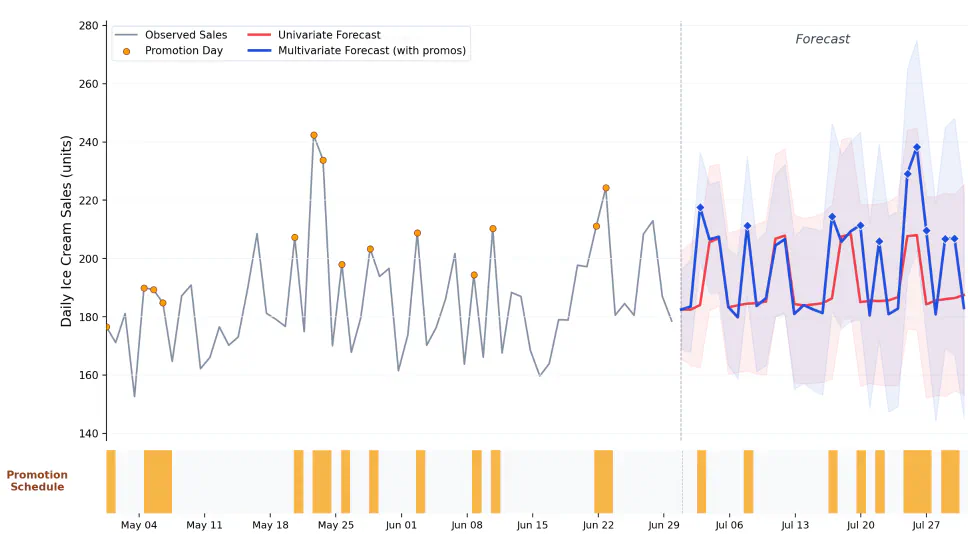
Image: TimesFM-3: A zero-shot foundation model for multivariate forecasting.
A univariate model predicts one series from its own history. If a retailer wants to forecast daily ice cream sales, for example, the model might learn weekly seasonality and recent sales trends, but it cannot automatically account for related products, store traffic, holidays, weather forecasts, or scheduled promotions.
TimesFM-3 is natively pretrained to handle three types of input:
- Multiple targets: Related series can be forecast jointly, with point estimates and uncertainty ranges generated for every target.
- Past covariates: The model can use variables available only for the historical period, such as earlier foot traffic or sensor readings.
- Past-future covariates: Known future information, including promotion calendars, holidays, planned maintenance, or weather forecasts, can influence the predicted horizon.
In Google’s illustrative retail example, the model observes how past promotions correspond with higher sales. When it receives the upcoming promotion schedule as a future covariate, its forecast anticipates an approximately 20% sales increase on promotion days. The univariate forecast continues projecting the usual weekly pattern because it cannot see that additional signal.
Earlier TimesFM checkpoints were designed around univariate forecasting. TimesFM-2.5 later received covariate support through XReg, but TimesFM-3 is the first version pretrained to model multiple targets and covariates jointly. That distinction should make multivariate behavior more central to the model rather than an additional regression stage attached to a univariate forecaster.
The foundation-model concept resembles the strategy behind an LLM: train one model on a broad corpus, then apply it to tasks it was not specifically trained to solve. TimesFM-3 is not a language model, however. It processes patches of numerical observations rather than text tokens and produces future values and quantiles instead of words.
Alternating Attention Connects Time and Variables
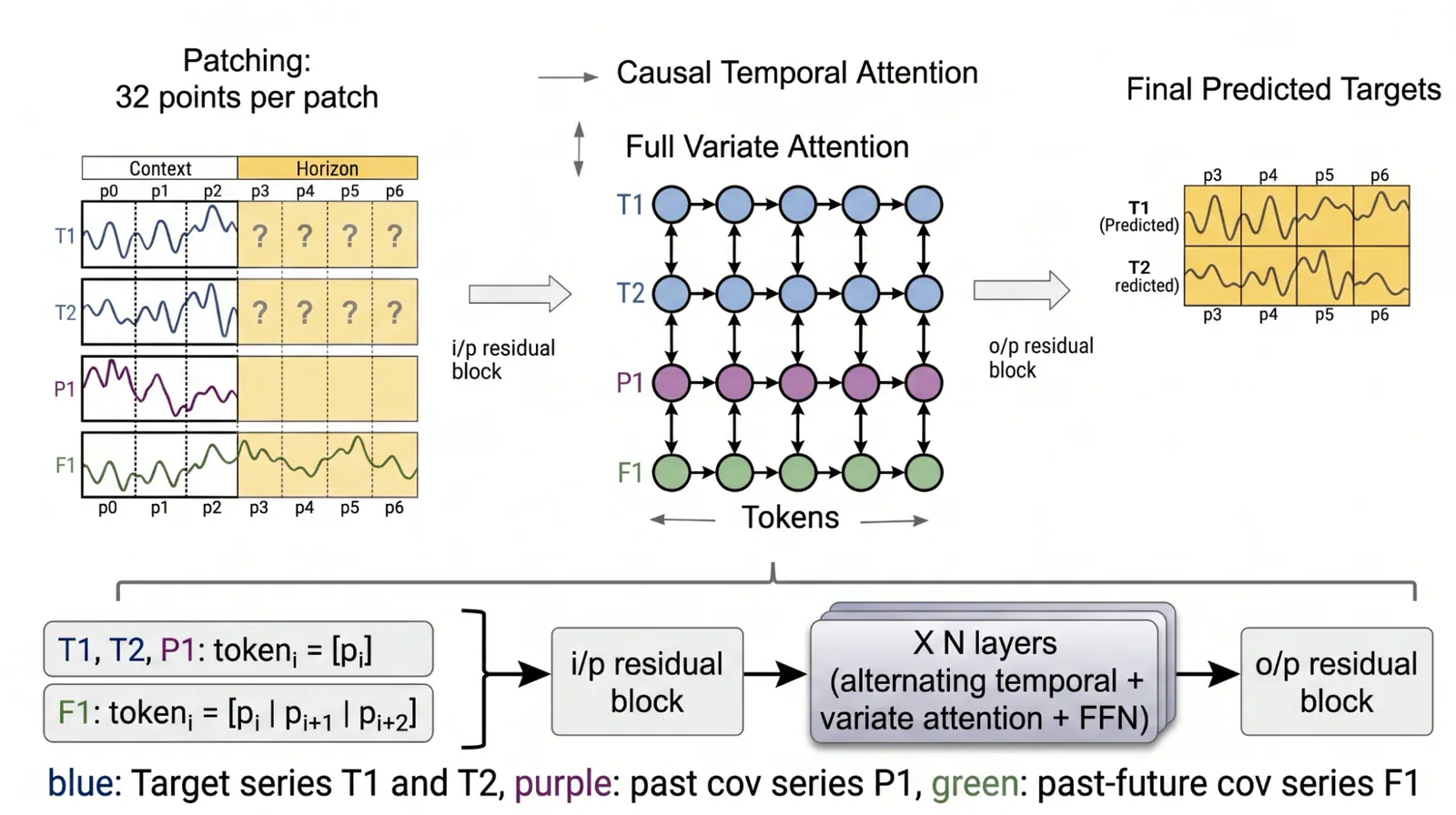
Image: TimesFM-3: A zero-shot foundation model for multivariate forecasting.
TimesFM-3 contains 330 million parameters and was pretrained on a mixture of real-world and synthetic data covering more than one trillion time points. Its official model card lists 20 transformer layers, a model dimension of 1,280, 16 attention heads, 32-step context patches, and 64-step forecast patches.
As with the original TimesFM architecture, the model groups consecutive observations into patches instead of representing every timestamp as a separate token. Patching reduces the sequence length the transformer must process and lets each token summarize a short local pattern. Google also normalizes each series individually so that variables with very different scales can appear in the same input.
The main transformer operates over a two-dimensional grid. One axis represents time, while the other contains targets and covariates:
- Causal temporal attention moves horizontally through each series. A token can examine earlier patches from the same variable, but not unknown future values.
- Full variate attention moves vertically across the variables at a particular point in time. It allows the model to detect relationships between targets, historical covariates, and future-known signals.
TimesFM-3 alternates these two attention mechanisms across its layers. Temporal attention can identify trends, seasonality, and recurring events within a series. Variate attention can then connect those patterns with changes elsewhere in the dataset.
Future-known covariates receive a special lookahead representation. Their tokens can combine the current patch with later patches because those values are already available. A planned promotion calendar is not data leakage: it is information the forecaster genuinely has before making the prediction. Targets and past-only covariates remain hidden beyond the observation boundary.
This design is particularly useful when the relationship between variables is present in the provided context but has not been learned as a fixed domain rule. The model can infer, for instance, that one store’s demand follows regional traffic or that a promotion repeatedly changes the sales pattern, then apply that relationship during zero-shot inference.
Single-Pass Decoding Removes the Autoregressive Loop
Previous TimesFM versions generated a forecast patch, appended it to the sequence, and repeated the process until reaching the requested horizon. That autoregressive procedure requires multiple sequential model calls for long forecasts. Errors made in an early patch can also enter the context used to generate later patches.
TimesFM-3 instead uses contiguous patch masking. The system places masked tokens across the entire future horizon, keeps any known future covariates visible, and predicts all missing target patches simultaneously. The full forecast therefore comes from one forward pass rather than a patch-by-patch decoding loop.
For each target and future timestamp, TimesFM-3 can return a point prediction and nine quantiles covering the 10th through 90th percentiles. These quantiles provide an estimate of uncertainty, which is essential when forecasts inform inventory, staffing, capacity, or risk decisions.
One-pass decoding removes sequential generation from the critical path and should reduce the opportunity for accumulated rollout errors. Google has not published comprehensive wall-clock throughput, memory, or cost comparisons in the announcement, though. Actual deployment performance will still depend on horizon length, variable count, batch size, hardware, and implementation.
Google Reports Wins Across Three Public Benchmarks
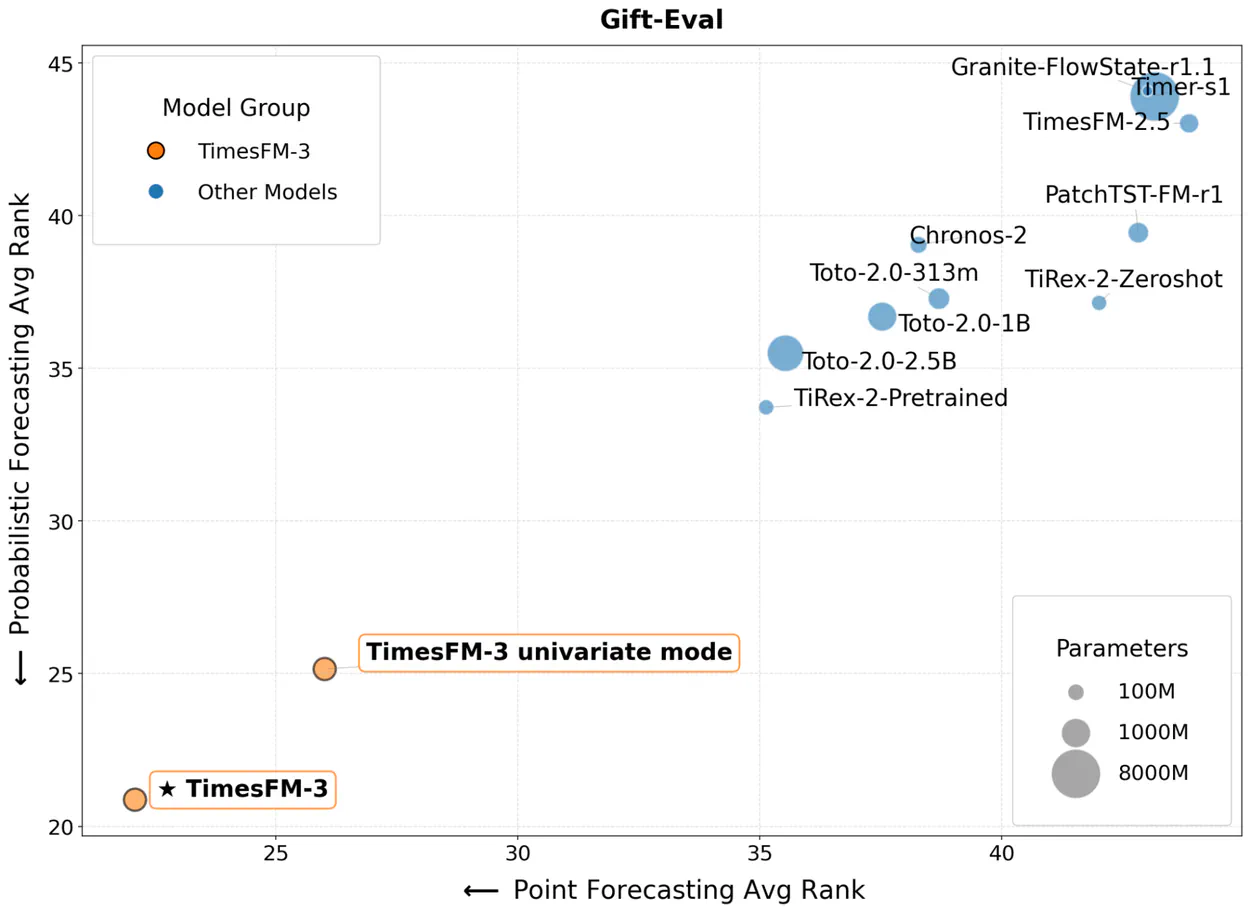
Image: TimesFM-3: A zero-shot foundation model for multivariate forecasting.
Google evaluated TimesFM-3 on three benchmarks designed to test general-purpose and zero-shot forecasting:
- GIFT-Eval contains 23 datasets, more than 144,000 time series, and 177 million data points across seven domains and 10 frequencies. It includes univariate and multivariate inputs alongside short- and long-term prediction horizons.
- FEV-Bench comprises 100 forecasting tasks across seven domains, including 46 tasks with covariates. Its evaluation framework uses bootstrapped confidence intervals and reports performance through win rates and skill scores.
- TIME uses 50 comparatively fresh datasets and 98 forecasting tasks. Its creators designed it for strict zero-shot testing while reducing the risk that benchmark data appeared in a model’s pretraining corpus.
The comparison covers TimesFM-2.5 and competing time-series foundation models including Chronos-2, TiRex, PatchTST-FM, and several versions of Toto 2.0. Google’s plots report average rank across tasks, with lower values indicating better performance for point forecasts and probabilistic forecasts.
Two TimesFM-3 configurations appear in the results. Univariate mode removes cross-series information and covariates, allowing a more direct comparison with models that process targets independently. Full multivariate mode provides all available related series and auxiliary variables.
TimesFM-3’s univariate configuration already matches or leads competing replicable foundation models in Google’s aggregate plots. Multivariate mode improves both point and probabilistic average ranks again, finishing first across all three benchmarks. The visual separation is especially large on GIFT-Eval, where both TimesFM-3 configurations sit well ahead of the compared models on the two ranking axes.
The univariate result suggests that the improvement does not come exclusively from giving TimesFM-3 more information at evaluation time. The new checkpoint appears to be a stronger general forecaster even when restricted to a single target. The larger multivariate gain then shows the additional value of modeling cross-series relationships and covariates.
The Benchmark Crown Still Needs Careful Interpretation
These results are substantial, but “state of the art” should be read as a claim about the tested models, benchmark versions, metrics, and evaluation configurations. Average rank shows how consistently a model places above alternatives; it does not directly reveal the raw error difference on an individual dataset or whether that difference would materially change a production decision.
The initial comparison also comes from Google. The benchmarks and model weights are public, so other researchers can reproduce the tests, inspect task-level performance, and evaluate TimesFM-3 on unseen proprietary data. Independent replications will be more informative than applying one overall ranking to every forecasting domain.
Training-data transparency deserves similar attention. The model card says TimesFM-3 used GIFT-Eval’s pretraining collection, Wikipedia pageviews through November 2023, Google Trends data through the end of 2022, and synthetic or augmented data. It also says datasets overlapping with FEV-Bench were excluded from the relevant pretraining collection.
TIME’s emphasis on fresh datasets offers another defense against contamination. Even so, the release materials do not yet include a dedicated TimesFM-3 research paper with full training details, ablation studies, compute requirements, and per-task failure analysis. The Hugging Face page still cites the paper for the original TimesFM model rather than a new technical report specifically covering version 3.
Downloadable Weights Come With a Commercial Restriction
Google has released the implementation through the TimesFM GitHub repository and published the PyTorch checkpoint on Hugging Face. The repository includes examples for univariate prediction and multivariate forecasting with both past-only and past-future covariates.
The licensing is more restrictive than the availability might initially suggest. TimesFM’s source code uses Apache 2.0, but the TimesFM-3 pretrained weights are covered by Google’s separate non-commercial license. The default checkpoint cannot currently be used for commercial or production purposes, and the repository describes the downloadable version as an unsupported Google product.
Google says TimesFM-3 integration with BigQuery will arrive in the coming weeks, although it did not provide an exact release date. As of the August 31 announcement, BigQuery’s AI.FORECAST route still directs users toward TimesFM-2.5 for immediate univariate forecasting.
For now, TimesFM-3 is best viewed as a strong research checkpoint and evaluation baseline. It gives developers a way to test zero-shot multivariate forecasting on demand, telemetry, capacity, energy, and other related signals, but commercial teams must wait for an appropriate licensed service or different usage terms.
Final Thoughts
TimesFM-3’s most important contribution is not simply its first-place average rank. Native support for multiple targets, historical covariates, future-known events, uncertainty estimates, and single-pass decoding brings the foundation-model approach closer to the forecasting problems organizations actually have.
The restricted weights and absence of detailed deployment measurements limit its immediate production impact. If independent testing confirms Google’s results and the planned BigQuery release provides commercially usable access, TimesFM-3 could become a useful default baseline before teams invest in specialized forecasting pipelines.
Frequently Asked Questions
5 questions
1What is Google TimesFM-3?
TimesFM-3 is a 330-million-parameter time-series foundation model developed by Google Research. It generates zero-shot point and probabilistic forecasts without task-specific fine-tuning. Unlike earlier TimesFM versions, it is natively pretrained for multivariate forecasting, allowing related targets, historical covariates, and known future variables to be processed together.
2
Sources
- Google Research introduced TimesFM-3research.google
- https://x.com/GoogleResearch/status/2094483372718580066x.com
- official model cardhuggingface.co
- original TimesFM architecturearxiv.org
- contiguous patch maskingarxiv.org
- GIFT-Evalarxiv.org
- FEV-Bencharxiv.org
- TIMEarxiv.org


