
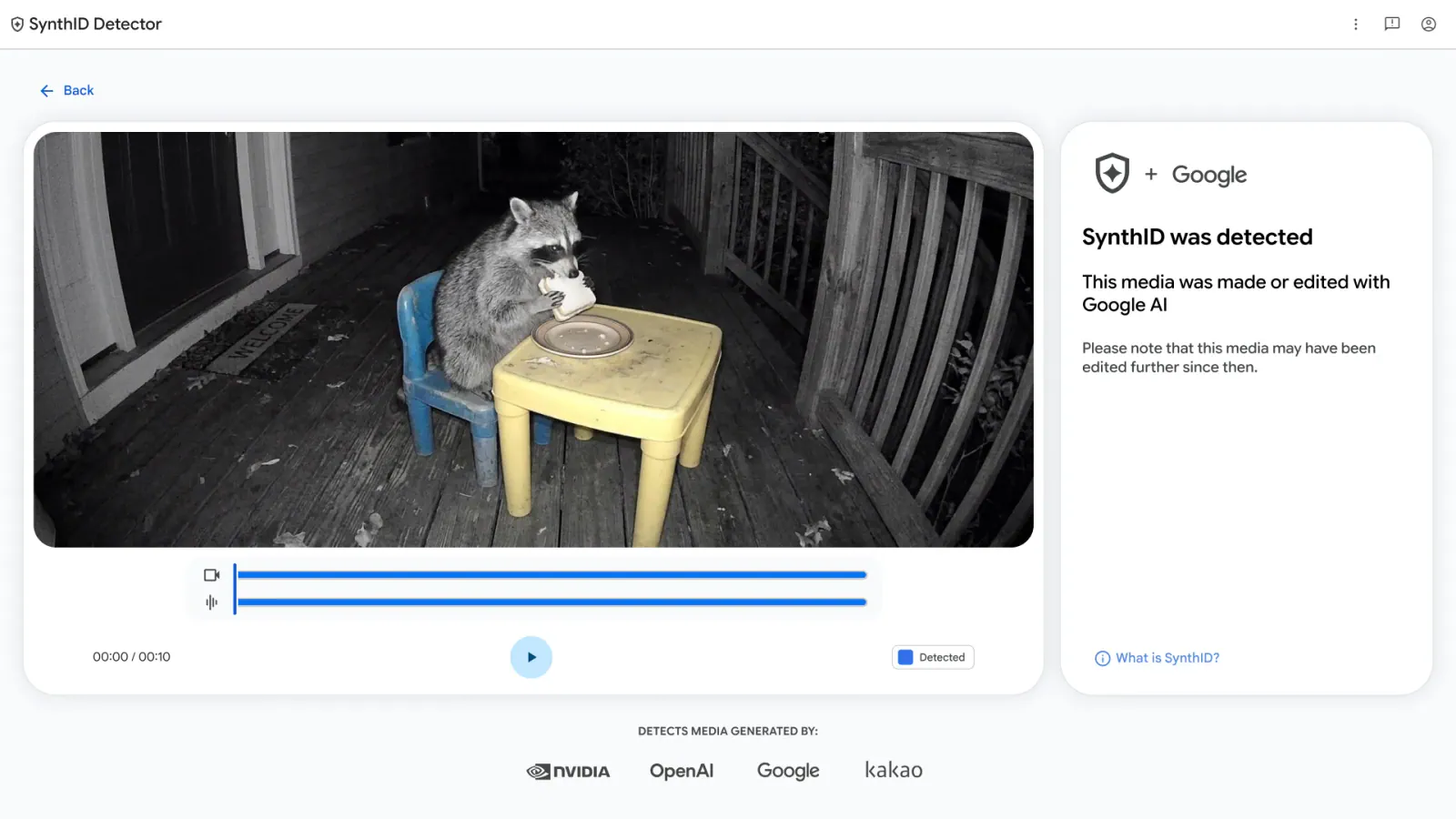
Anyone can now check a suspicious image, video or audio file for a SynthID watermark through Google’s public detector. The result can provide evidence that participating AI systems generated or altered the media, without requiring the viewer to spot visual mistakes or listen for an artificial-sounding voice.
Google’s SynthID Detector announcement says the service became available to everyone globally, in English, on October 7, 2026. It expands a verification portal previously tested with journalists and other media professionals.
The important qualification is what the detector actually looks for: SynthID watermarks, not every possible sign of AI generation. A detected mark can help establish how a file was produced. No detected mark does not establish that it came from a camera, an unedited recording or a human artist.
That makes the website useful as a first-pass check, provided readers treat its answer as one piece of evidence rather than a verdict on whether the content is trustworthy.
How to Check an Image, Video or Audio File
Start at the SynthID Detector website with the media file you want to inspect. The public tool covers images, video and audio. Google’s announcement does not describe a text-checking workflow for this portal, even though the broader SynthID technology also supports text watermarking.
A sensible checking process is:
- Get the closest available version of the file to its source. Prefer the actual media file over a screenshot of a post containing it. Keep a record of where you found it, who posted it and any claim attached to it.
- Submit the file through the detector’s checking workflow. Use a supported format and check the website’s current upload requirements.
- Read the result specifically as a watermark finding. The question is whether the detector found a supported SynthID mark, not whether it verified the event depicted.
- Continue checking the source and context. Compare the file with the original post, other reporting or recordings of the same event before deciding what it demonstrates.
According to TechCrunch’s launch coverage, supported formats include:
- Images: JPG, JPEG, PNG, BMP, WEBP, AVIF, HEIC, HEIF, TIFF, TIF and GIF.
- Video: MP4, MOV and WEBM.
- Audio: WAV, MP3, OGG, FLAC, AAC and M4A.
Format support matters because it lets readers inspect different kinds of suspicious media through the same service. It does not establish how well detection performs on every encoding, edit or file condition.
Before uploading confidential recordings, private photographs or unpublished material, check the site’s privacy and usage terms. Public availability is not, by itself, an assurance about how submitted files are handled. The launch announcement does not provide enough detail to make a retention or confidentiality promise on Google’s behalf.
Public Access Expands a Previously Limited Tool
Google introduced SynthID in 2023 and launched the earlier detector portal in 2025. Its SynthID overview describes that portal as a way to verify whether content carried a Google SynthID watermark, followed by testing and feedback from journalists and media professionals.
The October 2026 change is primarily about access. People outside that professional testing group can now use a dedicated English-language website to check files.
Google says the detector covers media made with its AI systems and participating partners, including OpenAI, NVIDIA and Kakao. Apple support is described as forthcoming, so it should not be treated as available at launch.
Those company names are not a guarantee that every output from every product they operate will carry a detectable mark. The relevant condition is whether the file contains a supported SynthID watermark. A partnership list cannot substitute for checking the specific file.
The new website also sits alongside verification features already built into Search, Gemini and Chrome. Google says those built-in features regularly handle more than one million requests a day. That figure describes the existing verification features collectively, not usage of the newly public detector website, and it is not an accuracy measurement.
For readers, the practical change is a dedicated place to submit media for inspection. The underlying scope remains tied to the watermarking system.
What SynthID Detects Inside the Media
SynthID embeds an imperceptible digital watermark into AI-generated content. For images and video, Google says the mark is added when content is created, including within video segments. Audio uses an inaudible watermark.
That distinguishes this approach from judging whether a picture “looks AI-generated.” A watermark detector searches for a signal intentionally inserted into the media. It does not need a malformed hand, inconsistent shadow or other conspicuous generation error to have something to check.
Google says its image and video watermarks are designed to withstand changes such as cropping, filters, frame-rate changes and lossy compression. It also describes audio watermarking designed to withstand common modifications including added noise, MP3 compression and changes in playback speed.
These are Google’s descriptions of the technology’s intended resilience. They should not be read as a guarantee that every mark survives every transformation or that every surviving mark will be detected.
That distinction matters when checking material downloaded from social platforms or repeatedly edited and re-uploaded. Keeping the closest available copy to the original reduces unnecessary changes to the evidence, although it cannot resolve whether the file was watermarked in the first place.
Google’s public-access announcement does not provide an independent accuracy evaluation or a false-negative rate for the new website. There is therefore no basis in that announcement for attaching a numerical confidence claim to the tool’s overall reliability.
A Positive Result Is Useful, but It Does Not Verify a Story
A detected SynthID watermark provides evidence that the file contains media generated or altered through a supported AI system. That is a meaningful finding when someone has presented an image as an untouched photograph or an audio clip as a straightforward recording.
Sources
- SynthID Detector announcementblog.google
- SynthID Detector websitesynthid.com
- TechCrunch’s launch coveragetechcrunch.com
- SynthID overviewdeepmind.google