
Google DeepMind introduced Cheminformatics Skills for Google Antigravity on November 3, 2026, giving its agent platform tools for searching chemical literature, organizing molecular data and proposing drug candidates. In the company’s worked example, an agent searched thousands of compounds, analyzed structural changes and proposed rigidified macrocycles with synthetic routes in about an hour. DeepMind’s announcement contrasts that with the multiple days it says a typical iteration requires.
The useful technical detail is how the work is divided. The language model coordinates research and navigates databases; deterministic chemistry software performs molecular calculations. For medicinal chemists, that creates a concrete workflow to inspect: retrieved structures, linked experimental data, computational analyses and proposed compounds.
What the Agent Does, and What RDKit Does
DeepMind built the skills around RDKit, the open-source cheminformatics toolkit, with connectors to ChEMBL and PubChem. The skills encode chemistry-specific practices into the agent’s workflow and give it access to local tooling. According to DeepMind, the division looks like this:
| Component | Documented role | Practical consequence |
|---|---|---|
| Language-model agent | Workflow orchestration, database navigation and scientific reasoning | Coordinates searches, analysis steps and interpretation |
| RDKit-based chemistry tools | Deterministic molecular calculations | Computes from molecular representations instead of relying on generated prose |
| ChEMBL and PubChem connectors | Access to chemical records | Supplies structured resources for the research workflow |
| Reports and interactive viewer | Presents compounds, associated data and plots | Gives scientists intermediate results to inspect |
This separation matters because chemical identity is unforgiving. DeepMind points out that the same compound can appear as an IUPAC name in a paper, a structure in a patent or an SDF record in a catalog. Changing one atom or bond produces a different compound.
My view is that the strongest design choice here is the explicit handoff to chemistry software. A model can decide that a molecular property should be calculated without being trusted to invent its value.
Deterministic calculation still depends on the input. A faithfully calculated descriptor for the wrong extracted structure remains the wrong result for the research question. The architecture makes an important part of the workflow more inspectable; scientists still need to check structure identity and the association between molecules and measurements.
The Lung-Cancer Example: Making a Molecule Less Flexible
DeepMind’s walkthrough uses rigidification, a familiar medicinal chemistry strategy: adding bonds to reduce a molecule’s freedom to change shape.
A flexible molecule can adopt many three-dimensional conformations in solution. Binding to a protein restricts that freedom, creating an entropic cost. Adding a suitable bond can constrain the molecule closer to its binding shape before it reaches the target. DeepMind describes this as “paying the entropic cost in advance.” Placement matters: constraining a molecule into an unsuitable shape would defeat the purpose. The announcement explains the mechanism through two established lung-cancer drugs:
- Crizotinib, a first-generation small-molecule tyrosine kinase inhibitor used for certain forms of non-small cell lung carcinoma, has five major rotatable bonds in DeepMind’s description.
- Lorlatinib, a third-generation inhibitor, has a related structure that is cyclized. DeepMind describes its effective rotatable-bond count as zero and links that rigidification to higher potency, among other effects.
The example gives the agent a specific research direction: investigate these drugs and their analogues, examine the relationship between cyclization and potency, then propose additional rigidified molecules.
It also gives chemists a useful sanity check. The system starts with a known medicinal chemistry relationship, making its intermediate analysis easier to scrutinize than an unexplained list of newly generated structures.
From Literature Search to Candidate Proposals
Retrieve Structures and Preserve Their Sources
The agent first searches literature for crizotinib, lorlatinib and related compounds. DeepMind says it extracts molecules, associates them with reported data and prepares them for analysis.
Within minutes, it retrieves thousands of compounds, removes irrelevant molecules such as solvents and buffers, and produces a report documenting sources. The initial report also highlights that the macrocycles are largely predicted to be brain-penetrant. DeepMind identifies that property as relevant because the lung cancer in question frequently spreads to the brain. These retrieval and reporting steps are described in the official walkthrough.
That prediction is a computational assessment, not a demonstrated measurement of brain exposure. For a chemist choosing what to investigate next, the distinction changes how much weight the result deserves.
I’d put source-linked curation near the top of the practical benefits. A proposed structure is more useful when its supporting measurements can be traced back to the original record, especially when the search spans thousands of compounds.
Inspect the Dataset Before Drawing Conclusions
The agent opens an interactive viewer containing curated compounds, associated data and customizable scatter plots. Scientists can select individual molecules to inspect their metadata and plot relationships across the dataset.
DeepMind’s example plots cellular potency against rotatable-bond count, with points colored by macrocycle status. It reports that the most potent compounds in the displayed dataset are the most rigid. The company describes the viewer here.
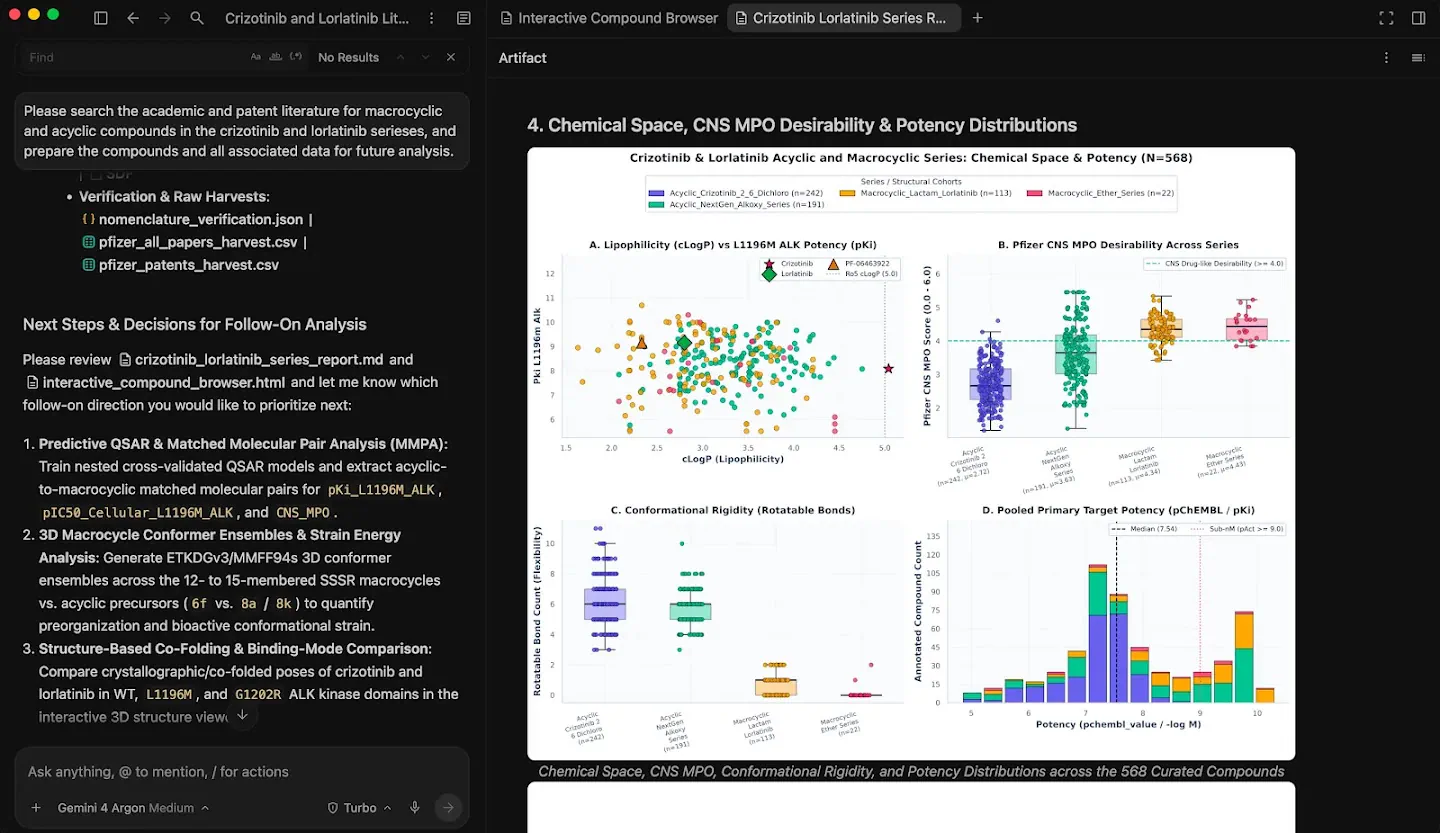
That plot is a useful starting point, but it cannot by itself isolate the contribution of ring closure. Different compounds can differ in several properties at once. The next analysis is therefore more consequential than the visual trend.
Compare Molecular Pairs and Build Potency Models
The workflow proceeds to matched molecular pair analysis, or MMPA. This compares closely related molecules with a localized structural difference, making it easier to examine the effect associated with a particular modification.
In this demonstration, the comparison concerns cyclization. TPS’s account of the walkthrough reports that the agent independently suggested the analysis and found that cyclization reduced rotatable bonds while generally increasing potency.
The same account says the agent built multiple potency models using different feature sets and model architectures, then evaluated them on held-out data. The skills also guide it toward chronological splits, training on older compounds.
That detail deserves attention. A chronological split asks a question closer to a discovery team’s actual task: can information available earlier help predict results for later compounds? It is a more useful test of prospective relevance than merely showing that a model fits familiar data. Its value still depends on the dataset and evaluation design.
Frequently Asked Questions
3 questions
1What Are Antigravity’s Cheminformatics Skills?
They are chemistry-focused tools and workflow guidance that let an Antigravity agent coordinate research while deterministic software performs molecular calculations.


