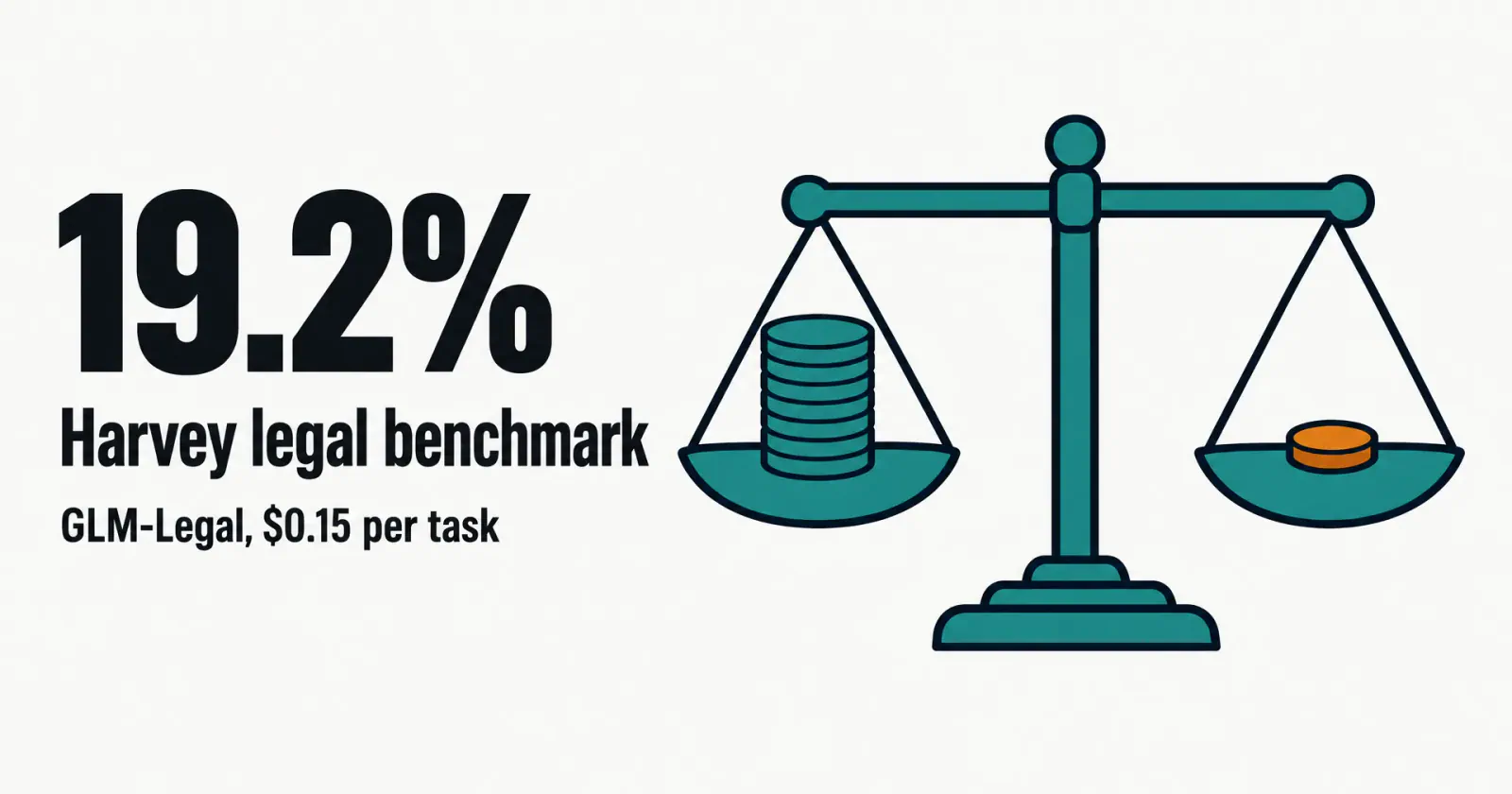
GLM-Legal reportedly passed every required criterion on roughly one in five tasks in Harvey’s Legal Agent Benchmark (LAB). Z.ai’s claimed 19.2% all-pass rate warrants investigation, but it does not measure how often the system can safely replace a lawyer.
Z.ai’s October 12, 2026 announcement, described in AI Weekly’s launch coverage, introduces a specialist legal model built on GLM-5.3-Flash. Access is application-based, with a design-partner route and an intended integration into AutoClaw, Z.ai’s desktop agent. The available reporting does not establish unrestricted API access or an open-weights release.
The launch attracted substantial discussion on Hacker News, where commenters questioned how well benchmark results distinguish routine legal work from unfamiliar problems. Practitioners evaluating domain-specific AI models have three things to examine here: a specialized model, a demanding reported evaluation, and a gated rollout that still requires careful testing.
The Specialization Extends Beyond Legal Chat
Z.ai describes GLM-Legal as built for agentic legal workflows. An agent is expected to work through a task, potentially using documents and tools, rather than simply answer a legal question in a chat window.
According to the launch reporting, the company’s training approach combines legal mid-training with post-training, including reinforcement learning across tens of thousands of legal environments. These vendor descriptions explain the development process; they are not independently verified evidence that the resulting system performs reliably in practice.
CellCog’s analysis reports that Z.ai trained the model and its agent harness together. The harness is the surrounding software that determines how an agent accesses information, uses tools, and proceeds through a workflow. According to the company’s account, then, the product goes beyond a base LLM with a legal instruction prompt.
That setup complicates evaluation. A legal agent’s result can depend on the model, the documents it receives, its tools, and the instructions governing its work. A score achieved by one configuration should not automatically be assigned to every interface or deployment using the same model name.
CellCog describes launch examples including tracked-change contract edits, analysis of contradictions across dispute documents, and a privacy checklist spanning several countries. These indicate the intended workload without establishing dependable coverage across jurisdictions, contract types, or legal specialties.