
The researchers behind GEAR have released an open-source framework for improving the software around an LLM agent: its instructions, tools, workflows, and context management. A task agent tackles individual jobs, while a separate Meta Agent studies the resulting evidence and proposes changes intended to help on subsequent tasks.
The authors report higher task pass rates with the same underlying model and reasoning-effort setting, including a rise from 52.8% to 62.9% on Terminal-Bench 2.1 for GPT-5.6 Luna at medium effort. The comparison details matter, though: one group measures changes to the same base harness, while another compares an optimized DSH harness against Codex.
GEAR’s most useful contribution may be its attempt to make that improvement process inspectable. It connects candidate changes to execution evidence, evaluation stages, and a controlled promotion decision.
How GEAR’s Two Learning Loops Work
An agent harness determines how a model operates: which tools it can call, what instructions it receives, how it manages context, and how work is organized. Changing those components can change task performance without changing model weights.
GEAR divides improvement into two levels, according to its architecture description:
- Inner loop: A rollout agent uses task feedback to refine its reasoning, planning, and actions within a task.
- Outer loop: A Meta Agent examines experiences across tasks, identifies recurring failures or effective strategies, and proposes reusable harness improvements.
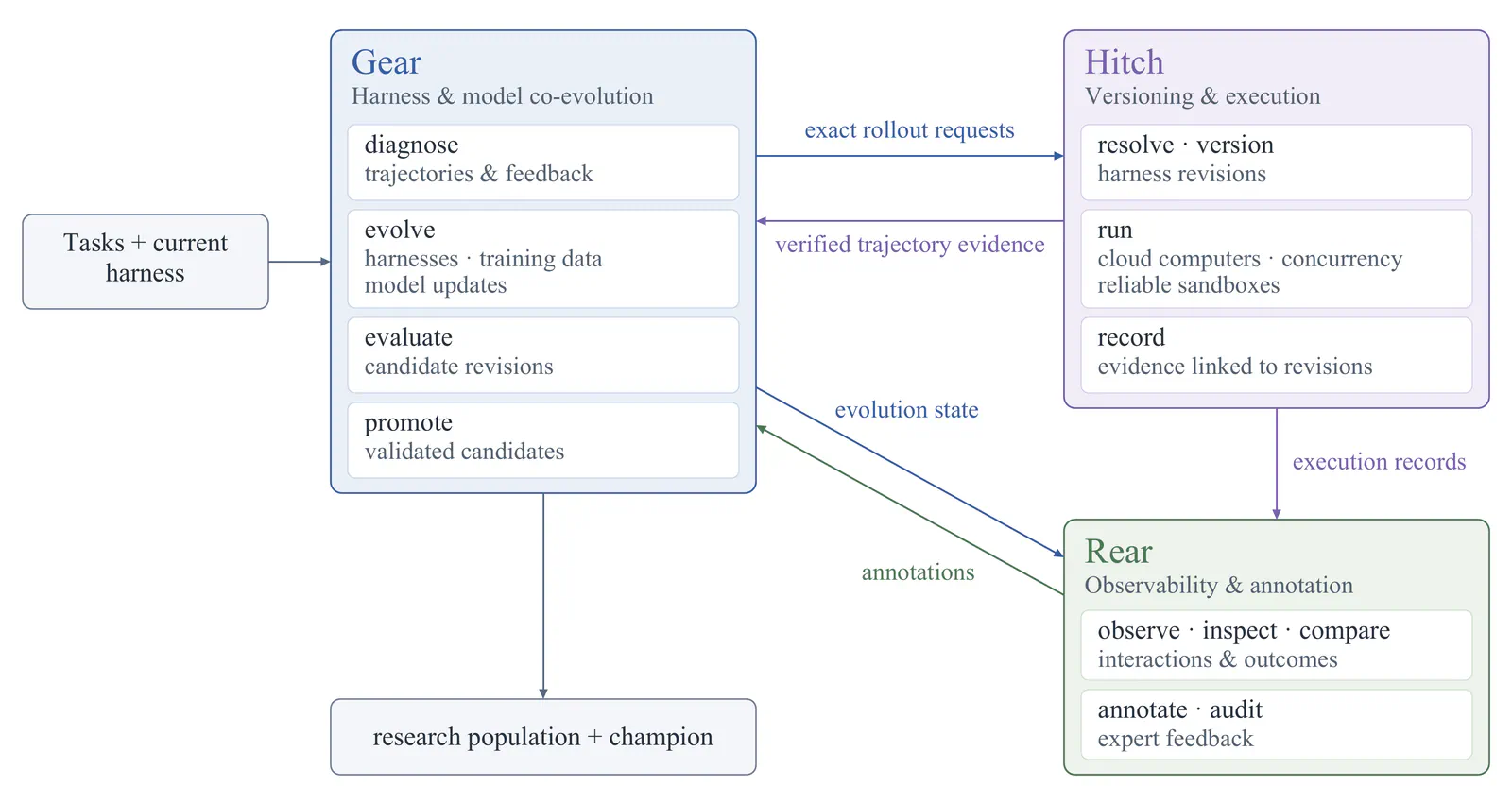
The connection is evidence. Task execution produces trajectories and outcomes; evaluation turns those into feedback that the outer loop can inspect. Proposed changes then undergo evaluation before promotion for use on subsequent tasks.
Consider a hypothetical support agent that repeatedly misses a required verification step. Correcting its current response is an inner-loop action. Changing a reusable support workflow so future tasks include that check is an outer-loop intervention. That example illustrates the distinction, not a reported GEAR experiment.
The two loops can be optimized independently. The repository documentation also says the Meta Agent can use a different model from the task agent. That separation lets researchers change the proposal system without automatically changing the model being evaluated.
Here, recursive improvement refers to the harness and its optimization process. The published evidence is not a demonstration of autonomous model-weight training or unrestricted self-modification.
Staged GEPA Has a Deliberate Control Boundary
GEAR presents evolutionary search as replaceable components. Its project page names five policy boundaries:
| Component | Decision it concerns |
|---|---|
| Parent selection | Which existing harness to improve |
| Proposal planning | How candidate improvements are proposed |
| Task sampling | Which tasks inform the search |
| Scoring rule | How outcomes receive scores |
| Candidate ranking | How candidates are ordered |
Staged GEPA is one concrete implementation within that architecture. Its visualization gives the sequence as Diagnose → Evolve → Local → Bridge → Full seed → Promote.
The clearest documented mechanism concerns parent selection. Staged GEPA uses task-level fronts to retain useful specialists and selects parents from a frozen archive. The selection process can read the archive, the current champion, and task-level evidence before producing a parent harness for candidate generation. This allows the search to retain candidates useful on particular tasks instead of relying exclusively on one overall winner. (Source)
A consequential qualification appears alongside those modularity claims: the current staged implementation exposes parent selection as a public policy hook. Evidence validation, evaluation stages, and final promotion remain controlled by the runtime.
That is a narrower implementation boundary than the five-component overview might initially suggest. Researchers get a framework organized around several replaceable decisions, but the page does not say that all five currently have equivalent public customization hooks.
I see the runtime-controlled promotion step as a sensible boundary. A component proposing changes should not be able to turn its own favorable assessment into an accepted result without passing the evaluation process. That is an architectural advantage, not proof that every evaluator or promotion rule is reliable. The published stage labels alone also do not specify sample sizes or promotion thresholds.
Reported Results Keep Models and Effort Fixed
The authors’ benchmark table reports task pass rates for AutomationBench marketing and support tasks, plus Terminal-Bench 2.1 coding tasks.
| Model and effort | Harness comparison | Marketing | Support | Terminal-Bench 2.1 |
|---|---|---|---|---|
| GPT-5.6 Luna, medium | DSH base → GEAR-optimized DSH | 27.0% → 40.0% | 17.0% → 25.0% | 52.8% → 62.9% |
| Absolute gain | +13.0 pp | +8.0 pp | +10.1 pp | |
| GPT-6 Astra, max | Codex → GEAR-optimized DSH | 57.0% → 61.0% | 35.0% → 39.0% | 86.7% → 87.6% |
| Absolute gain | +4.0 pp | +4.0 pp | +0.9 pp |
“pp” means percentage points. Moving from 27% to 40% is a 13-percentage-point increase, not a 13% relative improvement.
These are author-run results pending independent reproduction. The project page dates the research to October 2026 and lists the paper as forthcoming, so the linked project materials and repository currently carry the methodological detail.
The Baseline Difference Changes the Interpretation
Frequently Asked Questions
3 questions
1Can the Meta Agent Use a Different Model?
Yes. GEAR’s repository says the agent proposing improvements can use a different model from the agent executing benchmark tasks.