Anthropic’s proposed IPO would give public investors shares in the AI company without giving them the usual path to controlling its board. In an October 27, 2026 analysis, TechCrunch describes a governance structure that divides power among the founders, the Long-Term Benefit Trust, the board and, in specific disputes, employees.
Anthropic announced its S-1 filing on October 26, proposing to list Class A common stock on the Nasdaq Global Select Market under the symbol ANT. The company had not determined the number of shares or offering price range, and the registration statement had not become effective.
The key distinction is between buying an economic stake and acquiring control. Under TechCrunch’s reading, public shareholders would have limited influence over board selection even though the founders and Trust exercise different kinds of power.
The explanation below follows that reporting, supplemented by the available S-1 and trust-agreement excerpts. Those excerpts do not support a complete legal review. The prospectus is preliminary, terms may change, and formal rights cannot tell us how a future dispute would unfold.
Public Benefit Status Sets the Board’s Obligations
Anthropic’s status as a Delaware public benefit corporation establishes the legal framework beneath the voting arrangements.
The S-1 says Anthropic must balance three interests:
- Stockholders’ financial interests.
- The interests of people materially affected by its conduct.
- Its stated public benefit: “the responsible development and maintenance of advanced AI for the long-term benefit of humanity.”
That wording carries real weight. The filing describes a balancing obligation, so shareholder returns are one consideration alongside other interests. It also gives the board a basis for considering AI safety when a decision could affect financial performance.
TechCrunch characterizes this status as protection for mission-related decisions that investors might otherwise challenge. I would read that carefully: it explains why investors cannot assume shareholder value is the board’s sole objective. It is not a promise that every decision labeled an AI-safety measure will be beyond legal scrutiny.
Public benefit status also does not identify who selects the directors making those judgments. That is where Anthropic’s special stock classes become consequential.
Trust Board Seats and Founder Votes Are Separate Powers
TechCrunch reports that the Long-Term Benefit Trust holds Class T stock carrying the ability to elect and remove a majority of Anthropic’s board. The founders’ separate arrangement gives a majority of the seven founders 50.1% of shareholder voting power and the ability to elect three directors.
Those rights operate at different levels:
| Governance layer | Power described in the sources | Practical significance |
|---|---|---|
| Public benefit corporation status | Requires balancing financial interests, affected parties and the public benefit mission | Shapes what the board must consider |
| Trust-held Class T stock | Elects and removes a board majority, subject to specified checks | Gives the Trust substantial influence over board composition |
| Founder Class F arrangement | Gives a founder majority 50.1% of shareholder voting power and three board seats | Keeps general shareholder voting power with the founders when they agree |
| Nominating committee and employee mechanism | Routes certain contested Trust decisions to an employee vote | Places a conditional check on Trust authority |
The board majority and the shareholder voting majority should not be added together as if they were percentages of the same thing. One concerns director selection; the other concerns shareholder votes. That distinction explains how the Trust and founders can both hold substantial power without either having unrestricted control over every decision.
The Trust’s Mission Extends Beyond Shareholder Returns
The amended and restated trust agreement records that the Trust was established on June 29, 2023. It says the company conveyed all authorized Class T shares to the trustees.
Its purpose mirrors Anthropic’s balancing obligation: financial interests, people affected by the company and advanced AI’s long-term benefit to humanity. The agreement also states that the Trust has no beneficiaries.
That last detail helps explain what this institution is. It is a mission-governance mechanism, not a fund distributing benefits to a defined group. Its broad public purpose also does not give members of the public a direct vote.
TechCrunch reports that the Trust is chaired by Neil Shah and includes Ben Bernanke, Richard Fontaine and Christopher Stubbs. At the time of its report, one seat was vacant, with existing members responsible for choosing its replacement. Public shareholders therefore do not gain trustee-selection rights simply by buying shares.
Founder Agreement Determines How the Voting Bloc Works
TechCrunch describes the founders’ special voting power as conditional on a majority of the seven founders agreeing.
When no founder majority exists, their shares are instead voted proportionally with common shareholders. That fallback could increase common shareholders’ influence on the affected votes, but it is different from permanently ending the founder arrangement.
Founder disagreement and founder-control expiration are separate events. The first changes how votes are cast under the arrangement; the second ends the special control structure. Investors should distinguish them when assessing how durable the founders’ voting advantage may be.
Employees Get a Specific Role in Board Disputes
The board has a check on certain Trust decisions. According to TechCrunch’s account, the mechanism applies to specified Class T director nominations and removals without cause, meaning removals that do not allege misconduct.
The process has three relevant steps:
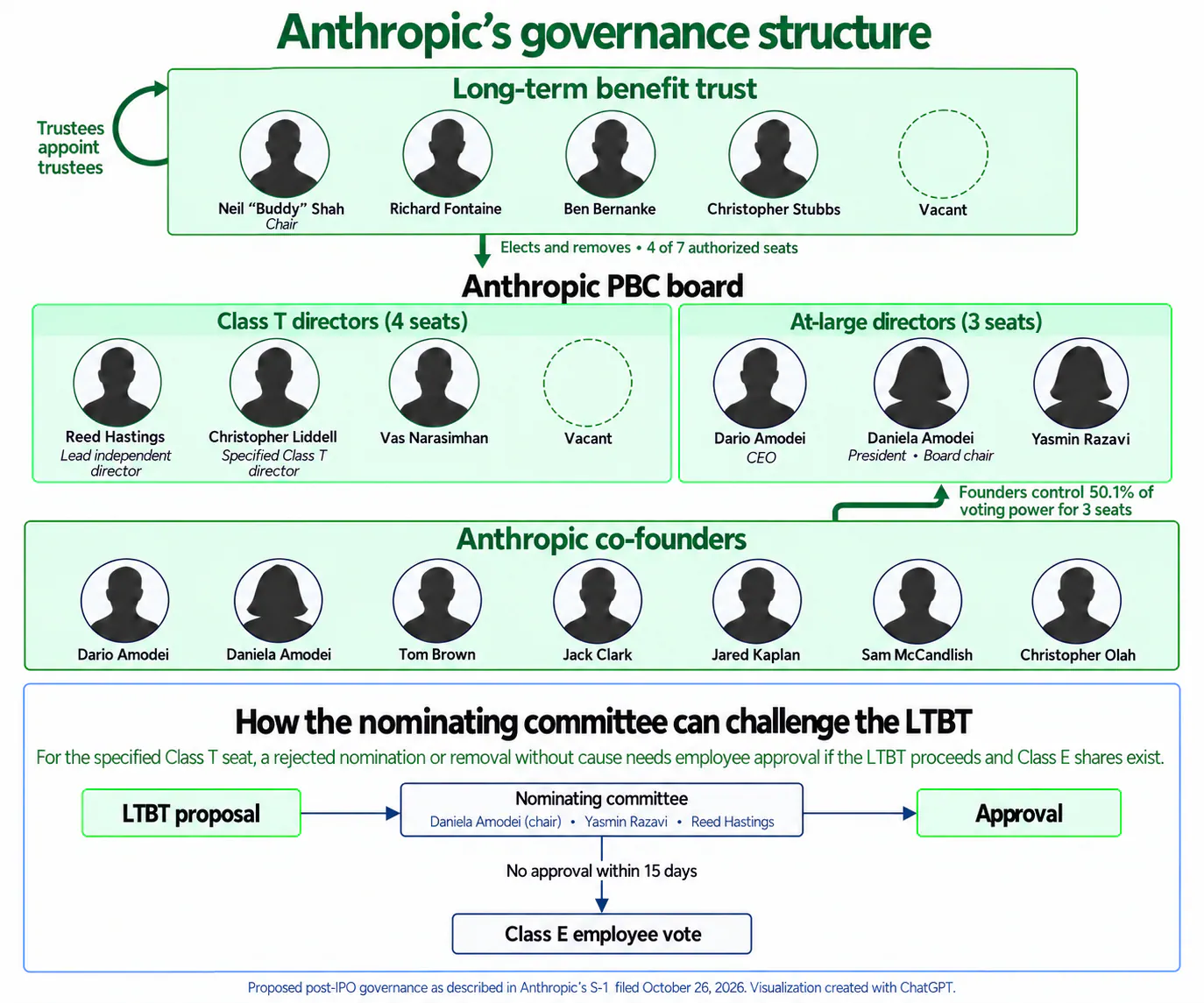
- The Trust proposes a covered nomination or removal.
- The board’s nominating committee can decline to approve it.
- The contested decision goes to an employee vote.
Employees can therefore back the board against the Trust in these circumstances. Describing this simply as a board veto would miss the next step: the committee can trigger a decision by another constituency.
I’d distinguish this from broad employee control of Anthropic. The mechanism described concerns particular board-selection disputes. It does not establish an employee vote on every product launch, safety policy or commercial agreement.
Frequently Asked Questions
3 questions
1How Much Voting Power Do Anthropic’s Founders Have?
TechCrunch reports that a majority of the seven founders can direct 50.1% of shareholder voting power and elect three directors. Without a founder majority, their shares are voted proportionally with common shareholders.