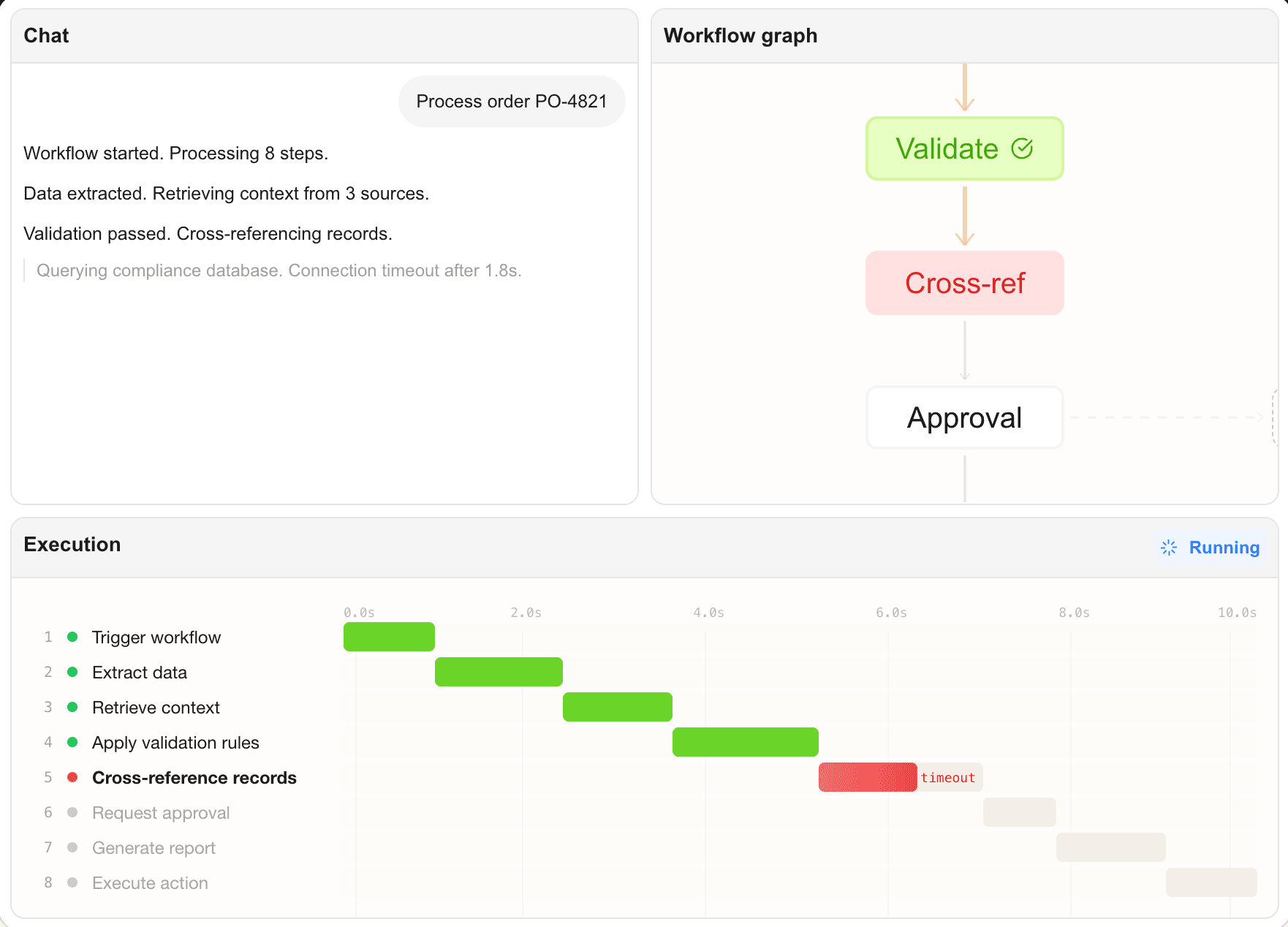
Most enterprise AI projects don't fail at the model level. They fail when someone tries to actually run them. A pipeline that works in a notebook silently breaks in production. A multi-step process times out because there's no mechanism to pause and resume. An approval step gets skipped because the system has no way to wait for human input.
Mistral's answer to this is Workflows, the orchestration layer for enterprise AI that brings the durability, observability, and fault tolerance required to move AI-powered processes from proof of concept to production. The product is now in public preview, and it marks a clear shift in Mistral's strategy: from model releases to full production infrastructure.
Mistral's revenue growth is being driven primarily by enterprise adoption, with approximately 60% of revenue coming from Europe, according to CEO Arthur Mensch's public statements. Workflows is a direct investment in keeping those customers.
What Mistral Workflows Actually Does
Mistral Workflows is a platform for building production-grade AI workflows: multi-step processes that combine LLM calls, tool use, external APIs, and human input. They survive crashes, restarts, and failures of any individual step.
The failure modes Mistral is targeting are consistent across industries: pipelines that run in a notebook but fail silently in production with no trace, long-running processes that can't survive a network timeout, multi-step operations that need human approval mid-execution but have no mechanism to pause and resume, and systems that offer no way to verify they're still doing what they're supposed to after deployment.
At its core, Workflows provides a structured system for defining, executing, and monitoring multi-step AI processes, from simple sequential tasks to complex, stateful operations that blend deterministic business rules with the probabilistic outputs of large language models.
The Temporal Foundation
Workflows is built on Temporal's durable execution engine, the same infrastructure that powers orchestration at Netflix, Stripe, and Salesforce. Mistral extended it for AI-specific workloads by adding streaming, payload handling, multi-tenancy, and observability that the core engine does not provide out of the box.
Originally spun out of Uber's Cadence project, Temporal transparently handles retries, state persistence, and timeouts, providing durable execution across failures. Mistral didn't reinvent the wheel here. It took a proven engine and adapted it for the specific demands of AI workloads.
Elisa Salamanca, who leads go-to-market for Mistral's enterprise products, described the engineering rationale clearly: