Chinese AI company MiniMax released M3, a new open-weight model that combines strong coding performance, native multimodality, and a one-million-token context window. That combination sounds like a checklist until you realize no open-weights model has managed all three at once. These three capabilities are now table stakes for closed-source frontier models. M3 is currently the first and only open-weight model to bring all three together.
The timing is pointed. Chinese open-weights models keep nibbling away at the leads of their US closed-source counterparts. M3 is the latest entrant, and MiniMax claims it is the first open-weights model to simultaneously deliver frontier-level coding, million-token context, and native multimodal capabilities. Until now, that combination had been the exclusive preserve of closed-source giants like GPT-5 and Gemini.
As someone who covers this space daily, M3 is the kind of release that actually warrants attention. Not because of the benchmark sheet alone, but because of what it means for developers who need long-context agentic workflows without routing sensitive code through a closed API.
What Is MiniMax M3?
MiniMax M3 is a multimodal foundation model from MiniMax. It accepts text, image, and video inputs and produces text output, with a context window of up to 1 million tokens and a guaranteed minimum of 512K. MiniMax positions it for long-horizon agent tasks, long-range coding, and long-form video understanding.
Over the last eighteen months, MiniMax built a solid reputation in the open-weights field, first with the MiniMax-01 series and then with the M1 and M2 reasoning models. With M3 the company raises the stakes and aims squarely at the tier of Western flagship models.
Coding and Agentic Performance
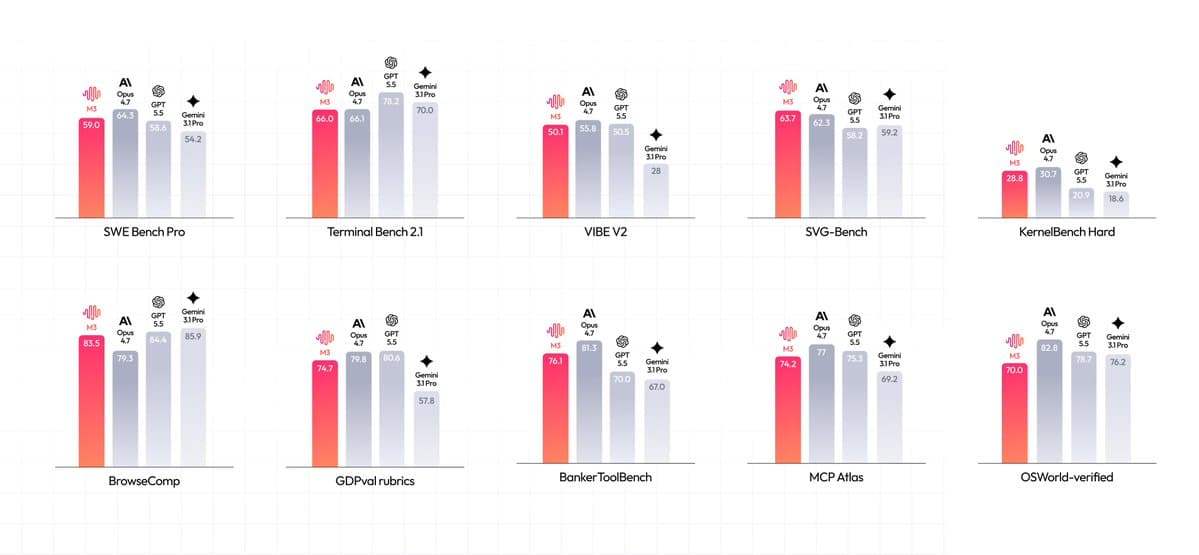
SWE-Bench Pro is the toughest version of SWE-Bench, the test that asks a model to fix real bugs and issues pulled from open-source software projects, complete with test execution to verify that the solution actually works. A score of 59.0% means M3 correctly resolves nearly six problems out of ten under conditions that trip up even the most expensive proprietary models.
The full benchmark picture across the agentic frontier:
- SWE-Bench Pro: 59.0%, behind Claude Opus 4.7 (64.3%) but ahead of GPT-5.5 (58.6%) and Gemini 3.1 Pro (54.2%)
- Terminal Bench 2.1: 66.0%, trailing GPT-5.5's 78.2% and Gemini 3.1 Pro's 70.0%
- BrowseComp: 83.5, ahead of Opus 4.7 at 79.3
- SWE-fficiency: 34.8% | KernelBench Hard: 28.8% | MCP Atlas: 74.2%
To get closer to real developer workflows, MiniMax built a simulator framework that mimics typical behavior patterns. These include refining requirements, discussing solution approaches, reacting to intermediate results, and carrying tasks across multiple contexts. This exposes the model to multi-turn collaboration during training, not just single, clearly defined prompts.