A coding agent can pay for the same line of reasoning more than once. It generates tokens while working through a step, then may send that reasoning back as context on later steps. Across a long task, an overlong trace can add to both output and input costs.
Fireworks says Ember-1, announced on September 23, 2026, addresses that problem. The company trained a specialized model built on Kimi K3 to produce shorter reasoning traces while retaining comparable task quality. It reports roughly 40% fewer tokens across its evaluations and about 35% fewer tokens per task in live customer A/B tests.
Those figures are promising, though they do not establish savings for every agent workflow. Ember-1 is a time-limited research preview, its published comparisons are Fireworks-run, and no downloadable Ember-1 weights accompanied the announcement. Developers can try the hosted model now and measure costs and failure rates against their own workloads before replacing Kimi K3.
Agent Loops Can Pay for Reasoning Twice
Fireworks says Kimi K3 can spend most of its generated tokens on reasoning instead of the final answer. At $15 per million output tokens, the posted rate for Ember-1 and the Kimi K3 rate Fireworks uses in its cost comparisons, a shorter trace can lower the charge for the call that produced it.
The saving can continue if an agent includes previous reasoning in subsequent requests. Suppose a ten-turn workflow produces 10,000 fewer reasoning tokens on each turn. That is 100,000 fewer output tokens, or $1.50 at the listed output rate. If every later turn also resends all earlier reasoning, it avoids another 450,000 input tokens. At $3 per million uncached input tokens, that would save $1.35 more; if every one of those input tokens qualified for the $0.30 cached-input rate, the additional saving would be $0.135.
That example illustrates the billing mechanism, not an Ember-1 test result. Real agents may omit reasoning from later prompts, summarize it, use caching, or change their workflow as the model changes. Shorter output does not automatically produce the same input saving in every application.
Simply lowering Kimi K3’s reasoning-effort setting cost too much quality in Fireworks’ experiments, the company says. Its approach is to train a model to use less unnecessary reasoning while retaining useful behavior, such as reconsidering an assumption after tool feedback. A shorter answer from a lower-effort setting is only a bargain if it still completes the task.
Ember-1 Has a Serverless API Path and a Preview Window
The Ember-1 model listing marks the hosted model as ready on Fireworks Serverless. Its model path is:
accounts/fireworks/models/ember-1
Fireworks lists these serverless prices per million tokens:
| Token type | Price |
|---|---|
| Input | $3.00 |
| Cached input | $0.30 |
| Output | $15.00 |
Developers can call Fireworks through its Python client, REST API, or the OpenAI Python client, according to the listing. It also lists a 1.04-million-token context window, function calling, and image input. Those specifications make Ember-1 relevant to tool-using agents, though the listed context window does not establish how well the model performs at its limit.
Availability has a more immediate qualification. Fireworks describes Ember-1 as a research preview and says its research releases offer two-week serverless access, with permanent availability depending on community demand. Teams considering it for production should check its current status and keep a fallback model ready.
The hosted listing marks fine-tuning as unsupported. Fireworks separately says it is launching Ember-1 training support for enterprises; that statement does not confirm fine-tuning availability through the listed serverless model.
Fireworks’ Benchmarks Show Savings, Not Uniform Scores
Fireworks says it trained Ember-1 across mathematics, coding, instruction following, search, tool use, and software engineering. It reports more than 50 training experiments and over 200 evaluations, but the announcement does not provide enough detail for an outside team to reproduce the training process.
Its published benchmark table offers a closer look at the quality claim. Fireworks compares Ember-1 with several Kimi K3 reasoning-effort settings, including the maximum setting, and calculates task costs using the same posted input and output rates. In three of the reported tests:
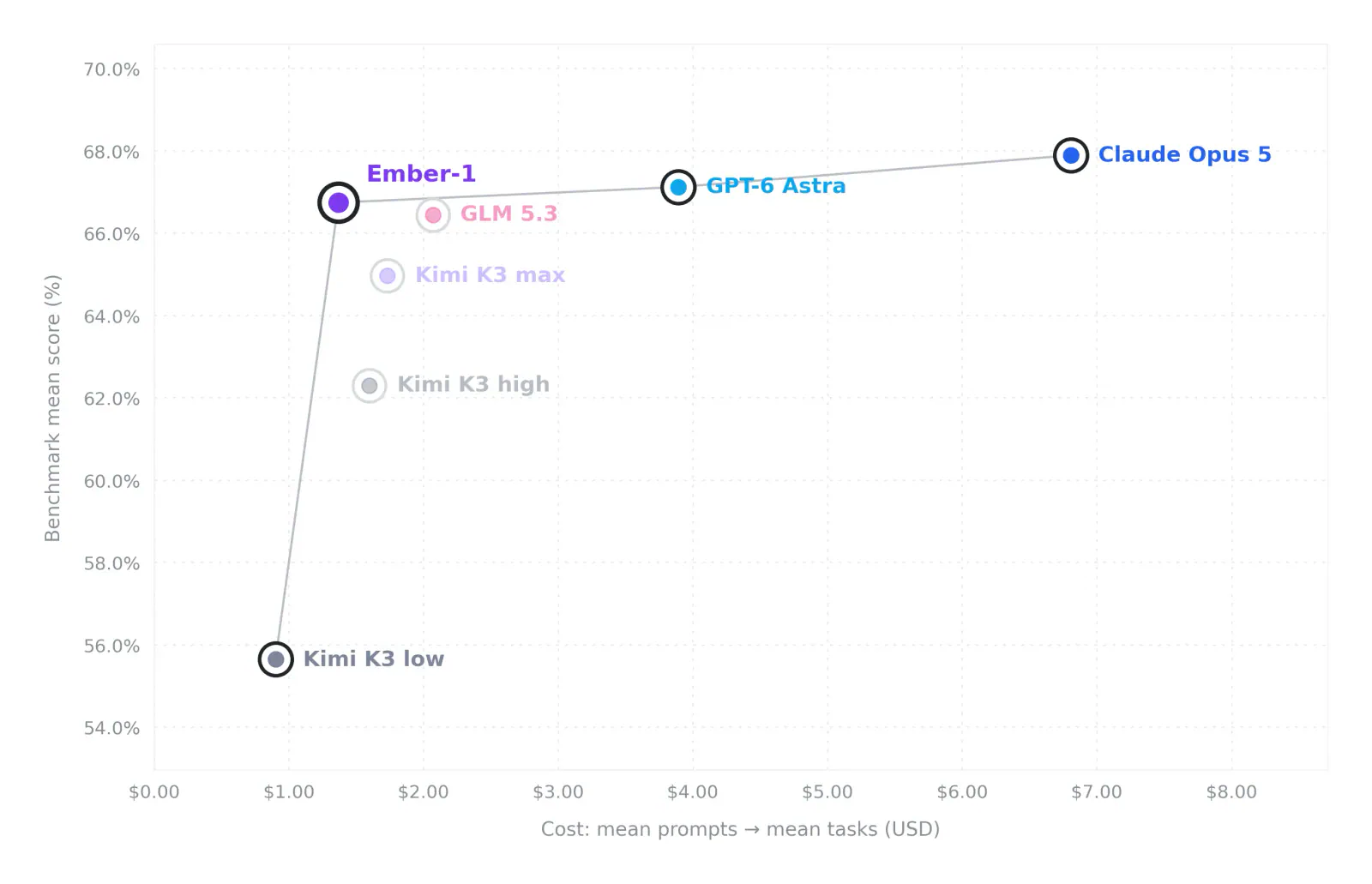
- On Terminal Bench 2.1, Ember-1 scored 82.0%, versus 80.9% for Kimi K3 at maximum reasoning effort, across 89 samples. Fireworks reports a 51.9% lower cost for Ember-1 in that comparison.
- On SWE-bench Verified, Ember-1 scored 92.2%, versus 93.2% for Kimi K3 at maximum effort, across 500 samples. The reported cost reduction was 15.5%.
- On SWE-Interact, Ember-1 scored 20.0%, versus 21.3% for Kimi K3 at maximum effort, across 75 samples. Fireworks reports a 32.5% lower cost.
The results vary by task. SWE-bench Verified shows a smaller cost reduction than the headline token-saving figure and a one-percentage-point lower score. Whether that trade is acceptable depends on the application and on what happens when a failed task requires another attempt.
Fireworks also says Ember-1 performs well on cost-versus-quality comparisons across its wider benchmark set, including a clinical-task benchmark. The company conducted and presented those comparisons. Public benchmarks are useful, but an independent evaluator has not run these models under separately controlled conditions in the supplied evidence.
Customer A/B Tests Are Encouraging but Narrow
Benchmarks cannot fully capture an agent working through a changing codebase, tool errors, and follow-up requests. Beyond its benchmark tables, Fireworks reports live A/B tests with two customers on production coding workloads. It says Ember-1 used approximately 35% fewer tokens per task at comparable quality in both tests, while most tracked downstream metrics held steady or improved.
One published comparison shows scores of 0.751 for Kimi K3 and 0.753 for Ember-1, alongside a drop from 49,300 to 29,900 output tokens. Fireworks also says one customer moved Ember-1 into live production following the tests. The observations concern workloads people actually run, rather than benchmark prompts alone.
Frequently Asked Questions
4 questions
1How Do I Access Fireworks Ember-1?
Ember-1 is available as a research preview through Fireworks Serverless using the model path accounts/fireworks/models/ember-1. Fireworks lists its Python client, REST API, and the OpenAI Python client as ways to call the service. Because Fireworks describes research releases as offering two-week serverless access, check the model’s current availability before depending on it for production traffic.
2
Sources
- Ember-1fireworks.ai
- Ember-1 model listingfireworks.ai
- Hacker News discussionnews.ycombinator.com