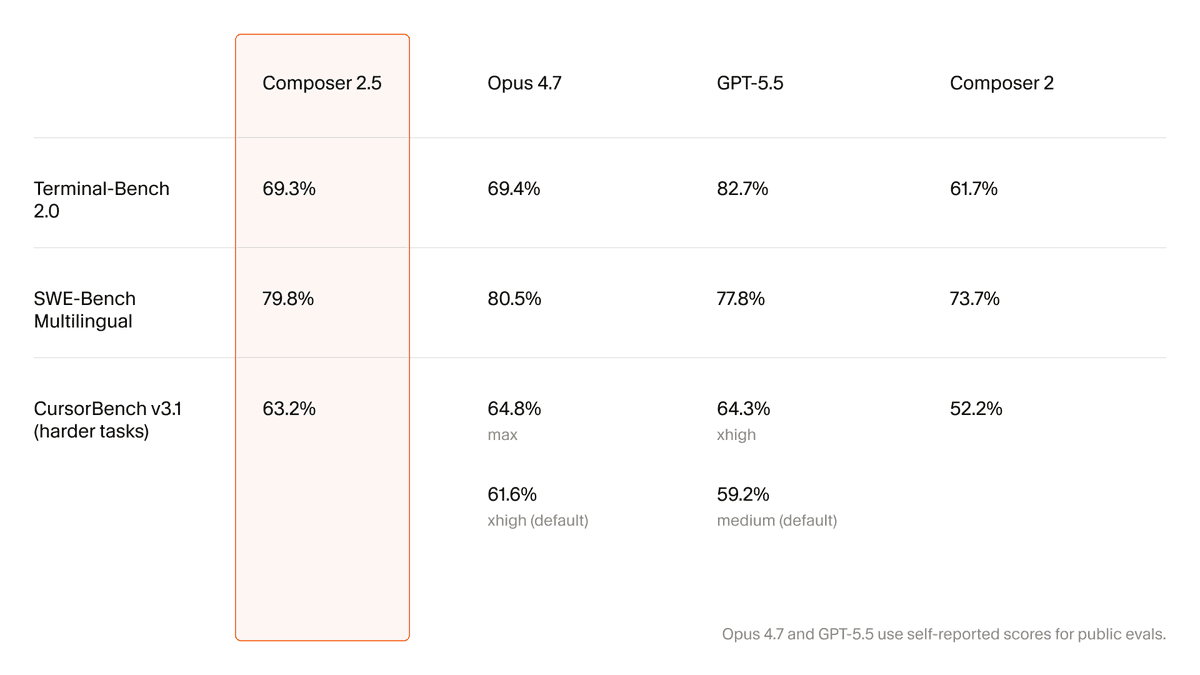
Composer 2.5 is now available in Cursor. It's a substantial improvement in intelligence and behavior over Composer 2, better at sustained work on long-running tasks, follows complex instructions more reliably, and is more pleasant to collaborate with.
What makes this release technically interesting isn't just that the model got smarter. It's how Cursor got it there. The team didn't swap the base model. Composer 2.5 is built on the same open-source checkpoint as Composer 2, Moonshot's Kimi K2.5. Instead, they went deep on post-training, and the results are hard to dismiss.
The timing matters too. This launch is a pointed move in an increasingly competitive market where Cursor, once the undisputed leader in AI-assisted coding, has found itself on the defensive. Claude Code has grown into a formidable rival, reportedly crossing $2.5 billion in annualized revenue and signing up over 300,000 business customers. Composer 2.5 is Cursor's direct answer to that pressure.
What Is Composer 2.5?
Cursor is an AI coding tool used by developers to write, edit, and debug software inside existing projects. Its Composer model acts like a coding agent, taking instructions from users and applying changes across files.
Built on the same open-source Moonshot Kimi K2.5 checkpoint as Composer 2, with 85% of its total compute spent on Cursor's own post-training and RL stack, this release is less about a new architecture and more about what aggressive post-training can actually do. The base is a mixture-of-experts model, roughly 1T total parameters with approximately 32B active per inference.
The model runs inside Cursor only. There is no public API, no third-party gateway, no Hugging Face mirror.
How the Training Stack Changed
This is where the technical substance lives. Cursor made three significant changes to their training pipeline for this release.
Targeted RL with Textual Feedback
Credit assignment during long rollouts is genuinely hard. Credit assignment during RL is becoming an increasingly difficult challenge as rollouts can span hundreds of thousands of tokens. When a reward is computed over an entire rollout, it may be hard for the model to tell which specific decision helped or hurt the outcome.
To address this, Cursor trained Composer 2.5 with targeted textual feedback. The idea is to provide feedback directly at the point in the trajectory where the model could have behaved better. For a target model message, they construct a short hint describing the desired improvement, insert that hint into the local context, and use the resulting model distribution as a teacher. They use the policy with the original context as the student and add an on-policy distillation KL loss that moves the student's token probabilities toward the teacher's, giving a localized training signal for the behavior they want to change while still retaining the broader RL objective over the full trajectory.