
Google DeepMind introduced Gemini Robotics 2.5 on November 10, 2026, reporting higher task success rates, faster execution, and improved physical-safety behavior. The company also described a production-line proof of concept in which Apptronik’s Apollo 2 humanoid robots achieved a 96% success rate while sorting automotive parts at Mercedes-Benz factories.
The availability detail is straightforward: Gemini Robotics 2.5 is rolling out to DeepMind’s robotics partners. The announcement introduces a named vision-language-action model, but it does not announce a general developer API or public model download. The reported performance gains therefore arrive ahead of broad access for outside evaluation. Google DeepMind’s announcement supports both the technical claims and that narrower release status.
What Has Launched, and Who Can Use It?
Gemini Robotics 2.5 converts visual and language inputs into motor control. In practical terms, it connects what a robot sees and what it has been asked to do with movements that carry out the task.
DeepMind’s Gemini Robotics model page separates three models:
- Gemini Robotics 2.5: The vision-language-action, or VLA, model that generates robot actions.
- Gemini Robotics ER 2: An embodied reasoning model for understanding physical spaces and planning complex, multistep work.
- Gemini Robotics On-Device 2: A lightweight VLA model optimized to run locally on robotic hardware.
Those names matter when assessing access. The page’s invitation to try Gemini Robotics ER 2 refers to the reasoning model, not public access to Robotics 2.5’s motor-control capabilities. Likewise, the existence of an on-device model does not mean this 2.5 release runs locally.
The model page lists research partners including Apptronik, Agile Robots, and Boston Dynamics. It also describes a program involving more than 100 trusted testers and offers an early-access waitlist. That broader program should not be read as confirmation that every tester already has Robotics 2.5.
For developers, I’d treat this as a partner model launch, not an API launch that can immediately become a weekend robot project. The next steps depend on access, compatible hardware, integration requirements, and deployment conditions, none of which the announcement packages into a public setup guide.
What Google’s Performance Numbers Actually Say
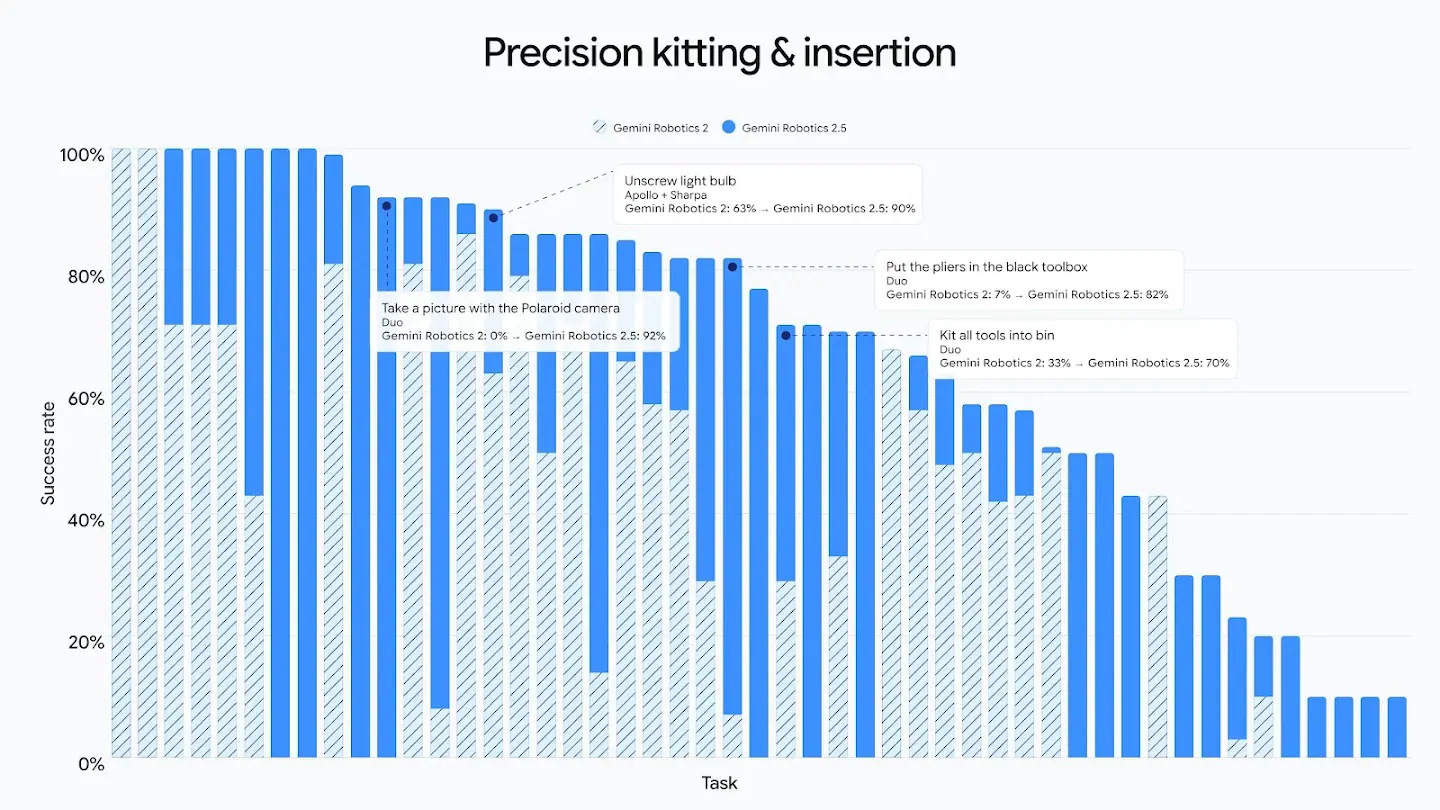
DeepMind says it tested Gemini Robotics 2.5 across more than 200 distinct tasks. Examples include serving food with tongs, tying a bow on a gift box, and pipetting liquid. These activities exercise different kinds of manipulation: tool use, flexible materials, and delicate objects.
The company reports the following results:
| Measure | DeepMind’s reported result | Scope or condition |
|---|---|---|
| Evaluation breadth | More than 200 distinct tasks | Multiple kinds of manipulation |
| Task success | 30% to 100% higher success rate | Varies by task type, compared with previous baselines |
| Task execution | Tasks completed 20% to 30% faster | Compared with previous baselines |
| Factory kitting | 96% success rate | Mercedes-Benz production-line proof of concept |
| Safe task completion | Improvement of 33% around obstacles and 43% around nearby people | DeepMind’s safety evaluations |
These are vendor-reported measurements. The opened coverage does not supply independent replication, and the announcement does not provide enough task-level detail to reconstruct the headline comparisons. DeepMind describes the comparison as being against previous baselines, so it would be too specific to label every result a direct comparison with one earlier released model.
The success-rate wording also needs care. A 30% higher success rate is not a gain of 30 percentage points. As an illustration, a baseline success rate of 50% would become 65% with a 30% relative improvement. That example explains the arithmetic; it is not a published Robotics 2.5 result.
The task examples offer useful context beyond the percentages. A ribbon changes shape as a robot manipulates it, while tongs require control through a tool rather than direct contact with the object. A model that improves across these different conditions is addressing a broader problem than repeating one fixed movement.
DeepMind says Robotics 2.5 works with both Apollo 2’s five-finger, 22-degree-of-freedom SharpaWave hand and the Franka Duo platform’s two-finger parallel grippers. That hardware range is meaningful, although the aggregate scores do not tell readers whether each robot achieved comparable improvements on the same tasks.
Mercedes-Benz Provides a Factory Test, Not a Deployment Verdict
Apptronik’s Apollo 2 robots performed automotive kitting on active Mercedes-Benz production lines in Kecskemét, Hungary, and Sindelfingen, Germany, according to DeepMind.
Kitting means taking parts from bulk supplies and arranging them into trays or containers in the sequence needed for assembly. In this proof of concept, Apollo 2 picked up metal automotive brackets from supply bins and placed them into sequencing containers, correcting gaps as it worked.
The setup used two model roles. Gemini Robotics ER tracked the workflow, while Gemini Robotics 2.5 controlled the hands and arms. DeepMind’s account names the ER family but does not specify the exact ER version used in the pilot. The announcement reports a 96% success rate for the proof of concept.
Apptronik co-founder and CEO Jeff Cardenas described the improvement in a statement published by DeepMind:
Pairing Apollo 2 with Gemini Robotics, we saw the models improve dramatically in just a few weeks of post-training
That supplies some evidence for faster skill acquisition, but it is a partner’s description, not a controlled measurement of training time. The release’s quantified 20% to 30% speed gain concerns task execution, which is a different measure from how quickly a robot learns a skill.
The factory result is encouraging because it moves the evaluation into an operating workplace. Its practical meaning still depends on what counted as a successful attempt, how many attempts were evaluated, and how failures were recovered. Those details are not supplied in the announcement.
At face value, 96% success leaves 4% of evaluated attempts outside the success category. That arithmetic does not tell us whether an unsuccessful attempt meant a missed pickup, an incorrectly arranged part, or an intervention.
My view is that recovery is the consequential next measurement. A robot that safely detects and retries a missed pickup creates a different operational burden from one that silently delivers an incorrect kit. Ars Technica’s reporting likewise highlights the remaining reliability gap and reports DeepMind’s acknowledged tradeoff between broad generalization and very high success in a specific application.
Physical Hazard Avoidance and Jailbreak Testing Are Different
Gemini Robotics 2.5 uses inference-time reasoning guidance to steer around physical hazards, DeepMind says. Inference-time guidance operates while the model is producing its decisions, as opposed to changing the model only during training.
DeepMind reports that this improved safe task completion by 33% around obstacles and 43% around nearby people. Ars describes behaviors such as stopping or waiting until continuing is safe. These measurements concern completing tasks safely under the evaluated conditions; they are not direct measurements of workplace injury rates.
The release also introduces , an open-source robotics safety benchmark. reports that it contains 1,500 prompts designed to induce unsafe behavior.
Frequently Asked Questions
4 questions
1Is Gemini Robotics 2.5 Publicly Available?
DeepMind has announced a rollout to robotics partners. The cited announcement does not offer a general public API or model download.


