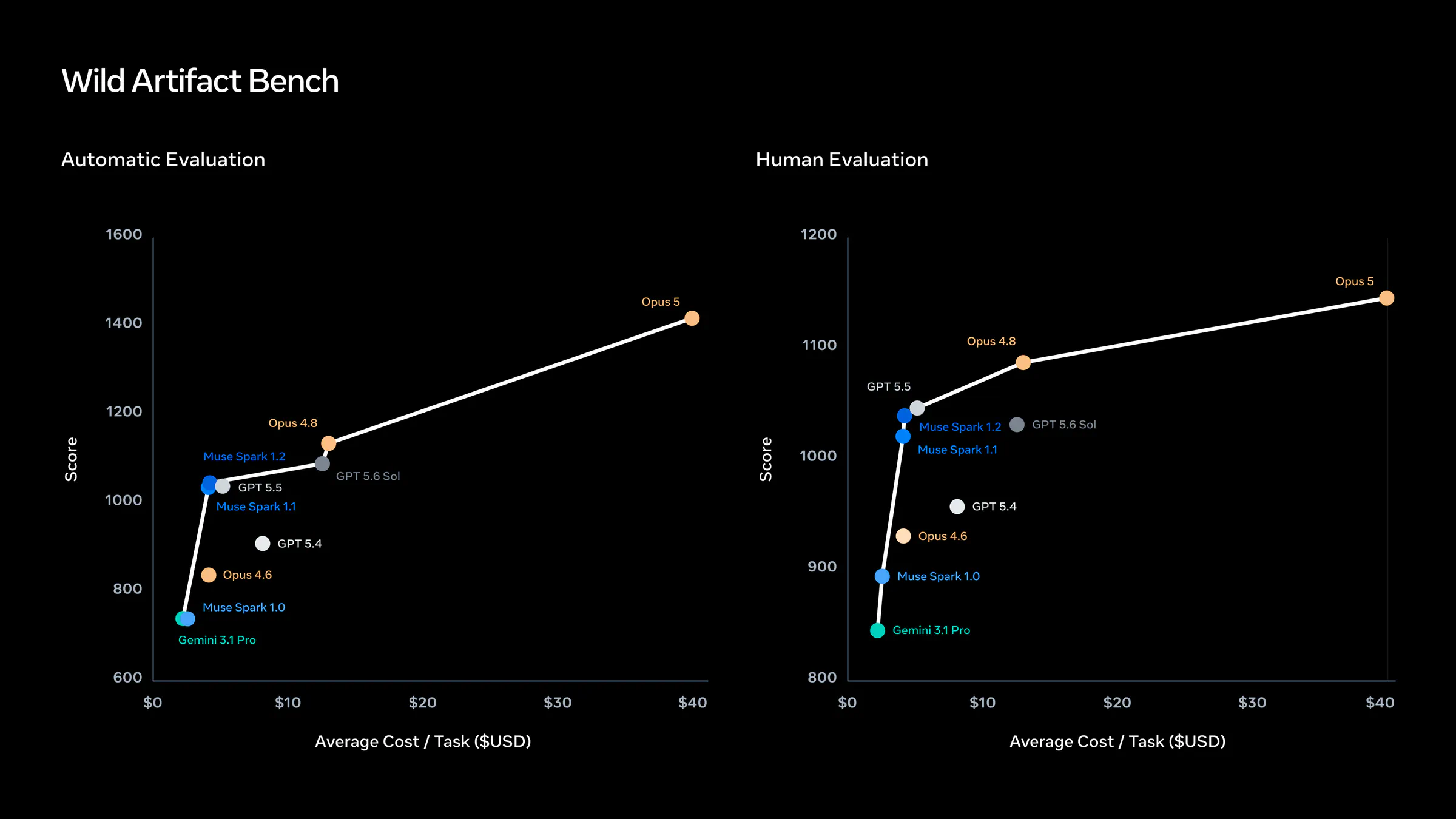
Anthropic released Fable 5 as its most capable publicly available AI model, with leading performance in software engineering, knowledge work, vision, and long-running agentic tasks. Corporate buyers have responded with considerably less enthusiasm than its benchmark results might suggest.
According to a Financial Times report based on Ramp data, Fable 5 represented only 11.4% of spending on Anthropic models during its first full month of availability. It accounted for an even smaller 6% of the Claude tokens purchased by businesses.
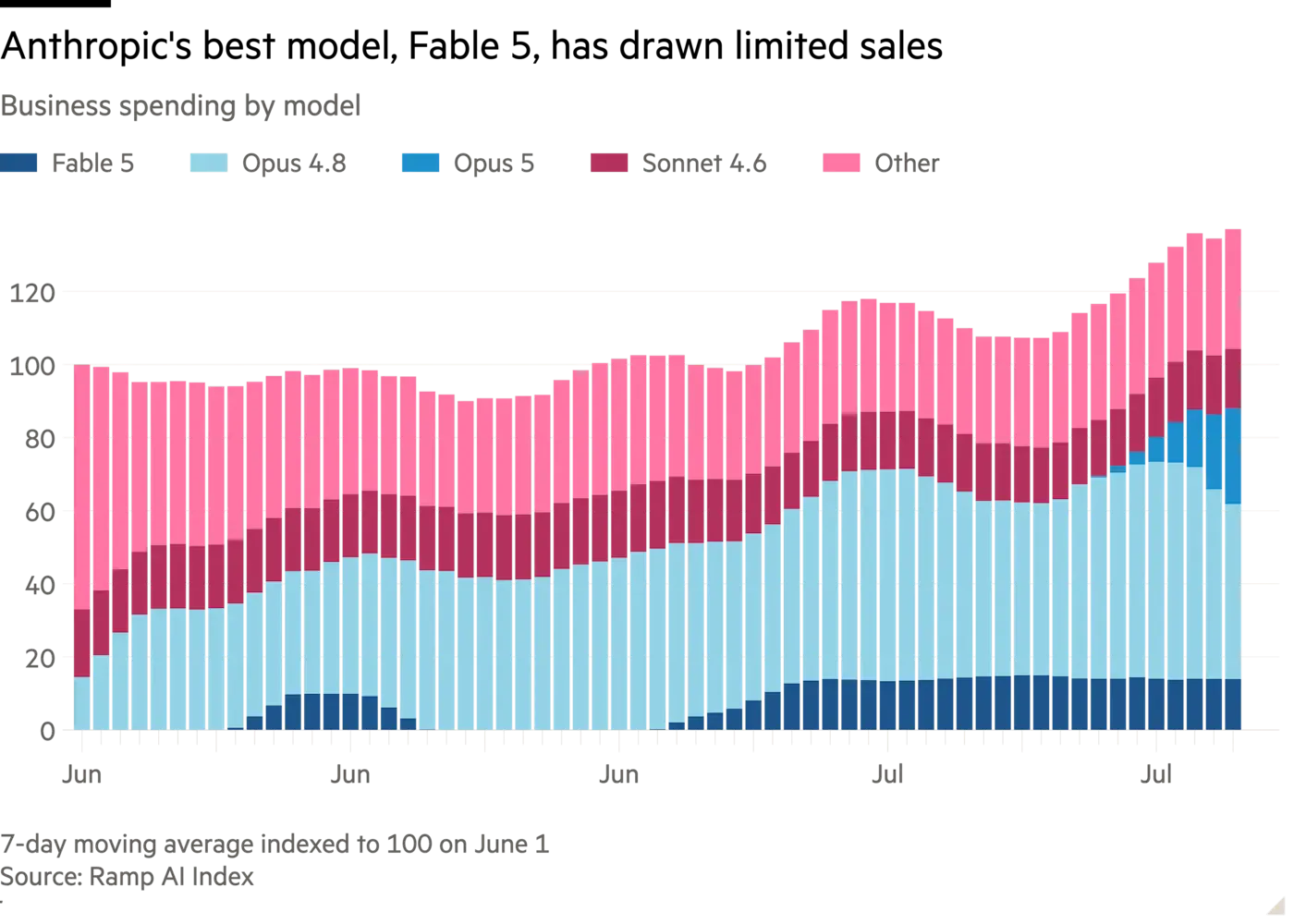
The result does not show that Anthropic is losing the enterprise AI market. It does reveal something potentially more important: being the best model is no longer enough to make a model the default choice. Fable 5 has reached the point where incremental intelligence must compete against a large and increasingly visible price premium.
Ramp’s 11.4% Figure Is Narrow but Important
The 11.4% statistic needs to be described precisely. It is not Fable 5’s share of all corporate AI spending on Ramp. It is the model’s share of spending attributed to Anthropic models among companies using Ramp’s token spend management product. The sample also leans more heavily toward technology companies than Ramp’s wider business dataset.
Within that sample, Fable 5 generated 11.4% of Anthropic model spending while handling 6% of token volume. OpenAI’s GPT-5.6 Sol, by comparison, represented 23% of OpenAI model spending and 25% of its tokens. Ramp estimated that Fable 5 produced approximately three-quarters as much model-attributed revenue as GPT-5.6 Sol in July 2026.
This is only an early snapshot, not a final judgment on the product. Even so, the imbalance between Fable 5’s technical position and commercial uptake provides evidence of a pricing ceiling. Businesses appear willing to reserve the best model for difficult work, but not to pay for it across every workflow.
Fable 5 Is Priced for Rare, Difficult Work
Claude Fable 5 costs $10 per million input tokens and $50 per million output tokens. Anthropic says its advantage grows as tasks become longer and more complex, particularly in autonomous software engineering, scientific research, analytical work, and other projects that require sustained reasoning.
That can justify the price when a failed answer would cost more than the model call. A successful code migration, security investigation, or specialist research task may save days of professional work. Routine document classification, extraction, summarization, customer support, and drafting rarely offer the same economics.
Price is not the only possible drag on adoption. Anthropic launched Fable 5 on June 9, 2026, suspended it on June 12 following a US government export-control directive, and restored global access on July 1. Its stricter cyber safeguards can route some requests to a lower-tier Claude model, while Anthropic also requires 30-day retention for Mythos-class business traffic. Those complications can matter to regulated or privacy-sensitive customers.
Open Models Turn “Good Enough” Into a Procurement Rule
The competitive threat is not that every open model has surpassed Fable 5. It is that an expanding group of cheaper models can complete a large percentage of business tasks well enough that Fable’s additional capability does not produce an equivalent financial return.
Moonshot AI’s Kimi K3, for example, costs $3 per million uncached input tokens and $15 per million output tokens. Both rates are 70% below Fable 5’s headline prices, while cached Kimi input falls to $0.30 per million tokens. Moonshot acknowledges that K3 still trails Fable 5 and GPT-5.6 Sol overall, but describes it as a frontier-level model for coding, reasoning, and knowledge work.
Kimi K3 is more accurately described as open-weight than fully open-source. Moonshot has released the model weights under a custom license, but that does not necessarily provide the training data, complete source material, and unrestricted licensing associated with conventional open-source software. The weights still give companies more deployment and customization choices than a closed API alone.
Token prices also do not equal total task costs. A cheaper model can consume more tokens, require additional retries, or produce work that needs more human review. Businesses therefore need workload-specific evaluations rather than simple price comparisons. The growing availability of credible alternatives, however, makes that evaluation worthwhile.
Anthropic Is Also Competing With Fable 5
Some of Fable 5’s strongest competition comes from inside the Claude family.
Anthropic released Claude Opus 5 on July 24 at $5 per million input tokens and $25 per million output tokens, exactly half Fable 5’s rates. The company describes Opus 5 as approaching Fable-level intelligence and says it matches or beats Fable on several cost-adjusted coding, automation, and computer-use evaluations.
Claude Sonnet 5 is cheaper again at $2 per million input tokens and $10 per million output tokens. Anthropic initially presented those rates as introductory pricing, then made them permanent on August 10.
| Model | Input per million tokens | Output per million tokens |
|---|---|---|
| Claude Fable 5 | $10 | $50 |
| Claude Opus 5 | $5 | $25 |
| Claude Sonnet 5 | $2 | $10 |
| Kimi K3 | $3 uncached | $15 |
This lineup gives businesses little reason to begin every request with Fable 5. A rational architecture might use Sonnet for high-volume work, Opus for complex projects, and Fable only when evaluations show a meaningful improvement. Fable can remain valuable in that system without becoming Anthropic’s highest-volume model.
This Is Workload Fragmentation, Not an Anthropic Collapse
Ramp’s wider numbers provide an important counterweight to the negative interpretation. In July, 43.5% of US businesses in its dataset paid for Anthropic subscriptions or tokens, up 1.1 percentage points from June. OpenAI reached 39.7%, leaving Anthropic in front on paid business adoption.
Open and Chinese models are growing from a much smaller base. The share of AI-using businesses purchasing from model-serving platforms rose to 6.1% in July. Ramp treats those platforms as a proxy for open-weight and Chinese model use because they provide access to many different models.
Earlier Ramp research on open-model adoption also found substantial overlap rather than wholesale replacement. In June, 93.2% of companies using model-serving platforms still used Anthropic, while 85.8% used OpenAI. The evidence points toward multi-model stacks in which businesses assign different workloads to different providers.
Anthropic is therefore not being removed from corporate AI budgets. Its problem is that customers may keep Claude while directing high-volume tasks toward cheaper models. That distinction matters because adoption can continue rising even as the spending mix shifts away from the company’s most profitable or strategically important products.
The Business Risk Is Margin Pressure, Not Immediate Churn
The timing is awkward because investors are placing enormous expectations on Anthropic’s continued expansion. Axios reported on August 17 that the company’s annualized revenue run rate had passed $65 billion ahead of an expected public offering. Commercial momentum remains strong, whatever concerns Fable 5’s early adoption creates.
The harder question is how much of that growth can retain premium pricing. If open-weight competitors remain only months behind the proprietary frontier, every capability improvement has a shorter period in which it can command exceptional rates. Anthropic may have to reduce prices, bundle more usage into subscriptions, or route requests automatically between Claude models.
That would not necessarily damage revenue. Lower prices can produce greater usage, especially as autonomous agents consume far more tokens than conventional chatbots. It could, however, weaken the idea that each new frontier model will automatically generate both higher demand and higher margins.
Final Thoughts
Fable 5 is not losing because cheaper models are universally better. It is losing volume because its lead matters intensely for a narrow set of tasks and only marginally for many others. Businesses are learning to purchase intelligence in tiers rather than treating the most capable model as the default.
Anthropic can respond by making Fable an escalation layer inside a broader Claude system, invoked when Sonnet, Opus, or an open-weight model fails an evaluation or encounters unusually difficult work. In that role, an 11.4% spending share may be reasonable.
The warning is for a different strategy: one that assumes frontier performance alone can sustain frontier pricing. Ramp’s data suggests corporate buyers have already stopped making that assumption.
Frequently Asked Questions
4 questions
1What is Anthropic’s Claude Fable 5?
Claude Fable 5 is Anthropic’s most capable generally available AI model and the public version of its Mythos-class technology. It is designed for long-running coding, research, vision, scientific, and professional workflows. Anthropic launched it on June 9, 2026, with stricter safeguards than its Opus and Sonnet models.