
Databricks announced on November 11, 2026, that Genie Ontology is generally available, giving customers a governed context layer that agents can use to understand company metrics, definitions, people and processes. Alongside it, the company introduced a second-generation Genie designed to keep working in the background, delegate tasks and ask people for decisions through an inbox and email.
The availability distinction matters: Genie Ontology is GA; the new always-on Genie, Genie Search and Ontology Manager are coming to preview and beta. Existing Genie is also generally available. The announcements connect these products into one architecture, but customers should not treat the entire package as production-ready today. Databricks’ announcement separates those release stages.
The most immediately useful change is the shared context layer. Companies can start governing what their agents understand about the business without waiting for the new autonomous workflow.
What Has Shipped and What Is Coming
Databricks’ Week of Genie announcements cover several related components:
| Component | Announced availability | What it provides |
|---|---|---|
| Existing Genie | Generally available | The existing enterprise AI assistant |
| Genie Ontology | Generally available | Shared, governed business context for agents |
| Unity Catalog Domains and Pages | Generally available | Organization of knowledge by business area and authoritative business definitions |
| Second-generation, always-on Genie | Coming to preview/beta | Background work, subagent delegation, progress tracking and decision requests |
| Genie Search | Coming to preview/beta | Governed search across enterprise data and applications |
| Ontology Manager | Coming to preview/beta | An interface for curating and governing ontology knowledge |
The Genie Ontology GA post confirms that Domains and Pages are also generally available. The broader announcement groups the new agent, Search and Ontology Manager as upcoming preview/beta capabilities; it does not support assigning a separate, firm launch date to each.
For deployment planning, I’d separate the available context foundation from the upcoming interfaces and automation. Ontology GA gives teams something concrete to organize now, even if their preferred curation interface or autonomous workflow is still ahead.
Genie Ontology Combines Learned Context With Governed Definitions
Genie Ontology addresses a familiar enterprise problem: access to a table does not explain how a company uses it.
An agent may find several revenue calculations and still need to determine which one finance certifies, which dashboard uses a regional adjustment and which notebook contains an outdated rule. Databricks’ approach combines knowledge extracted from everyday work with definitions that people explicitly maintain.
According to the technical announcement, the ontology has three main mechanisms.
Agents Extract Reusable Business Context
Genie Ontology learns from assets such as Databricks dashboards, SQL queries, notebooks and BI semantic models, including models in tools such as Power BI. Databricks also describes expanded organizational knowledge sources that help connect business information with the people behind it.
The extracted knowledge becomes Ontology Snippets: reusable pieces of context covering calculations, business rules and data relationships. Databricks says these snippets update as their underlying sources evolve.
This makes existing analytical work useful beyond its original audience. A calculation embedded in a dashboard can become context another agent can retrieve, without someone manually rewriting every rule into a separate agent prompt.
People Define What Must Be Exact
The learned layer sits alongside modeled knowledge governed through Unity Catalog semantics:
- Metric Views hold certified key performance indicators.
- Domains organize knowledge by business area.
- Pages record authoritative definitions of business concepts.
Databricks gives recognized revenue and annual recurring revenue, or ARR, as examples of definitions that require precision. The ontology is designed to treat governed definitions as the source of truth wherever they apply.
That division is sensible: automated extraction can capture the long tail of operational knowledge, while accountable teams retain control over definitions with financial or operational consequences. Learning a rule from a frequently used dashboard should not automatically make that rule official.
OntoRank Selects Context by Authority
When an agent requests context, Databricks’ OntoRank algorithm weighs signals including source authority, certification, contributor expertise and relevance, popularity, and recency. It uses those signals to select context while respecting existing user permissions.
Consider a hypothetical forecast task. A recent sales notebook and a finance-certified metric might calculate revenue differently. The documented architecture gives certification and authority a role in deciding which context reaches the agent, instead of relying only on which document is newest or easiest to retrieve.
Through Genie MCP, that context can also be made available to external agents, including ChatGPT, Claude and Microsoft Copilot. MCP, the Model Context Protocol, provides an integration path for those tools. Sharing still requires that connection; an unrelated agent does not automatically inherit a company’s ontology.
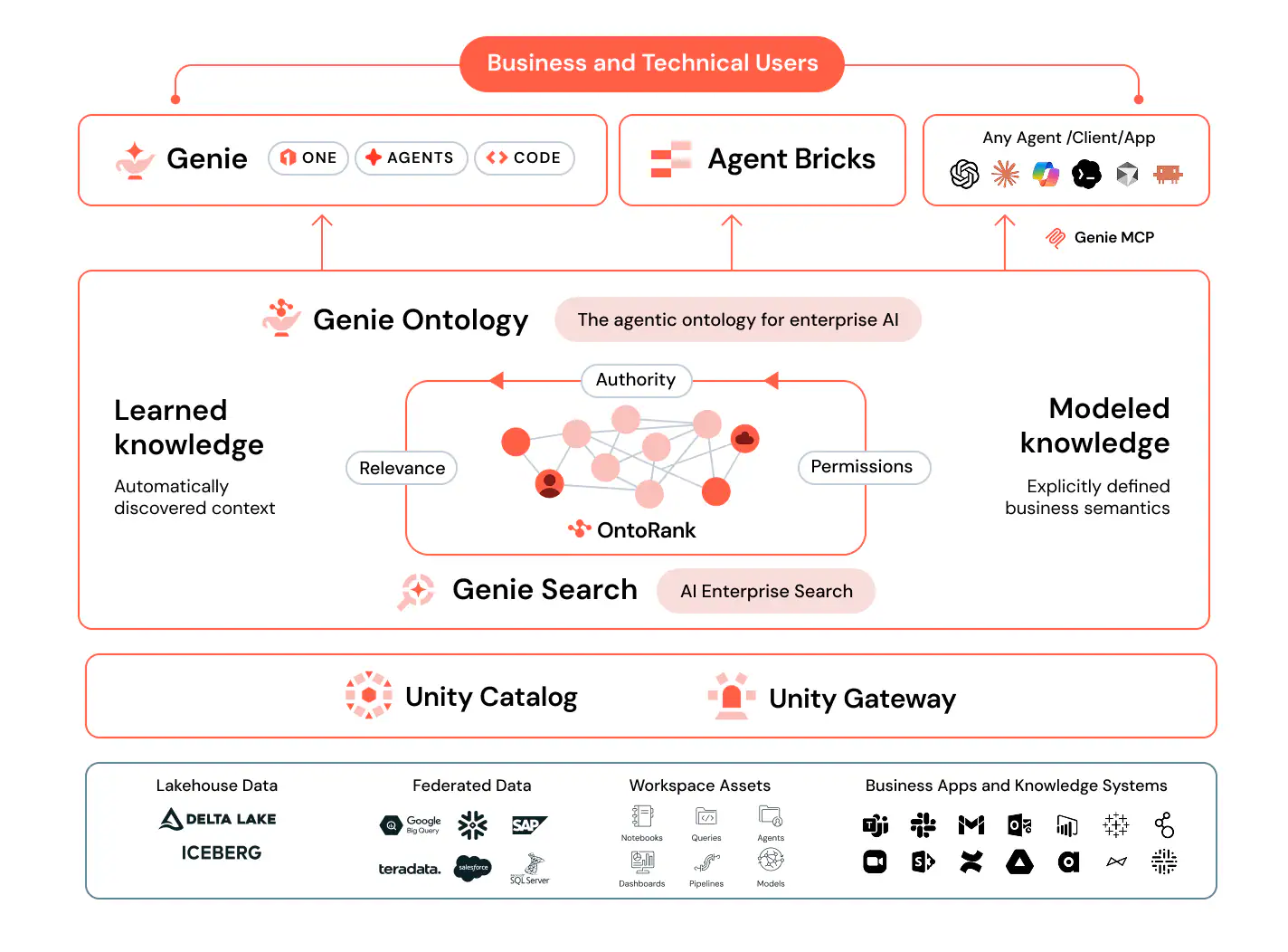
The practical consequence is significant: teams can maintain a shared business definition once and expose it to multiple agents, reducing the need to build separate context packages for each assistant.
Genie Search Uses Three Connection Strategies
Genie Search is the upcoming retrieval layer spanning lakehouse data and business applications. Databricks names Google Drive, Jira and Confluence among the supported systems and says it now offers more than 100 connectors across its connection strategies. The press release describes three approaches:
| Strategy | How Databricks describes it | Practical distinction |
|---|---|---|
| Ingestion | Bring data into the lakehouse through Lakeflow Connect | Data is ingested for use within the lakehouse |
| In-place indexing | Index content in the tools where it resides | Search can discover source content without treating ingestion as the only route |
| Live access through MCP | Query applications through MCP | Agents can request information from connected applications |
The connector count should not be read as a promise that every source supports all three modes. The announcement describes breadth across connection strategies.
That distinction affects architecture choices. A team evaluating a ticketing system needs to establish whether its intended workflow uses ingested records, indexed content or live application queries. Those paths have different implications for freshness and operation.
Databricks says Genie Search combines structured and unstructured information in a single search, uses Genie Ontology to interpret results in business context, and follows Unity Catalog access rules. It also says customers will not need separate search infrastructure outside their existing Databricks environment.
I’d judge connector coverage by the workflow it completes, not the headline total. Finding a document, interpreting its business meaning and acting in its source application are separate requirements. A connector list alone cannot show that all three are supported for a particular task.
Always-On Genie Adds Delegation and a Decision Inbox
The second-generation Genie changes the interaction from a sequence of questions into an ongoing assignment.
Databricks says users will be able to provide a goal and boundaries, after which Genie runs in the background using its own compute. It can delegate work to multiple subagents, track progress, follow up on missing inputs and contact a person when a decision is needed. Proposed uses include monitoring customer usage, tracking revenue trends and maintaining a quarterly forecast.
Frequently Asked Questions
3 questions
1Is the New Always-On Genie Generally Available?
No. Existing Genie and Genie Ontology are generally available. The second-generation always-on Genie, Genie Search and Ontology Manager are coming to preview or beta.


