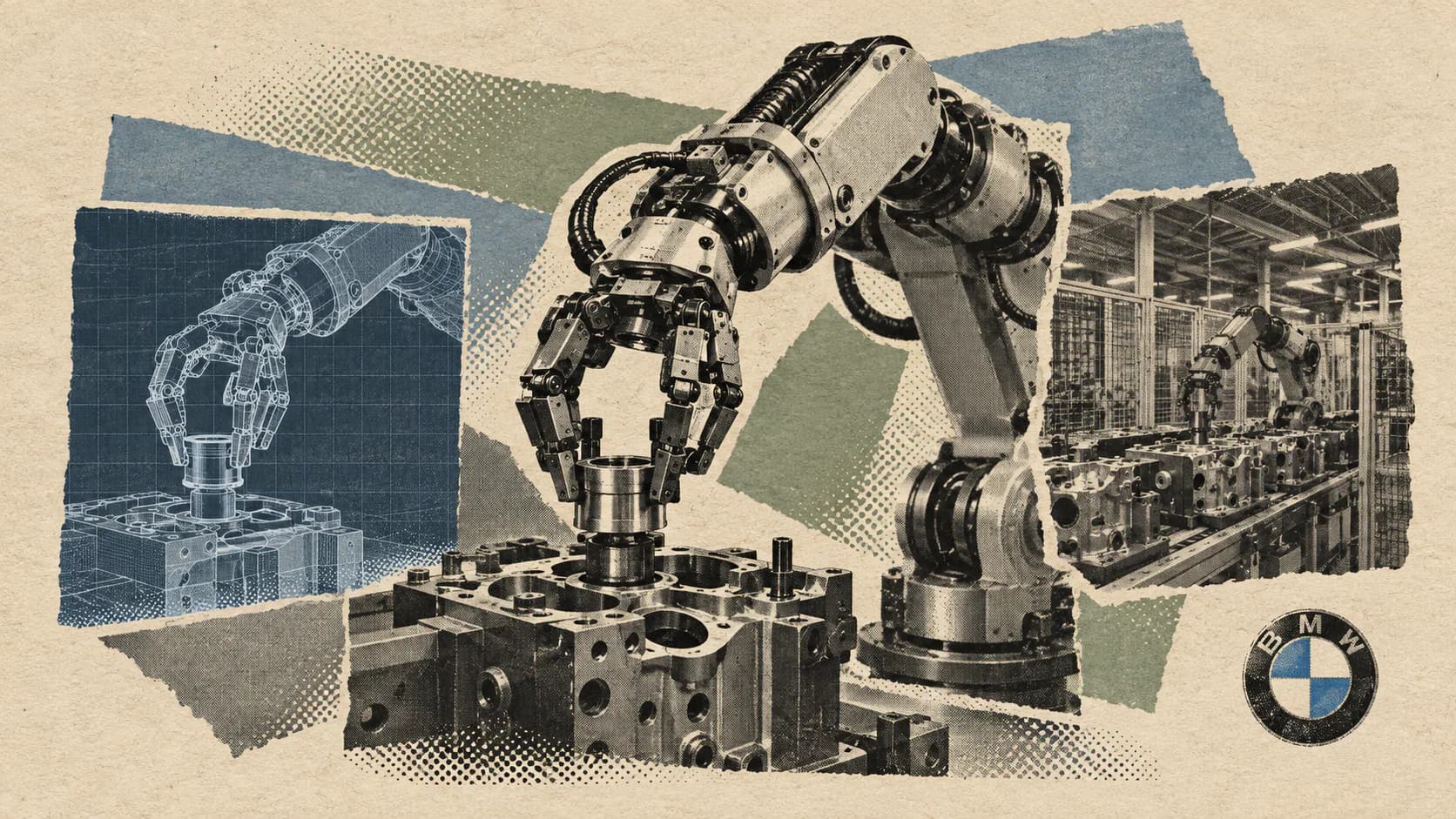
Industrial Next’s AI-powered robotic workstations have a named automotive evaluator: BMW Group Technology Office. The startup announced the partnership at TechCrunch Disrupt on October 13, 2026, according to TechCrunch’s reporting.
The company’s pitch is specific: factories should be able to teach robots new manufacturing tasks through simulation and demonstration, rather than spend weeks on custom programming. Its self-contained stations target delicate assembly work, including operations involving small connectors and flexible cables.
BMW’s involvement gives that pitch a concrete industrial evaluation opportunity. It does not establish that BMW has purchased the workstations, deployed them in production, or validated Industrial Next’s performance claims. The reported announcement does not disclose the evaluation’s timeline, manufacturing tasks, commercial terms, or success criteria.
For readers tracking the AI industry, the distinction matters. This is an early commercial test of whether adaptable robotic systems can reduce the work involved in changing production tasks, not evidence that an AI-controlled factory is already operating at BMW.
The Product Is a Reconfigurable Workstation
Industrial Next builds modular robotic work cells, rather than humanoid robots. The company describes them as self-contained stations that can be reconfigured, combined, and redeployed across product lines.
According to the startup, proprietary foundation models connect vision, task context, and robot motion. The intended advantage is that a workstation can respond to product variation without requiring engineers to write a separate, rigid sequence for every situation.
That distinction is central to the product’s appeal. Repeating a successful movement is useful, but a manufacturer evaluating flexible automation needs to know what happens when the part or assembly requirement changes. Industrial Next is selling the prospect of carrying useful capabilities across those changes.
The available disclosures do not provide enough technical detail to judge the breadth of that transfer. They do not describe the model architecture, training-data scale, or controlled evaluations showing how well a skill learned for one task carries over to another.
“Foundation model” therefore describes the company’s approach, not an independently established level of general-purpose robotic capability. BMW’s evaluation could help test its industrial usefulness, but the partnership announcement itself supplies no results.
Simulation and Demonstration Replace Hard-Coded Task Scripts
Industrial Next says new skills are taught through simulation and demonstration instead of traditional hard-coded programming.
In TechCrunch’s account, co-founder Lukas Pankau describes a high-fidelity simulation engine intended to approximate the physical dynamics of precision manufacturing. The company’s argument is that robots can develop an understanding of an assembly process in that simulated environment before performing the work on actual equipment.
The practical goal is to reduce the amount of task-specific programming required when a manufacturer changes products or processes. Demonstration provides another route for teaching the desired behavior, although the report does not explain how demonstrations are collected or how much human guidance each new skill requires.
This is a more demanding proposition than generating a plausible-looking movement. Threading a delicate cable or seating a small connector requires the robot to complete a physical operation successfully, not merely follow a visually convincing path. A useful evaluation would need to establish how well the simulated learning survives differences in real parts, equipment, and operating conditions.
The timing claim also needs a clearer definition. Industrial Next’s product website says factories can change in minutes rather than weeks, while another performance statement describes retooling new tasks in hours. Those claims might refer to different levels of adaptation, but the site does not explain the boundary between them.
Changing a familiar task to accommodate a product variant is not necessarily equivalent to introducing a new assembly operation. Nor does teaching a robot a motion establish how long it takes to prepare the surrounding station and approve the resulting output.
Until the company publishes a defined changeover benchmark, “minutes” should be read as an attributed vendor claim, not a demonstrated duration for converting an entire production line.
The Smartphone Examples Are Specific, but Unverified
Industrial Next says its technology is already being used in smartphone manufacturing. Pankau told TechCrunch that some workstations contribute to making one of the world’s most popular smartphones, but he did not identify the customer.
The examples are more informative than a generic claim of manufacturing readiness. They include threading a delicate flex cable and snapping a tiny connector cap into place, tasks the company says manufacturers had previously struggled to automate.
Pankau also described a station that removes protective film from camera modules and buttons. According to his account, it works at or above human speed with 100% accuracy, including after transfer to an unfamiliar phone model and production line.
These remain company statements reported by TechCrunch. The article does not supply an independently reproduced test, a named customer confirmation, or enough information about the number of attempts and operating conditions to assess the claimed accuracy.
Industrial Next’s website offers additional performance figures. It advertises 99.9%+ first-pass task completion and describes a production cell with a cycle time below 3.3 seconds, operating around the clock at a major contract manufacturer.
Those figures should not be combined into a single performance benchmark. The public material does not establish that the 100% film-peeling claim, the website’s 99.9%+ figure, and the sub-3.3-second cycle time refer to the same task or evaluation.
For a manufacturer, the missing denominator matters. A reported success rate needs a sample size, a definition of failure, and an explanation of whether operator intervention or retries are counted. Cycle time needs its own context: which operation was timed, what product variants were included, and whether the figure covers the full station process.
The smartphone examples make Industrial Next’s intended use cases concrete. They do not yet provide independently verified evidence of deployment scale or sustained performance.
BMW’s Other Robotics Pilots Provide Context, Not Confirmation
BMW has separately described its interest in adaptive robotics through its physical-AI production pilots. In that account, the automaker says pilot projects help it test and develop AI-enabled robots in real industrial settings.
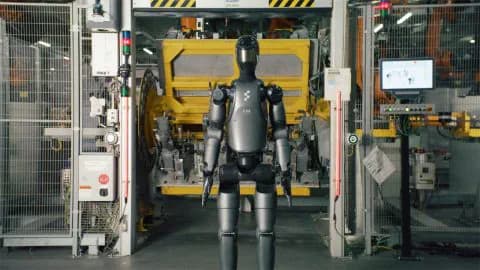
Its published examples involve other companies, including Hexagon’s AEON humanoid robot at Leipzig and Figure’s robots at Spartanburg. They should not be treated as deployments of Industrial Next’s technology.
Sources
- TechCrunch’s reportingtechcrunch.com
- product websiteindustrialnext.ai
- physical-AI production pilotsbmwgroup.com