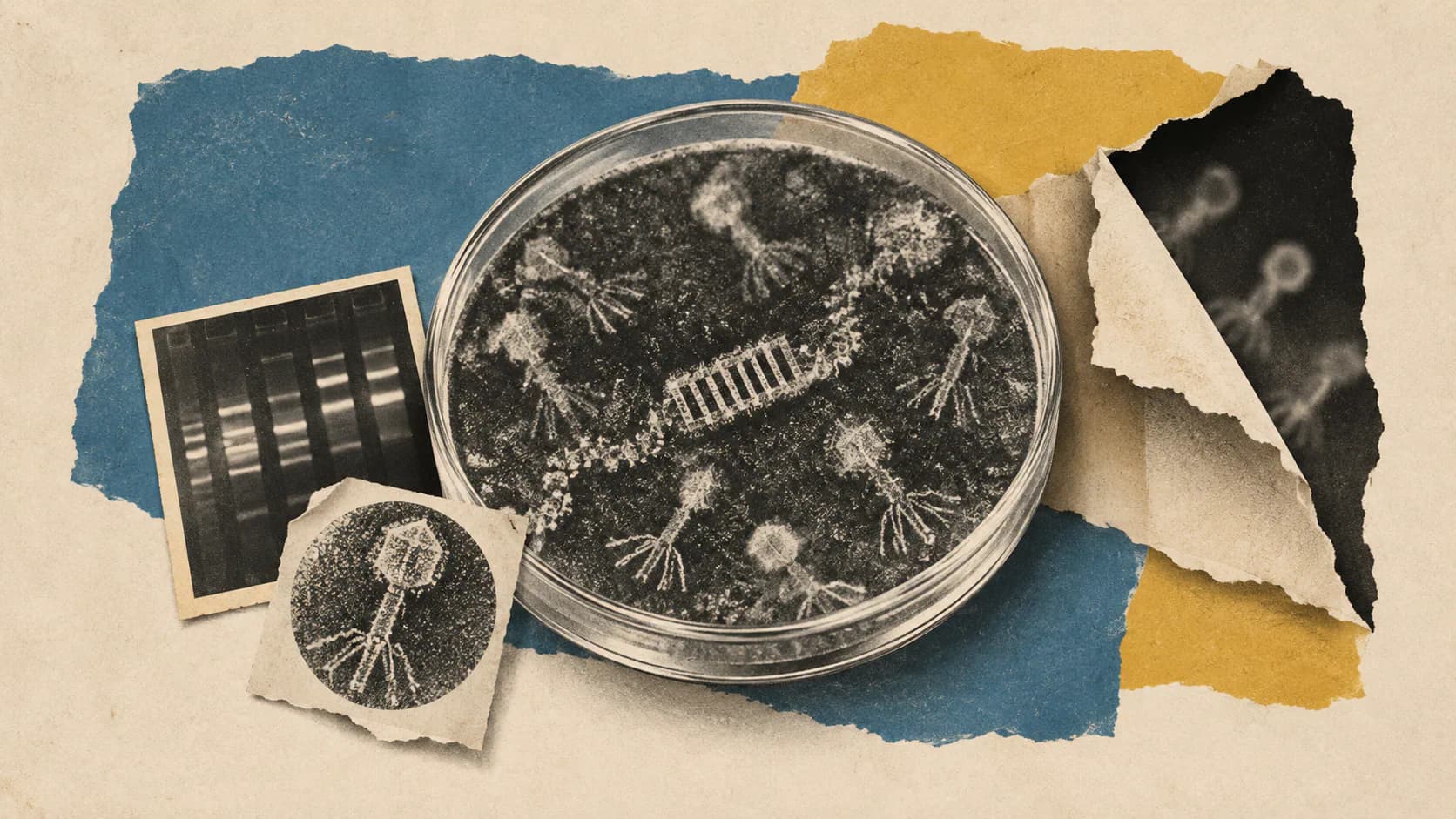
Anthropic says Claude identified a previously uncharacterized genetic system in bacteriophages, the viruses that infect bacteria. In its September 23 announcement, the company calls the candidate an array-associated reverse transcriptase, or ART. It combines a reverse transcriptase gene, a neighboring partner gene and an array of repeated DNA sequences.
The search reportedly took 21 hours, involved roughly 950 Claude agents and used 210 million tokens. Human scientists then observed short RNAs produced from the repeat array. That experiment supports the idea that the array is biologically active, but Anthropic says ART’s function remains unknown. It has not demonstrated that ART edits genes.
Even without a new gene-editing tool, this is a substantial claim about AI-assisted scientific research. Claude appears to have selected an unusual pattern from a large sequence search and pursued it far enough to give scientists a testable lead. What the pattern does is a separate question.
A Known Enzyme Gene in an Uncharacterized Arrangement

The reverse transcriptase at the center of Anthropic’s finding was not newly invented or previously invisible. According to the company, earlier studies had identified the underlying enzyme, which belongs to a class that copies RNA into DNA. Claude’s reported contribution was noticing features around it that had not been characterized together: the adjacent partner gene and the long array of regularly spaced repeats.
ART is a proposed system, not a newly designed molecule. The agents mined existing phage sequence data for an arrangement that might signal biological activity. Neighboring genes and conserved-looking sequence patterns can suggest a connection, but proximity alone cannot establish that the components work together or reveal their purpose.
The repeat array prompted the CRISPR comparison. Some CRISPR systems also contain DNA repeats and produce short RNAs. Similar-looking genomic layouts need not have the same mechanism, though. In ART’s case, the resemblance is a reason to investigate, not evidence that researchers have found another CRISPR system.
What 950 Claude Agents Did in 21 Hours
Anthropic says its scientists gave Claude an initial objective: search a large DNA sequence database for interesting reverse transcriptases. The agents assembled a collection of more than 200,000 RTs, identified about 3,500 candidate systems and narrowed those to 20 candidates for deeper analysis and human-readable reports.
During that search, one agent examined the raw DNA next to an unusual RT and noticed the repeat array. It counted repeats, checked their spacing, compared the arrangement with known RT systems and searched the literature for earlier descriptions. It then submitted a candidate for human review.
This was more involved than asking a chatbot for a biological hypothesis. Anthropic describes agents carrying out a sustained search, deciding which leads deserved more attention and connecting a sequence observation to relevant literature. The company says it sometimes uses a custom system to coordinate many Claude sessions in parallel. The 950 figure refers to software agents, not independent scientists checking the result.
Twenty-one hours measures the computational search, not the time required to understand ART or independently confirm it. Anthropic suggests an expert might spend weeks or months on comparable analysis, but the announcement does not provide a controlled comparison with established genome-mining workflows. The candidate counts show how the agents narrowed a search; they do not establish how often such searches produce useful findings.
The Lab Confirmed RNA Expression, Not Function
Human scientists performed the physical experiments. Anthropic reports that they detected distinct short RNAs expressed from the ART repeat array. The finding goes beyond a pattern spotted in a sequence database: the array is transcribed under the conditions the researchers tested.
What the RNAs do remains unknown. The reported result does not show that they guide the RT, identify a target, participate in phage defense or cause a change to DNA. Nor does the public account establish what the neighboring partner protein does. Anthropic says experiments to determine ART’s primary function are continuing.
The company has released a technical preprint describing the work. It gives other researchers a basis for scrutiny, but it is not independent replication. So far, the supported finding is that Claude nominated an apparently unusual genomic arrangement and Anthropic’s scientists obtained an initial experimental indication that one part of it produces RNA.
Why “Claude Invented CRISPR” Is False
CRISPR was discovered long before this project, and Anthropic does not claim Claude created it. ART was found in natural sequence data, not designed by the model. Its repeat array resembles one feature associated with CRISPR systems, but that does not establish the mechanism researchers use for gene editing.
The wording can easily slip from comparison into an unsupported capability claim. A TechCrunch report on the announcement suggests the new system can cut, copy and paste DNA. Anthropic’s announcement makes a narrower point: other systems with a similar collection of characteristics are known to perform such operations. It does not report those abilities for ART.
The presence of a reverse transcriptase gene cannot settle the question, either. Knowing what an enzyme class generally does is different from demonstrating what this particular combination of genes and RNAs does inside a phage. Until experiments connect the components to a mechanism, calling ART a gene editor would turn a research hypothesis into a result.
Claude’s Discovery Still Depends on Human Science
Anthropic describes this run as requiring high-level direction from its scientists before the search and laboratory follow-up afterward. People chose the research area, supplied the objective, assessed the candidate and carried out the experiment. Earlier researchers had already identified the underlying RT, while existing sequence databases and scientific literature made the search possible.
Claude’s apparent contribution sits between those stages: it selected a promising anomaly from many candidates and developed a case for examining it. That is a plausible and useful form of scientific agency. It does not mean the model conceived the whole project, performed wet-lab work or resolved the biology.
The distinction has surfaced in discussion of the finding on Hacker News. One commenter argued that the precise description is a previously undescribed genomic arrangement around a known RT; others questioned whether the CRISPR framing runs ahead of the evidence. Those are individual reactions, not scientific validation. They do identify the attribution problem: “AI found a lead worth testing” and “AI discovered a working biotechnology” describe very different achievements.
Frequently Asked Questions
4 questions
1What Did Anthropic’s Claude Agents Find?
Anthropic says Claude found a previously uncharacterized arrangement in bacteriophage sequence data: a reverse transcriptase gene beside a partner gene and an array of DNA repeats. The underlying reverse transcriptase had been identified before. Anthropic calls the proposed system an array-associated reverse transcriptase, or ART, but says its biological function remains unknown.
2
Sources
- September 23 announcementanthropic.com
- technical preprintwww-cdn.anthropic.com
- TechCrunch report on the announcementtechcrunch.com
- discussion of the finding on Hacker Newsnews.ycombinator.com