Anthropic Adds a Separate Opt-In for Claude Voice Data
Claude’s observed audio-training control is off by default and separate from chat permissions, but retention rules and rollout details remain unclear.
Listen
AI narration
11:29
0:00 / 11:29
AI SummaryGenerated from this article
Anthropic has added a separate opt-in permission for using Claude voice recordings and audio-chat data to improve its AI models. The toggle appears in Settings > Privacy and is disabled by default, independent of the existing training preference for text conversations and Claude Code sessions. However, Anthropic has not yet published detailed documentation explaining data retention, which sessions qualify as "approved," deletion procedures, or how overlapping audio and transcript permissions interact.
Claude voice users have a privacy setting worth checking: a separate permission allowing Anthropic to use audio recordings and voice-chat data to improve its AI models. In the interface observed by BleepingComputer, that permission is disabled by default and can be reviewed under Settings > Privacy.
The choice is independent of the training preference for regular chats and Claude Code sessions. Users should check both controls; an existing decision about text conversations does not necessarily cover voice recordings.
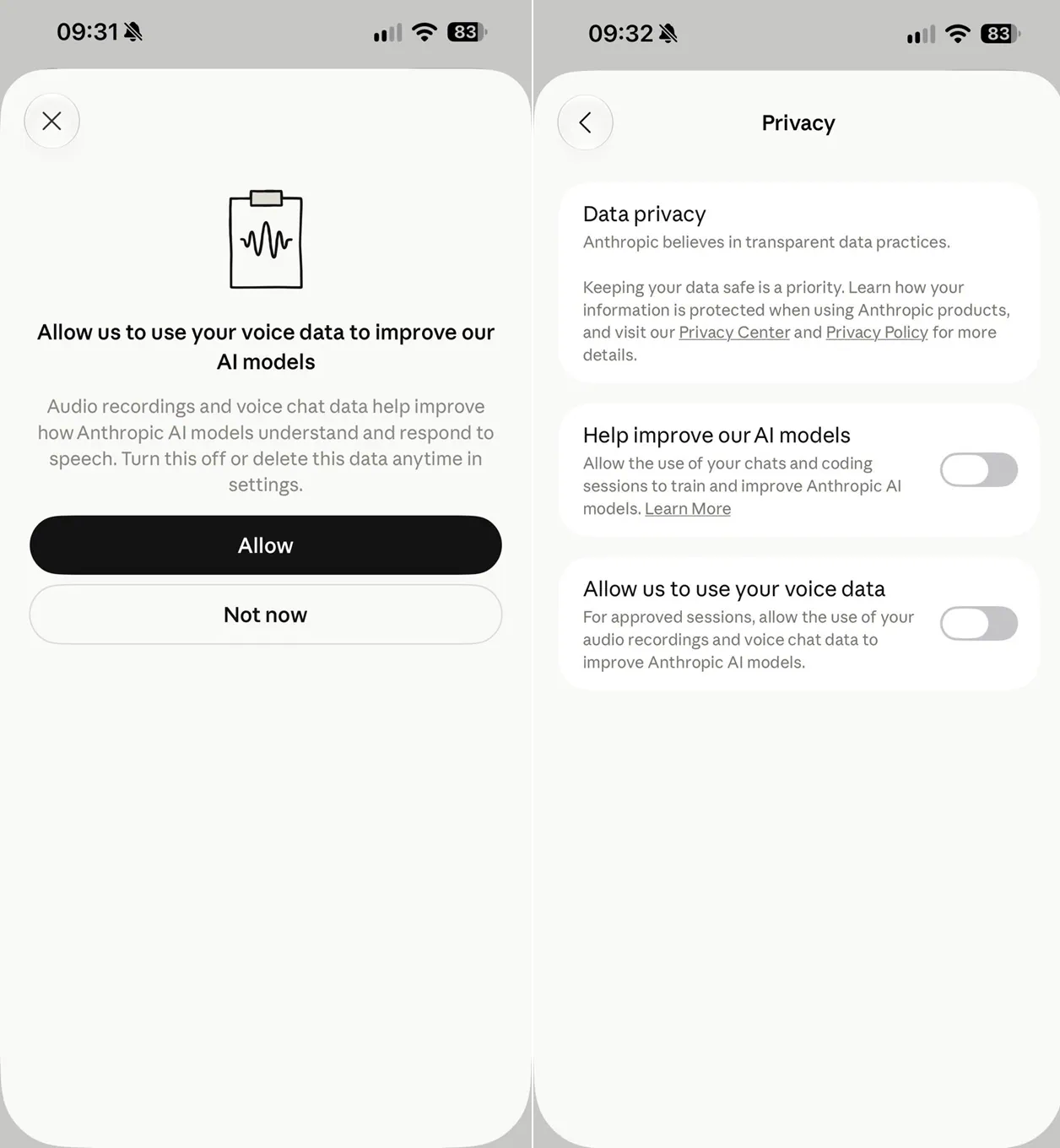
BleepingComputer’s October 4 report documents a prompt offering “Allow” or “Not now.” The report establishes that the permission request has been observed, without confirming a universal rollout. It does not include a detailed standalone Anthropic announcement explaining retention, account eligibility, or exactly which sessions qualify.
The Prompt Requests Permission to Use Audio Recordings
The observed prompt asks users to allow Anthropic to use their voice data to improve its AI models. Its explanation explicitly names “audio recordings and voice chat data,” so the request extends beyond permission to use a written transcript.
According to the wording reproduced by BleepingComputer, Anthropic says:
“Audio recordings and voice chat data help improve how Anthropic AI models understand and respond to speech. Turn this off or delete this data anytime in settings.”
The prompt gives Anthropic’s stated purpose for the permission, but leaves several details unspecified: which models would receive improvements, what training methods would be used, and how much benefit the company expects from participating users.
A transcript captures the words someone said. A recording can also preserve how they said them, including vocal characteristics, pauses, and potentially surrounding sounds. Consent to use one form of data should not automatically be treated as consent to use the other.
With “Allow” and “Not now” choices, the observed interface presents participation as optional. It does not present the request as a mandatory step for authorizing training.
Voice and Chat Training Have Different Controls
BleepingComputer reports that the voice-data toggle is separate from Anthropic’s existing setting for using chats and Claude Code sessions in model training.
Work with Zeniteq
Let’s work together
We’re open to thoughtful collaborations with teams building in AI. Explore the ways we can work together.
Users therefore have two decisions to review independently:
Voice-data training: Permission to use audio recordings and voice-chat data from sessions covered by the setting.
Chat and Claude Code training: The separate preference governing those interactions.
In the observed interface, a user could allow voice-data training while keeping chat and Claude Code training disabled, or make the opposite choice. Enabling one does not establish that the other is enabled.
People may be comfortable sharing selected written interactions while unwilling to contribute recordings containing their voice. Others might want to help improve speech interaction while keeping coding conversations excluded.
Separate controls do not, however, explain how every component of a voice conversation is classified. The available evidence does not establish how a voice transcript is treated when the voice-training and chat-training preferences differ. Users can verify both permission states, but the two switches alone do not provide a complete data-handling policy.
Review the Voice Setting Under Settings > Privacy
The observed control appears in Settings > Privacy and is labeled “Allow us to use your voice data.”
Its explanatory text refers to allowing audio recordings and voice-chat data from “approved sessions” to improve Anthropic’s models. In the interface BleepingComputer saw, the toggle was off.
Check its current state separately from the chat and Claude Code training preference.
If you previously enabled it and no longer want to participate, turn it off.
If the prompt appears before you have decided, “Not now” is the offered alternative to granting permission. That choice should not be interpreted as a decision about the separate chat-training control.
Anthropic’s interface also says users can delete voice data through settings, though the supplied evidence does not document the deletion workflow in detail or explain its scope.
Turning off permission and deleting data are different actions. The interface offers both. The report does not establish whether switching the toggle off also removes previously contributed recordings, or whether deleting data reverses any training already completed.
A missing control does not, by itself, tell you whether your account is excluded, awaiting access, or governed by another arrangement. Availability across accounts and regions remains unresolved in the observed report.
Audio Carries Privacy Risks That Text Does Not
Recordings can contain information beyond the spoken words, which justifies a separate audio-training decision.
A recognizable voice can carry identity-related information, while tone and pacing can add context that a transcript omits. Depending on the recording environment, audio may also include another person speaking nearby or sounds that reveal something about the setting.
These are reasons to evaluate audio sharing carefully. They do not establish that Anthropic is performing biometric identification, retaining particular background sounds, or using recordings for an undisclosed purpose. The observed prompt provides no evidence of those practices.
Bystanders complicate consent. A user can decide whether to contribute their own conversation, but another person audible nearby may not know that a recording could be eligible for model improvement. Keeping training disabled is a relevant choice, although it does not promise that the service processes no audio.
Anthropic’s voice-mode documentation describes two ways to interact: hands-free mode, where Claude listens continuously during the conversation, and push-to-talk, where users hold a button while speaking. The company recommends push-to-talk in noisy environments or when other people are talking nearby.
Push-to-talk offers more control over when Claude listens. It does not replace the training permission or establish that background speech cannot be captured while the button is held.
The same documentation says textual transcripts of voice conversations are saved in chat history, like text conversations. The recording, its transcript, and permission to use either for model improvement are related, but they are not interchangeable.
Default-Off Training Is Not a No-Storage Guarantee
The strongest supported privacy finding is narrow: the audio-training control was off by default in the interface BleepingComputer observed. Users were not automatically opted into this particular permission in that interface, but that finding does not establish every aspect of Claude’s handling of voice data.
Voice interaction requires the service to process spoken input. Whether recordings are stored, how long they remain available, and which operational or safety rules apply are separate questions from whether a user authorizes model-improvement use.
Transcripts appearing in chat history also means “training disabled” should not be interpreted as “nothing from this conversation is saved.”
A privacy check therefore involves two questions: Have I authorized training on my voice data? And what information does the service retain when I use voice mode? The new control addresses the first more clearly than the second.
Anthropic Still Needs to Explain “Approved Sessions”
The wording “approved sessions” leaves a material gap. The observed interface does not explain who approves a session, which sessions qualify, or whether eligibility depends on account type, content, region, or another condition.
Several other details remain unestablished in the supplied reporting:
The exact rollout time and whether access is staged.
Which accounts or regions receive the permission request.
The retention duration for contributed audio.
The scope and timing of voice-data deletion.
How overlapping audio and transcript permissions are handled.
October 4 is the date of BleepingComputer’s report, not a confirmed launch timestamp. It cannot support a precise account-wide availability claim.
The separate, default-off audio-training control still gives users a concrete decision without requiring them to infer permission from a broader chat setting. Meaningful consent also depends on knowing what participation covers.
Anthropic’s next useful step would be documentation connecting “approved sessions,” retention, deletion, and transcript handling to the control users see. Until then, review both training settings and avoid treating either switch as a complete explanation of voice-data privacy.
Frequently Asked Questions
4 questions
1
How do I turn off Claude voice-data training?
Open Claude’s Settings > Privacy, look for “Allow us to use your voice data,” and turn the toggle off if enabled. BleepingComputer observed this control separately from the chat and Claude Code training preference. The interface also mentions deleting voice data, but the report does not detail that process.
2
Is Claude voice-data training enabled by default?
It was disabled by default in the interface BleepingComputer observed. This does not verify the default for every account or region. The prompt offers “Allow” and “Not now”; check your own Privacy settings to confirm the current permission state.
3
Does disabling voice training stop Claude from saving transcripts?
It should not be treated as that guarantee. Anthropic’s voice-mode documentation says textual transcripts appear in chat history like text conversations. The training toggle addresses permission for model improvement, without fully explaining storage or transcript handling.
4
Does deleting voice data undo previous model training?
The available evidence does not establish that it does. Anthropic’s interface says users can turn permission off or delete voice data through settings, but it does not explain the effect on previously trained models. Revoking permission, deleting recordings, and reversing completed training should not be assumed to be equivalent.