Agentic AI Foundation Adds Four Developer Projects | Zeniteq
Loading
Loading article
Agentic AI Foundation Adds Four Developer Projects
Agent Skills, Open Responses, OpenEnv, and OpenSandbox bring reusable capabilities, model APIs, training environments, and sandboxed execution under AAIF governance.
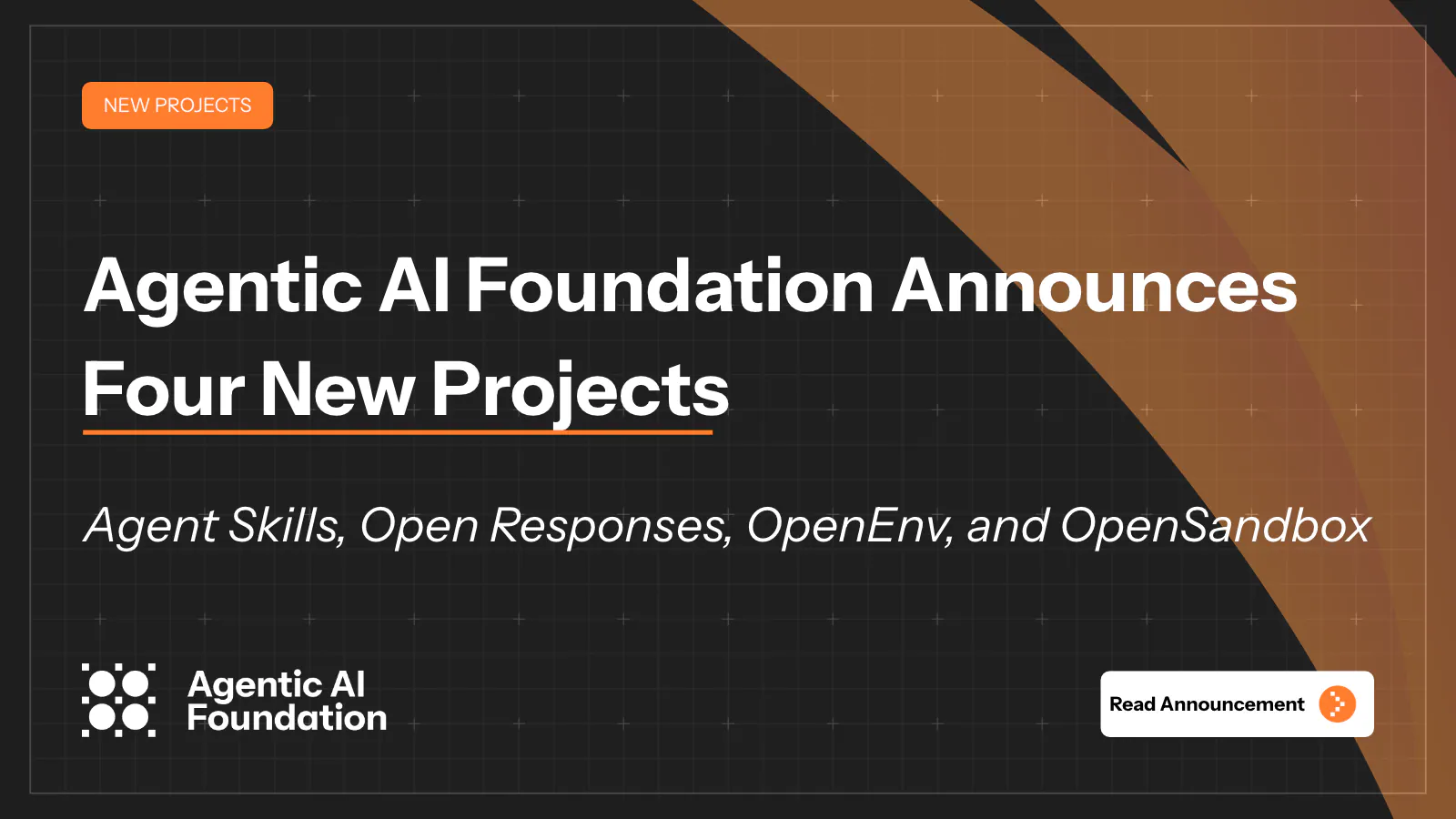
The Linux Foundation's Agentic AI Foundation (AAIF) added four new developer projects on October 22, 2026, bringing its total to ten hosted projects, up from three at its December 2025 launch.
The four additions — Anthropic's Agent Skills, OpenAI's Open Responses, Hugging Face's OpenEnv, and Alibaba's OpenSandbox — target distinct developer problems: packaging reusable task instructions, standardizing multi-provider model APIs, containerizing reinforcement-learning environments, and providing sandbox lifecycle and execution APIs with Docker and Kubernetes runtime backends.
The Linux Foundation’s Agentic AI Foundation (AAIF) added four projects on October 22, 2026: Anthropic’s Agent Skills, OpenAI’s Open Responses, Hugging Face’s OpenEnv, and Alibaba’s OpenSandbox. Announced at AGNTCon + MCPCon North America in San Jose, the additions bring AAIF to ten hosted projects, up from three at its December 2025 launch. All four join under the foundation’s open, vendor-neutral governance. (Linux Foundation announcement)
Each project targets a different developer problem. Agent Skills packages reusable instructions and resources. Open Responses defines a shared interface for talking to models. OpenEnv helps developers build and share reinforcement-learning environments. OpenSandbox provides APIs for creating isolated execution environments and running work inside them.
The useful way to read this announcement is as a map of dependencies an agent application might otherwise handle separately. A team can change its model provider, execution infrastructure, training environment, or reusable task instructions for different reasons. These projects aim to give each of those changes a more stable interface, without requiring developers to adopt one company’s entire agent stack.
Four Projects, Four Developer Jobs
AAIF’s announcement places the additions across capabilities, model interoperability, training, and execution. Here is what that means for a developer deciding where to start. (Project descriptions)
Project
Contributed by
What it standardizes or provides
Concrete developer use case
Agent Skills
Anthropic
An open format for reusable instructions, scripts, and resources
Package a recurring workflow so compatible agents can load its guidance when needed
Open Responses
OpenAI
A model-interface specification with shared schemas, streaming events, and extensible tooling
Build an application’s model integration around a common request-and-response structure
OpenEnv
Hugging Face
A framework and community hub for containerized reinforcement-learning environments
Work with Zeniteq
Promote your app with us
Reach readers exploring AI tools and workflows. Discover sponsorship and advertising options for your app.
Build and share a task environment that agents and training libraries can interact with
OpenSandbox
Alibaba
Sandbox lifecycle and execution APIs, SDKs, and runtime backends
Give a coding agent an isolated workspace to install dependencies, edit files, and run tests
These are complementary projects, but developers should not read the table as a required installation list. A team building a coding assistant might have an immediate need for reusable skills and sandboxed execution, with no reason to build a reinforcement-learning environment.
My view is that selecting a project around a specific integration problem is more useful than treating AAIF membership as a reason to adopt everything. The four additions address different kinds of portability, and their value depends on which dependency is causing friction.
Agent Skills Makes Task Knowledge Reusable
Agent Skills is an open format for packaging instructions, scripts, and resources that agents can load on demand. The foundation describes its purpose as making specialized knowledge portable across agent products and platforms. (Linux Foundation announcement)
Consider a team that repeatedly asks an agent to prepare a software release. The useful knowledge might include a release checklist, a script for generating an artifact, and reference material explaining the required output. A skill can group that material into a reusable package instead of leaving developers to copy instructions into each agent’s setup.
That example illustrates the project’s scope. A skill supplies task knowledge and supporting resources; the agent still needs the tools, permissions, and execution environment required to carry out the work.
The on-demand loading model also matters. It gives an agent a way to obtain specialized guidance for a particular task without making every workflow’s full instructions part of every interaction. The announcement describes this mechanism, but provides no measurements of context savings or task-performance improvements.
I’d evaluate a reusable skill by asking two questions: can another compatible agent load the package, and can it successfully follow the workflow with the tools available to it? The first tests format portability. The second tests whether the surrounding assumptions travel with it. A common package format helps with distribution, while a useful skill still needs clear prerequisites.
Open Responses Targets the Model API Boundary
Open Responses is an open specification based on the OpenAI Responses API. It defines a shared schema, consistent streaming events, and extensible tooling for multi-provider model interfaces. The stated aim is to let developers describe requests and outputs once and use them across providers with minimal translation. (Linux Foundation announcement)
For an application developer, this addresses the code between the product and the model service. That code needs to construct requests, receive outputs, handle incremental events, and represent tool interactions. Provider-specific differences at this boundary can spread through an application if they are not contained.
A shared specification offers a common target for those integrations. Streaming consistency is especially useful because an application may react to events as they arrive, updating an interface or coordinating further work before a complete response is available.
API compatibility and model equivalence remain separate questions. Two models can accept the same request structure while producing different answers, choosing different tools, or handling a long task differently. That follows from the distinction between the interface carrying a request and the model processing it.
For a team considering a provider change, I’d separate the evaluation into two tracks:
Interface compatibility: Can the application send its requests and process the returned events through the shared specification?
Task suitability: Does the candidate model meet the application’s requirements for output quality, latency, tool use, and reliability?
Open Responses targets the first track. Developers still need workload-specific evidence for the second. Its practical promise is a smaller integration rewrite when changing providers, not interchangeable model behavior.
OpenEnv Gives Training Environments a Shared Interface
OpenEnv is a framework and community hub for building reinforcement-learning environments. AAIF describes it as a containerized service exposing both MCP, an interface familiar to agent developers, and Gym, an interface used by training libraries. Its stated goals include making environments easier to build, share, connect, and scale. (AAIF project announcement)
In reinforcement learning, an environment supplies the setting in which an agent acts and receives observations and feedback. The model is only part of the system. Developers also need a task that can be presented consistently and a way to determine how well the agent performed.
A practical example would be a controlled software-maintenance task. An environment could present an agent with a repository and a goal, allow it to make changes, and evaluate the result against defined criteria. This is an illustrative use case, not a task implementation demonstrated in the announcement.
OpenEnv’s two interfaces are consequential because agent applications and training libraries approach an environment from different directions. MCP provides an agent-facing route to interaction, while the Gym interface connects to training workflows. The containerized service supplies a packaged environment around those interactions.
For teams creating internal evaluation tasks, the potential benefit is less custom work connecting each environment to different consumers. The framework does not remove the need to design a meaningful task or scoring method. A portable environment can still reward behavior that fails to match the intended real-world outcome.
That is the distinction I would keep in view: sharing an environment and validating its evaluation design are different jobs. OpenEnv addresses how environments are built and accessed; task designers remain responsible for what success means.
OpenSandbox Separates Execution APIs From Infrastructure
OpenSandbox provides a general-purpose sandbox platform for AI applications, with multi-language SDKs and Docker and Kubernetes runtime backends. Its sandbox protocol defines lifecycle and execution APIs, and the project supports extending the platform with custom runtimes. (Linux Foundation announcement)
AAIF’s accompanying architecture explainer gives the clearest technical example among the four additions: a coding agent that needs to clone a repository, install dependencies, edit files, and run tests. Running those operations directly on a host could expose files or services outside the task. A sandbox provides an isolated workspace with limited host access. (OpenSandbox architecture explainer)
The platform separates two jobs:
Lifecycle operations create, inspect, pause, resume, renew, snapshot, and delete a sandbox.
Execution operations run commands and code, manipulate files, maintain sessions, and collect resource measurements inside it.
This split matters because creating an environment and doing work inside it are different parts of the application’s control flow.
A Coding Task Through OpenSandbox
The architecture explainer describes the following sequence:
The agent, or its coordinating application, requests a sandbox through an SDK.
The lifecycle server validates the request and passes provisioning to the configured runtime service.
The runtime creates a Docker container or Kubernetes workload.
Once the sandbox reaches its running state, the agent sends commands and file operations to an execution daemon called execd.
The agent receives results and resource measurements.
The sandbox is deleted when the work finishes or its expiration time is reached.
Sandbox creation is asynchronous. That is a practical detail for application developers: submitting a creation request is not the same as having a workspace ready to accept commands. The application needs to account for the transition to a running state. (OpenSandbox architecture explainer)
Inside the sandbox, execd handles shell commands, code execution, file and directory operations, persistent shell sessions, and measurements such as CPU and memory use. An agent can use that path to clone a repository, install its dependencies, and run its test suite.
A Common API Does Not Make Runtimes Identical
OpenSandbox uses the same lifecycle interface for its Docker and Kubernetes backends. The Docker backend manages a container directly; the Kubernetes backend creates a workload and associated resources. The agent can use common operations while the backend performs runtime-specific provisioning. (OpenSandbox architecture explainer)
That is a useful separation for teams expecting their infrastructure to change. Agent-side logic can target sandbox operations without directly managing every Docker or Kubernetes detail.
Security still depends on the deployed environment. I’d review filesystem exposure, credentials, network access, resource controls, and cleanup behavior before allowing an agent to execute untrusted work. A shared sandbox API makes those environments easier to request and control; the isolation boundary still needs its own assessment.
The architectural benefit is therefore specific: OpenSandbox can reduce coupling between an agent and the infrastructure that hosts its work. It is not evidence that every supported deployment has the same security properties.
How the Four Projects Could Fit Together
A software-maintenance agent provides a useful way to connect the four roles. This is an architectural example, not an announced integration of all four projects.
Agent Skills could package the team’s maintenance procedure, supporting scripts, and reference material. Open Responses could provide the application’s interface to a compatible model service. OpenSandbox could supply the isolated workspace where the agent changes files and runs tests. OpenEnv could support a separate training or evaluation environment built around related maintenance tasks.
The important observation is that each project covers a different boundary:
If a team changes…
The relevant portability target is…
What still needs checking
Its agent product
The Agent Skills package format
Tool availability and workflow assumptions
Its model provider
The Open Responses interface
Model behavior and workload suitability
Its training setup
The OpenEnv environment interface
Task design and evaluation criteria
Its execution infrastructure
The OpenSandbox APIs
Runtime behavior and deployment security
This is where the announcement has practical significance beyond the project count. Developers often face a chain of dependencies, and changing one can force changes elsewhere. Shared interfaces can help contain those changes to a smaller part of the application.
That containment is the strongest reason to pay attention. It lets teams evaluate competition in the AI industry at a more granular level: a model provider on model suitability, an execution platform on operational requirements, and a reusable workflow on the quality of its instructions.
Neutral Governance Creates a Shared Place to Evolve
The four additions join Agent2Agent (A2A), Agent Router, agentgateway, AGENTS.md, goose, and the Model Context Protocol (MCP) under AAIF. The foundation says all ten operate under its open, vendor-neutral governance. (AAIF announcement)
That puts contributions from Anthropic, OpenAI, Hugging Face, and Alibaba into the same institutional home. For developers, the governance question is consequential because interfaces evolve: fields change, capabilities expand, and implementations encounter requirements their original authors did not anticipate.
A neutral home offers a place for those decisions to involve participants beyond the originating company. The published announcement and OpenSandbox explainer establish the projects’ scope and intended architecture; they do not supply independent measurements of adoption, compatibility, production maturity, or isolation strength.
I’d use that distinction when evaluating the news. AAIF membership is a reason to examine a project’s specification, implementation support, and contribution process. The strongest adoption case will come from a documented interface that removes a real dependency problem in the application being built.
Frequently Asked Questions
3 questions
1
Do Developers Need All Four Projects?
No. They address separate needs: reusable skills, model interfaces, training environments, and sandboxed execution. Start with the project that matches an actual integration problem.
2
Does Open Responses Make Different Models Behave Alike?
No. It defines a shared interface for requests, outputs, streaming events, and tooling. Developers still need to evaluate each model’s behavior on their own workloads.
3
What Is the Difference Between OpenEnv and OpenSandbox?
OpenEnv focuses on environments for reinforcement learning and agent evaluation. OpenSandbox focuses on provisioning and controlling isolated execution environments. Their use cases can overlap, but they standardize different parts of the system.