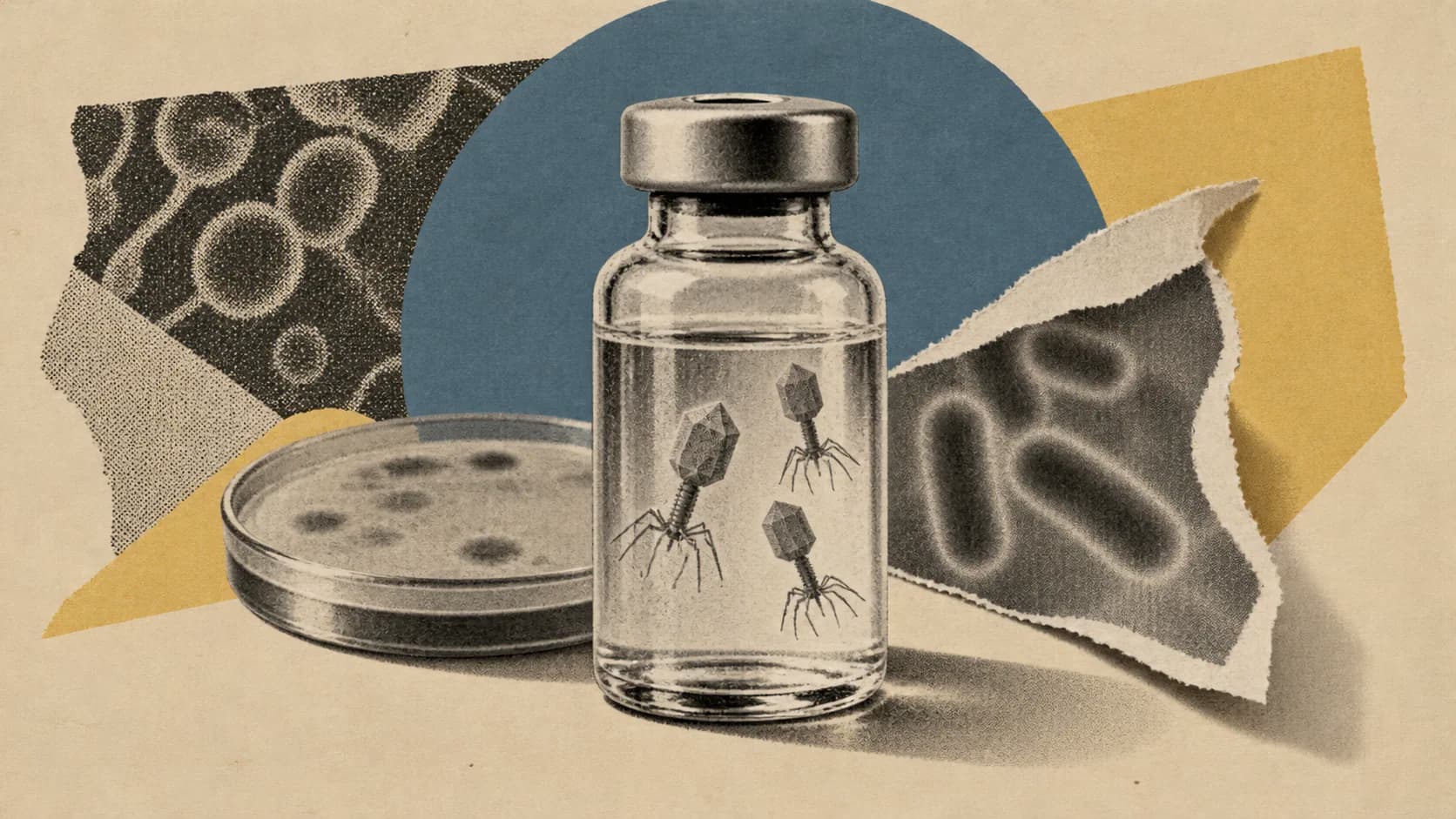
Phages designed with Radical Numerics’ Omnii-1 model were administered to one patient with an antibiotic-resistant bacterial infection, the company says. The intervention took place under an authorized, physician-led compassionate-use pathway. If taken as reported, it marks a consequential step for generative biology: an AI-designed therapeutic candidate moved from computational design and laboratory testing into a human clinical setting.
The company’s October 20, 2026 announcement describes two separate milestones. The designed phage cocktail reportedly eliminated the patient’s bacterial isolate in vitro, meaning in a laboratory experiment. The phages were subsequently administered to the patient. The announcement does not disclose whether the patient improved, whether the infection cleared, or what adverse effects, if any, occurred.
This is a reported translation milestone, not a demonstrated treatment success. Radical Numerics cites patient privacy for withholding the clinical course and outcome, and acknowledges that one case cannot establish safety or efficacy.
The Laboratory Result Is Not a Patient Outcome
Bacteriophages, usually shortened to phages, are viruses that infect bacteria. Phage therapy seeks to use that activity against the bacteria responsible for an infection.
Finding a suitable match is a central challenge. A phage may recognize and infect one bacterial strain while failing against another. Radical Numerics describes this specificity as both the opportunity and the practical difficulty: a highly targeted treatment still needs phages that work against the particular bacteria causing a patient’s infection.
A bacterial isolate is a sample of those bacteria separated for laboratory study. Testing a candidate against it can establish whether the candidate has activity against the target under the tested conditions.
According to the company, its designed cocktail eliminated this patient’s isolate in vitro before administration. That reported experimental result involves the intended bacterial target and provides more information than a model prediction that a sequence might work.
The laboratory experiment does not, however, measure the patient’s response. It cannot by itself establish that the treatment cleared an infection in the body, improved symptoms, or was tolerated safely. The word “eliminated” must therefore remain attached to the laboratory isolate, not to the patient’s infection.
Without knowing what happened after administration, readers cannot distinguish a successful treatment from an unsuccessful intervention or a more complicated course. Privacy explains the company’s decision not to publish those details; it does not supply the missing evidence.
What Omnii-1 Adds to Phage Design
Radical Numerics describes Omnii-1 as a multimodal genome language model pretrained on genomic sequences and multiomics data, then further trained on phage genomes. Its stated role spans generating candidates, prioritizing variants and predicting interactions between phages and bacterial hosts.
The biological challenge extends beyond recognizing a bacterium. As the technical account explains, a phage must attach to a compatible bacterial receptor, deliver its genetic material, overcome bacterial defenses and reproduce. A design that improves one interaction may still fail elsewhere.
The company aims to narrow the experimental search by using a genome model to propose variants worth evaluating in the laboratory. This gives researchers an approach beyond screening existing phage collections or testing random changes.
“AI-designed” does not necessarily mean an entirely new viral genome generated from scratch. Radical Numerics explicitly describes modifying selected regions associated with particular biological functions while retaining the surrounding phage genome.
One example in the announcement concerns T7, a phage that infects E. coli. The company describes using Omnii-1 to generate changes in a region encoding a receptor-binding tail fiber protein, with surrounding genomic sequence providing context. That example illustrates its design method; it should not be read as identifying the organism involved in the undisclosed patient case.

To assess the model’s contribution, the relevant question is whether AI-guided changes help produce useful, experimentally functional candidates against a particular target. Generating more DNA sequences is not itself the therapeutic achievement.
The reported patient administration suggests that at least one design effort progressed beyond a laboratory demonstration. How reliably the system could repeat that process across different infections remains unestablished, as does how much better it performs than other candidate-selection and engineering methods in clinical practice.
Compassionate Use Is Not Broad Approval
Radical Numerics says the intervention took place through an authorized, physician-led compassionate-use pathway. In its account, compassionate use allows people with serious conditions to receive investigational therapies outside clinical trials when satisfactory alternatives are unavailable, subject to the relevant authorities’ oversight and safety requirements.
The company is describing an exceptional use of an investigational intervention. It is not announcing a broadly approved treatment available through routine prescribing.
The public account does not identify the treatment location, administering institution or authorizing regulator. It would therefore be inappropriate to label this an FDA-authorized case, assign it to another jurisdiction, or infer the specific review process.
Authorization for a particular compassionate-use intervention concerns access under a particular set of circumstances. It does not prove that a therapy is safe and effective.
A single case can be informative, especially when documented in detail. It can describe what was administered, how the patient was monitored and what clinicians observed afterward. Even a favorable outcome, though, would not establish that the intervention works reliably or characterize its risks across a wider population.
Interpreting benefit would also require understanding the rest of the patient’s care. A useful clinical report would explain accompanying treatments and the basis for attributing any improvement to the phages. No such attribution can be made from the disclosed laboratory result and administration claim alone.
Sources
- October 20, 2026 announcementradicalnumerics.ai
- research materialsradicalnumerics.ai