
Google is using AI agents to help researchers develop models, but Sundar Pichai says that work remains “pretty far from the end state of RSI,” or recursive self-improvement, according to Business Insider’s October 23 report.
AI contributing to its successors is different from AI independently directing the research needed to improve itself. Pichai’s reported description supports the former. It neither establishes the latter nor supplies a measurable timeline for reaching it.
Pichai Describes Researchers Working With Agents
Pichai made the remarks in an interview with Alex Kantrowitz for the Big Technology Podcast. The interview’s accompanying article, published October 20, 2026, says the conversation was recorded that week at Google’s Mountain View headquarters. The exact recording date is not given. Business Insider published its account three days later.
The publicly accessible interview excerpt discusses AI helping develop future models, but does not include the specific RSI exchange. The relevant quotations therefore come through Business Insider’s reporting, without a directly verified transcript of that portion.
According to that account, Pichai described agents helping AI researchers work together, with some automation, across aspects of model development. He expected that continuum to keep progressing into the following year.
His description is of collaborative research becoming more automated. The assessment that Google remains far from an eventual end state is an executive judgment, not a benchmark result or a forecast with a defined deadline.
AlphaEvolve Shows a Bounded Improvement Loop
Google has published a concrete example of AI improving processes used to build AI. In its May 14, 2025 AlphaEvolve announcement, DeepMind described a Gemini-powered coding agent that proposes algorithms, tests them with automated evaluators and uses an evolutionary framework to develop promising candidates.
Generating code alone does not establish that an algorithm works or improves performance. AlphaEvolve’s evaluators run and score proposed programs against measurable criteria, allowing the system to select useful changes.
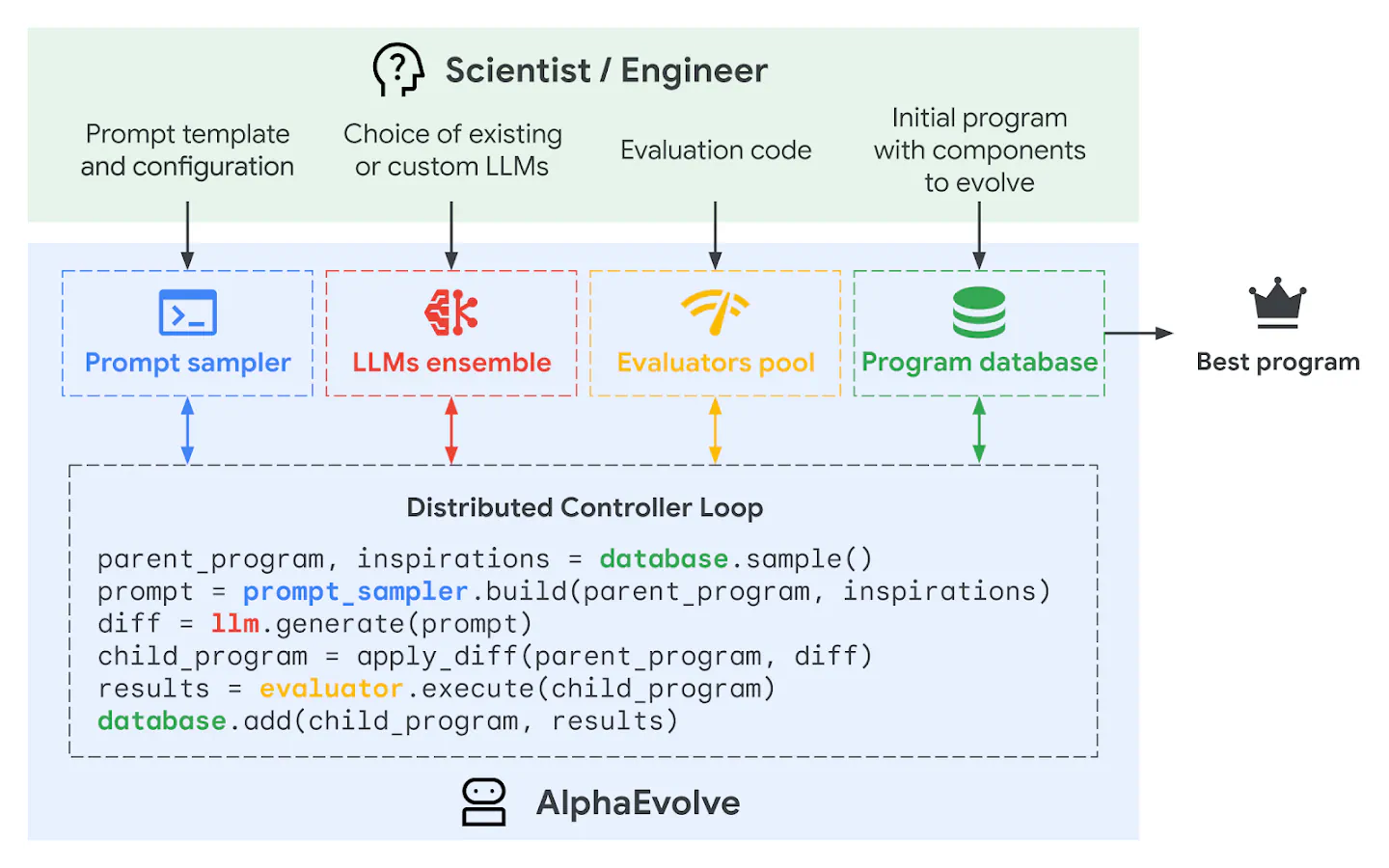
DeepMind said AlphaEvolve improved Google’s AI training processes, including training the language models underlying AlphaEvolve itself. This creates a feedback mechanism: a model-powered system helps improve the computing processes used to train models.
For example, DeepMind said AlphaEvolve sped up a matrix-multiplication kernel in Gemini’s architecture by 23%, producing a 1% reduction in Gemini’s training time. Those figures describe different levels of the system: a substantial improvement to one component translated into a smaller improvement across training as a whole. Neither measures an increase in model intelligence or demonstrates that the system can independently manage its successor’s development.
The results are company-reported evidence, not an independent assessment of Google’s current internal workflow. They illustrate useful AI-driven optimization without establishing autonomous, end-to-end AI research.
Brin’s “RSI Treadmill” Can Fit the Same Picture
Business Insider also reported earlier remarks from Google cofounder Sergey Brin, who described researchers and models working together to produce subsequent models. Brin characterized Google as “starting to get onto that RSI treadmill.”
That language sounds more expansive than Pichai’s caution, but the reported descriptions need not conflict. Brin emphasized the beginning of a feedback process; Pichai emphasized the distance from its eventual endpoint. Both accounts describe researchers working with AI.
Treating those remarks as opposing capability claims would require a shared definition of the milestone each executive meant. The cited material does not provide one.
Comparing the workflows they describe is more useful than comparing the optimism of their phrasing. Neither reported account establishes that people have stopped directing the research process.
The Missing Measure Is Research Autonomy
How much of model development can proceed without researchers supplying direction, checking results or deciding what happens next? That remains the central unanswered question.
Evidence of autonomous end-to-end improvement would need to address a wider chain of activities than generating useful code: choosing research objectives, designing experiments, interpreting outcomes, integrating changes and validating a successor model. This is an analytical distinction, not a claim that Google has published a formal autonomy threshold.
The cited accounts provide no independent measurement of that chain. AlphaEvolve documents a bounded optimization process; Pichai describes agents collaborating with researchers. Neither establishes an acceleration rate for successive model generations or a date when human involvement becomes unnecessary.