Fal AI's "H3 Max Live" Makes Real-Time Video Generation Possible
Fal’s chat-directed experiment turns short H3 Max clips into an endless broadcast, but the real-time claim needs careful interpretation.
Last updated on
AI Summary
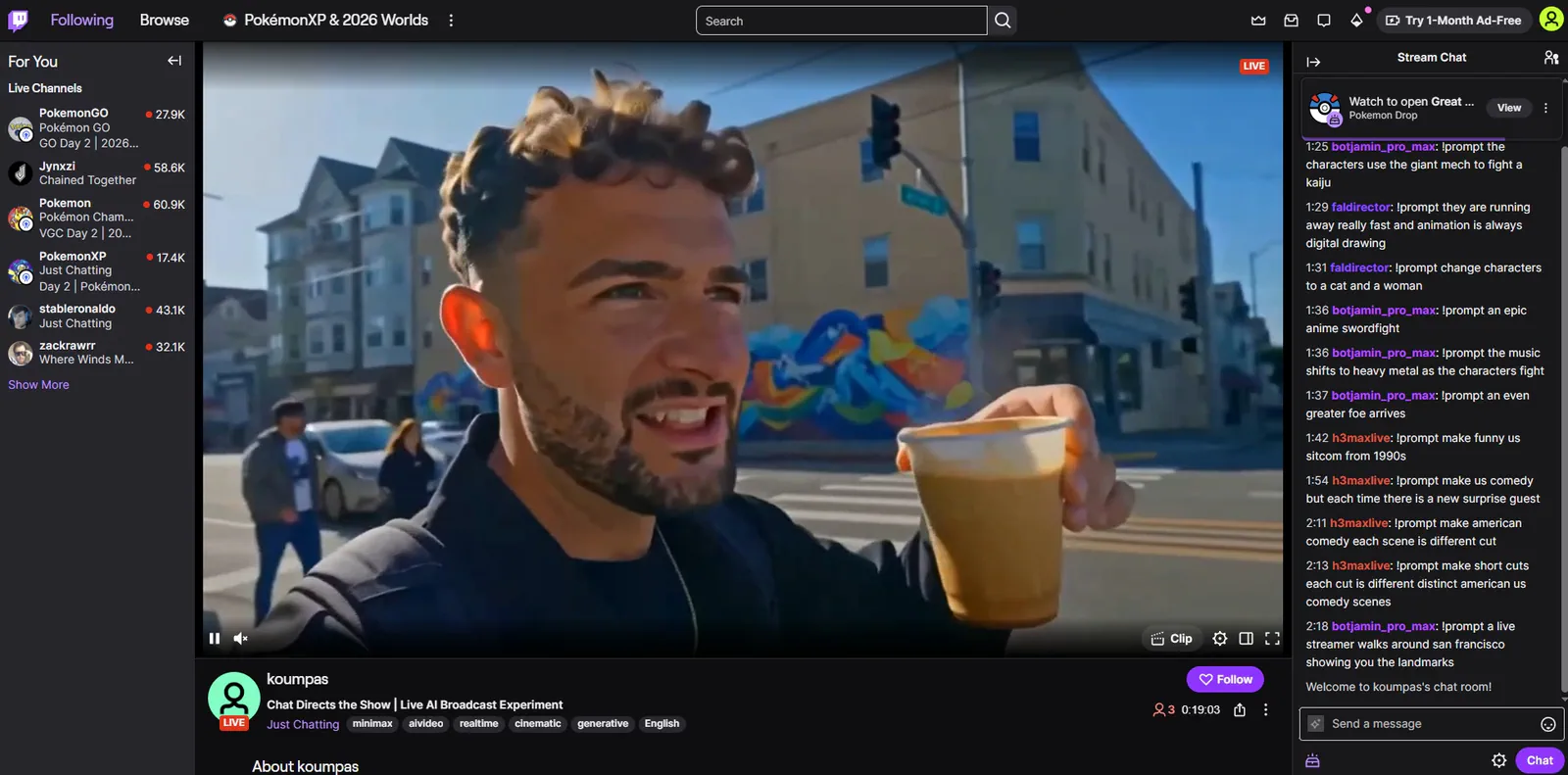
Fal demonstrated H3 Max Live, a chat-directed AI video stream that generates short clips faster than playback and queues them into an apparently endless broadcast.
Viewers use the !prompt command to choose upcoming scenes without interrupting the channel. Launched August 27, H3 Max is a post-trained MiniMax H3 variant that generates five seconds of 768p video in under three seconds, with backend inference around 2.5 seconds; 15-second clips take roughly 15 seconds. It supports text-to-video, image-to-video, and synchronized audio. Fal’s available API returns completed clips lasting five to 15 seconds, suggesting Live orchestrates sequential segments rather than producing one continuous generation.
The key questions are whether Fal can maintain continuity, moderate prompts, handle failures, and control costs. At $0.04 per generated second during the introductory discount, a continuous hour costs about $144, rising to $288 at the standard $0.08 rate before infrastructure and delivery expenses.
Fal has demonstrated an AI video stream that viewers can direct through chat. Type !prompt, describe the next scene, and H3 Max generates it for an “infinite broadcast” without stopping the channel or sending viewers to a progress screen.
The experiment follows the August 27 launch of H3 Max, a post-trained MiniMax H3 variant that fal says can render five seconds of 768p video in under three seconds. That speed creates a practical possibility that slower video models cannot offer: generating the next segment while the audience is still watching the current one.
This does not yet amount to a persistent, infinitely coherent AI world. It does show how video generation changes when rendering becomes faster than playback. Instead of requesting isolated clips, users can begin directing an active channel.
The Broadcast Turns Prompts Into a Continuous Stream
Fal presents H3 Max Live as an endless feed in which every frame is generated on the fly and scenes are selected through chat. A viewer can enter an instruction using the !prompt command, and the requested idea appears in the broadcast within seconds.
The public demonstration turns prompting into a shared experience. People are not separately generating files, downloading them, and deciding what to do next. Their instructions become part of a running program that others can watch, much like an audience-controlled television channel.
Fal has not published a detailed architecture for the Live system or released it as a separate documented endpoint. The available H3 Max API returns completed clips lasting between five and 15 seconds. The most defensible interpretation is that the broadcast generates and queues short segments, then plays them sequentially while new requests are processed. It is “infinite” at the application level, rather than one unbroken model generation.
That distinction matters. A queued clip system must handle transitions, audience voting, prompt moderation, generation failures, and visual continuity between requests. Fast inference solves the waiting problem, but orchestration is what makes the result feel like a live channel.
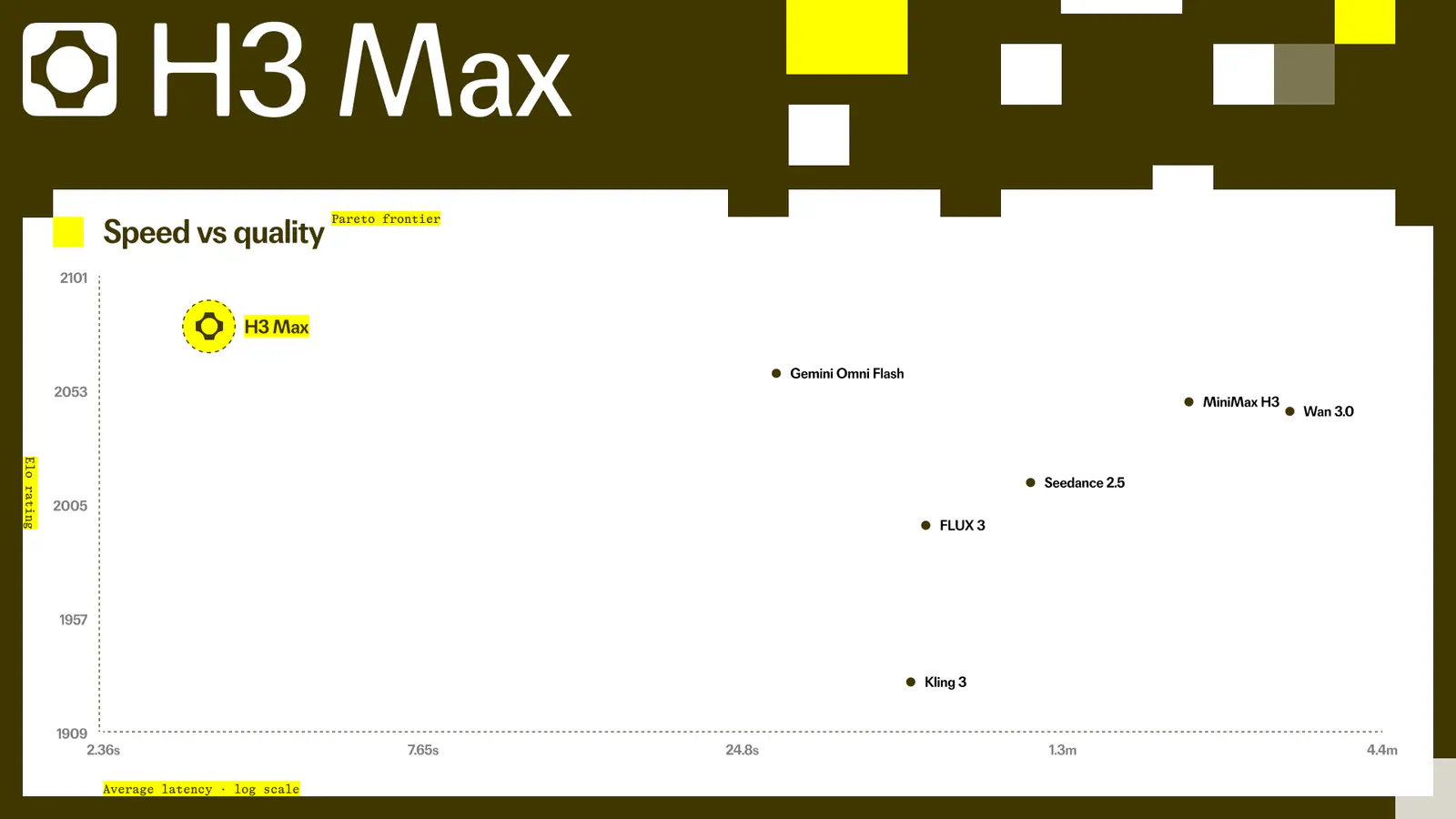
Fal reports that a five-second 768p H3 Max clip takes approximately three seconds to generate, with backend inference around 2.5 seconds under its documented settings. The company describes that as roughly 35 times the throughput of MiniMax’s official H3 endpoint.
Once generation takes less time than playback, an application can maintain a rolling buffer. While viewers watch one five-second scene, the system has enough time to render the next scene and potentially begin another. That surplus makes interruptions less likely and gives the service time to reject unsafe prompts or recover from failed generations.
“Faster than real time” should not be confused with zero latency. Prompt expansion, queueing, safety checks, file transfer, and player buffering all contribute to the delay users experience. Fal’s documentation also says a 15-second generation takes around 15 seconds, so the clearest speed advantage applies to short clips. A live service can work around that limitation by generating compact segments and staying ahead of playback.
H3 Max Is Also an Inference Engineering Project
H3 Max is not an entirely new foundation model. Fal started with the open-weight MiniMax H3 model and added post-training data focused on prompt adherence and visual quality. Its research and inference teams then optimized the serving system alongside the model rather than deploying the finished weights through a generic video pipeline.
That co-design is central to the result. Video models can often be accelerated by reducing precision, cutting sampling steps, or approximating expensive operations, but those techniques may weaken motion, detail, or instruction following. Fal says it retained only optimizations that preserved H3 Max’s position in its internal quality evaluations.
The model produces 480p or 768p video, supports text-to-video and image-to-video generation, and can create synchronized audio in the same pass. Standard MiniMax H3 remains the better fit for applications needing 2K output, reference-video generation, or video editing. H3 Max is optimized around fast, prompt-responsive clips.
Fal evaluated H3 Max against 12 video models using head-to-head human preferences. Evaluators judged overall preference, prompt understanding, and aesthetics, with results aggregated through Bayesian Elo ratings and 95% confidence intervals. Fal reports that H3 Max finished first in all three internal categories.
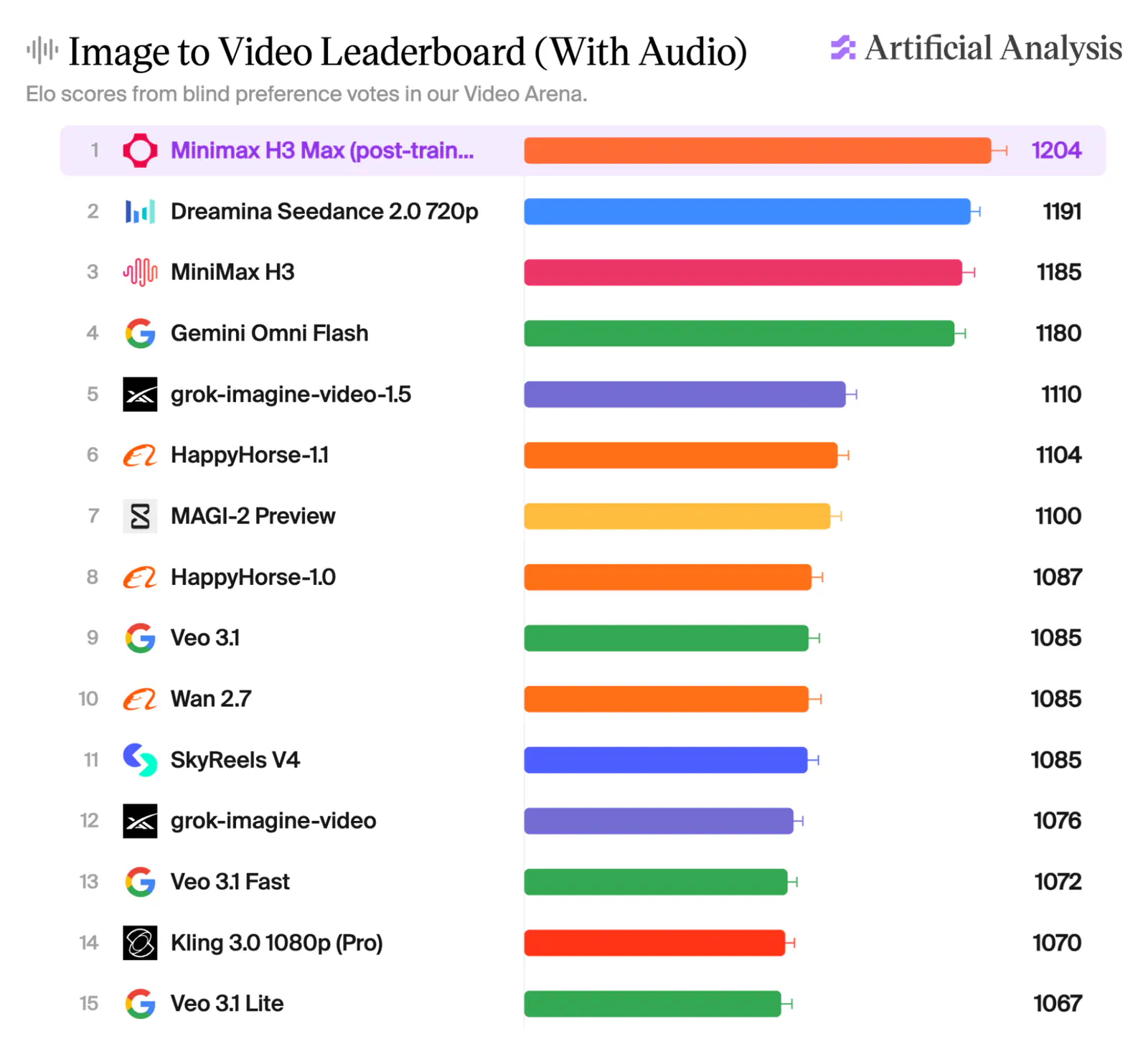
Public leaderboards provide some outside support. As of August 30, 2026, Design Arena’s image-to-video leaderboard places H3 Max first, while Artificial Analysis ranks it first on its image-to-video board with audio under the name MiniMax H3 Turbo.
Those results support the argument that fal did not obtain its speed by simply discarding quality. They do not prove that H3 Max can preserve a character, location, or storyline across hundreds of separately generated scenes. Clip-level preference benchmarks and long-running broadcast consistency are different tests. An audience-directed stream may make continuity failures more visible because every new prompt can abruptly change the subject, style, camera, and setting.
An Infinite AI Channel Still Has Practical Limits
Interactive fiction, live music visuals, game-world broadcasts, event backdrops, and audience-controlled animation are obvious applications. The important shift is that AI video can respond during a session instead of becoming something creators generate and edit beforehand.
The economics are less magical. As of August 30, fal’s introductory 768p price is $0.04 per generated second, compared with the standard rate of $0.08. A continuously generated hour would therefore cost about $144 at the promotional rate or $288 at standard pricing, before retries, application infrastructure, moderation, and delivery costs.
Developers can reduce that bill by generating only when viewers submit prompts, reusing successful scenes, lowering the active frame area, or mixing generated segments with conventional content. The complete H3 Max Live broadcast layer does not appear to be a packaged product yet, but the underlying text-to-video and image-to-video endpoints are available through fal’s API.
Final Thoughts
Fal’s demo is important because it moves AI video generation behind the playback experience. The audience no longer has to submit a job and wait for a finished asset. It can direct a channel that continues running while the model works ahead.
Raw speed is only the first requirement for that medium. Persistent characters, smooth transitions, predictable costs, prompt moderation, and reliable scene memory will determine whether infinite broadcasts become useful products or remain impressive demonstrations. H3 Max appears fast enough to cross the playback threshold; the harder task is making an endless stream worth continuing to watch.
Frequently Asked Questions
3 questions
1
What is Fal H3 Max Live?
Fal H3 Max Live is an experimental AI video broadcast directed through chat prompts. Viewers type !prompt followed by a scene description, and the system adds generated H3 Max footage to the running stream. Fal has demonstrated the interface publicly, although it has not documented Live as a separate commercial product or API.
2
Is H3 Max really faster than real time?
H3 Max is faster than playback when generating short clips under fal’s reported settings. A five-second 768p video takes under three seconds, with backend inference averaging roughly 2.5 seconds. Longer requests do not necessarily maintain that ratio: fal says a 15-second clip takes around 15 seconds to generate.
3
How much would a continuous H3 Max stream cost?
A continuous hour of 768p H3 Max video would cost about $288 at fal’s standard rate of $0.08 per generated second. The introductory 50% discount reduces that estimate to $144 per hour. These figures exclude failed generations, moderation, storage, streaming bandwidth, and the infrastructure needed to manage prompts and queue scenes.