
Alibaba’s Qwen team released Qwen3.8-Max-0902 on September 2, 2026, as an upgraded snapshot of its largest hosted AI model. The architecture and one-million-token context window remain familiar, but additional post-training targets coding, collaborative agent work, and long-horizon tasks that require multiple tools and several stages of execution.
The official Qwen3.8-Max-0902 model page describes improvements in engineering-scale development, end-to-end task delivery, chart reasoning, document parsing, and multimodal perception. Alibaba’s launch post extends that positioning to complex enterprise tasks and scientific research.
The stronger claims deserve some separation from the headline specifications. Qwen3.8-Max-0902 has 2.4 trillion total parameters, but it does not activate all of them for every token. Its million-token capacity is valuable for large codebases and document collections, but context size alone does not guarantee accurate retrieval or reliable execution. Early external results support the coding improvement, although broader enterprise and scientific performance remains less well documented.
The Upgrade Changes Behavior, Not the Base Architecture
Qwen3.8-Max-0902 is a post-training update rather than a new foundation model. It retains the scale, context capacity, reasoning mode, multimodal inputs, and hosted tool ecosystem of Qwen3.8-Max. The change is intended to improve how the model applies those capabilities to difficult, multi-stage work.
Qwen highlights three areas:
- Engineering-scale coding: Working on larger projects, producing complete applications, and maintaining progress through longer development tasks.
- Collaborative agent work: Coordinating several tools, managing intermediate steps, and carrying tasks through to a final deliverable.
- Multimodal understanding: Reading charts, parsing documents, and reasoning over images or video alongside text.
That focus is sensible. For enterprise AI, the practical bottleneck is often not whether an LLM can answer a single difficult question. It is whether the model can preserve requirements, use the correct tools, detect errors, and continue working after an intermediate result changes the plan.
“Coding & Cowork” is Qwen’s concise label for this post-training direction, not a technical description of the training recipe. Alibaba has not published a detailed breakdown of the datasets, reinforcement-learning environments, or task distributions used for the 0902 update. The public evidence currently tells us more about the intended behavior than the exact method used to produce it.
4 Trillion Parameters Does Not Mean Dense Compute
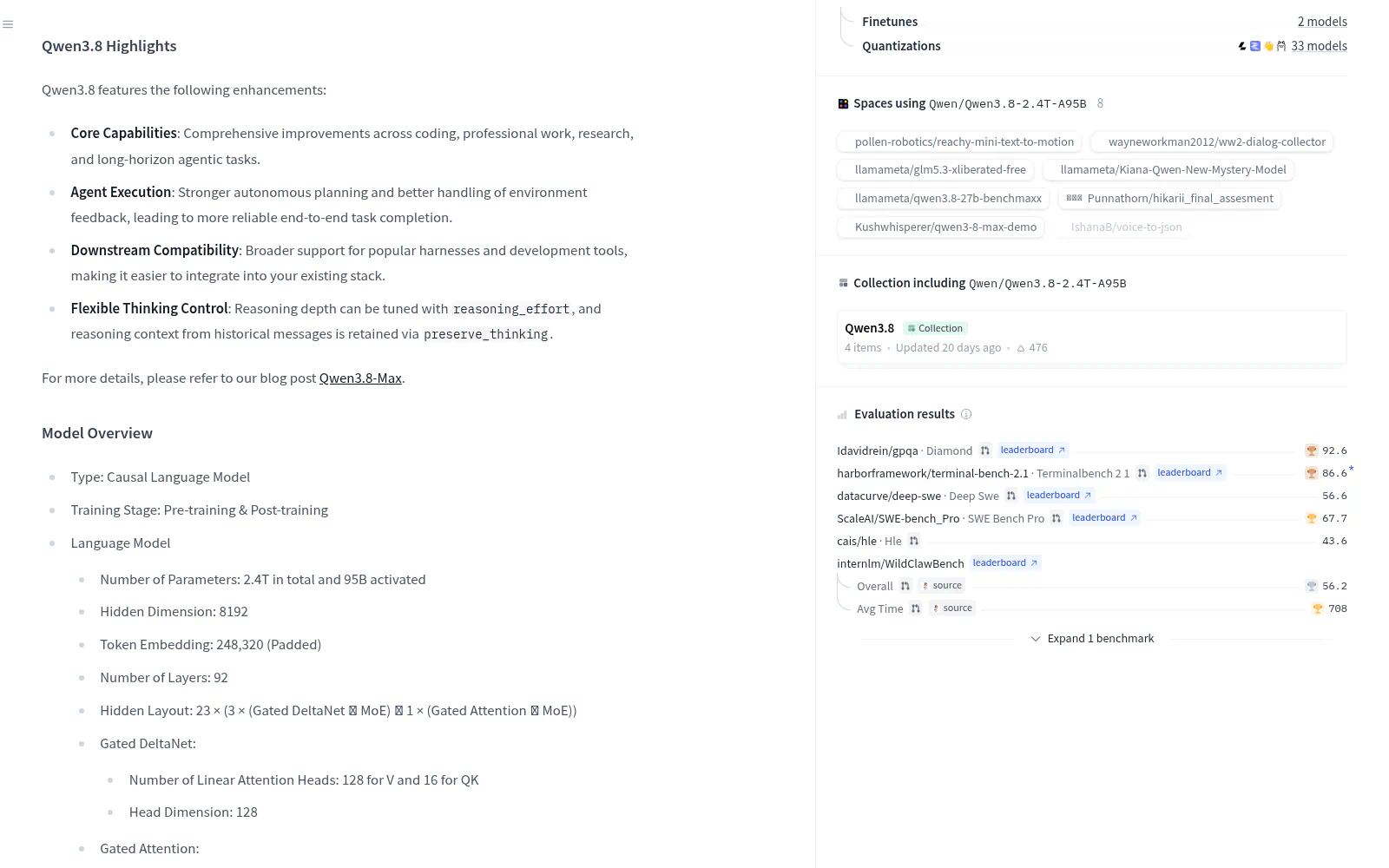
Screenshot: Qwen/Qwen3.8-2.4T-A95B · Hugging Face.
Qwen3.8 uses a Mixture-of-Experts, or MoE, architecture. Its 2.4 trillion parameters represent the model’s total capacity, while approximately 95 billion parameters activate for each token.
The Qwen3.8-2.4T-A95B model card lists 512 experts, with 10 routed experts and one shared expert used per token. A routing system selects the relevant experts as the model processes each piece of input. This gives Qwen access to far more total capacity than a 95-billion-parameter dense model without requiring all 2.4 trillion parameters to participate in every computation.
That distinction matters when comparing LLMs. A 2.4-trillion-parameter MoE should not be interpreted as having the same per-token compute profile as a dense model of equal size. Total parameters describe capacity distributed across experts, while activated parameters provide a better indication of the work performed during inference.
There is also an important open-weights distinction. Alibaba released the underlying Qwen3.8-2.4T-A95B weights, allowing developers with suitable infrastructure to deploy and modify the base post-trained model. Qwen3.8-Max adds managed inference, native vision input, non-thinking operation, built-in tools, and a default one-million-token context window.
As of September 2, Qwen documents the 0902 upgrade as a QwenCloud snapshot rather than a separately downloadable open-weights checkpoint. Developers therefore have access to open Qwen3.8 weights, but should not assume that the exact Qwen3.8-Max-0902 behavior is available for local deployment.
A 1M Context Window Helps, but It Is Not Memory
The underlying open-weight Qwen3.8 model natively supports 262,144 tokens and can be extended to roughly 1.01 million tokens using YaRN context scaling. The hosted Qwen3.8-Max service provides the million-token context configuration by default.
That capacity can accommodate substantial material in one request, including:
- Multiple software repositories and related documentation
- Long research papers, appendices, and supporting datasets
- Contracts, policies, and enterprise knowledge bases
- Extended agent histories and tool results
- Large collections of charts, screenshots, and technical documents
A large context window reduces how aggressively developers must split or summarize information. It can also help an agent maintain continuity when a workflow produces many intermediate artifacts.
It does not give the model perfect memory. Important details can still be overlooked, conflicting instructions can interfere with one another, and supplying more material can make evidence selection harder. Long-context evaluations should measure whether the model retrieves the correct passage, cites it accurately, and applies it consistently, not merely whether the API accepts the tokens.
The same caution applies to scientific research. A million-token input can hold many papers, but capacity is not evidence of scientific validity. Citation accuracy, numerical verification, methodological reasoning, and reproducibility require separate evaluation. Qwen has not yet published a dedicated 0902 benchmark package demonstrating those capabilities across scientific disciplines.
The Coding Gain Has Early External Support
The clearest external signal comes from the Code Arena WebDev leaderboard, which evaluates AI models through comparative voting on generated web-development results.
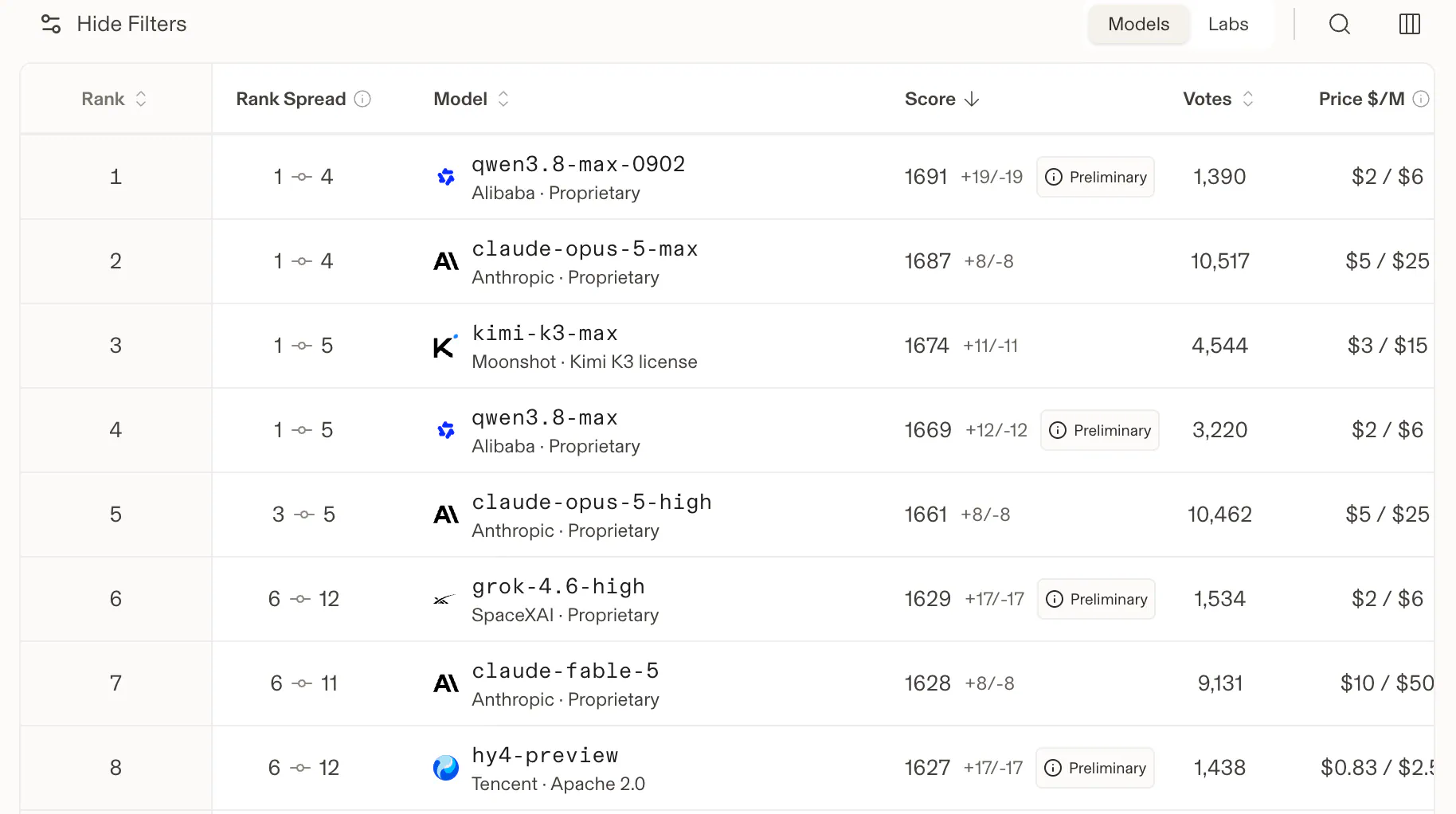
As of September 2, Qwen3.8-Max-0902 has a score of 1691 ±19, compared with 1669 ±16 for the previous Qwen3.8-Max. The new model appears near the top of the overall leaderboard with a preliminary rank range of first through fourth.
The 22-point difference is encouraging, but it is not definitive. The confidence intervals overlap, the new result is marked preliminary, and rankings can change as more votes arrive. Code Arena also concentrates on web-development output. It does not measure every part of repository maintenance, backend engineering, tool recovery, scientific analysis, or enterprise workflow execution.
The result nevertheless provides independent support for Qwen’s central claim: additional post-training appears to have improved coding behavior without changing the model’s underlying parameter count or context capacity. It is stronger evidence than a vendor-selected benchmark alone, while still being too narrow to validate every use case named in the announcement.
QwenCloud Pricing Rewards Reused Context
QwenCloud prices Qwen3.8-Max-0902 aggressively for a frontier-scale hosted model:
| Token category | Price per 1M tokens |
|---|---|
| Standard input | $2.00 |
| Output | $6.00 |
| Explicit cache creation | $2.50 |
| Explicit cache hit | $0.17 |
| Implicit cache hit | $0.25 |
These rates apply to the hosted model and should not be confused with the infrastructure cost of running the open-weight Qwen3.8 model independently.
A request containing one million uncached input tokens and 100,000 output tokens would cost approximately $2.60. If a later request reused 800,000 explicitly cached tokens, added 200,000 uncached tokens, and generated the same 100,000-token output, that subsequent request would cost about $1.14, after the cache had already been created.
The low cache-read price is particularly relevant to agent systems. A coding agent might repeatedly reuse repository documentation, architectural instructions, API specifications, and shared source files while changing only the current task and recent tool results.
Caching is not automatic cost elimination, however. The QwenCloud prefix-caching documentation says cache hits depend on matching prompt prefixes and model configuration. Implicit caching requires an identical prefix of at least 1,024 tokens. Explicit caches carry a creation charge and normally expire after five minutes, although a successful hit resets that window.
Teams expecting the $0.17 rate throughout a workflow will need to structure prompts deliberately. Frequently changing system instructions, tool definitions, or early conversation content can prevent the stable prefix required for a cache hit.
The API Is Ready, but Production Claims Need Testing
Qwen3.8-Max-0902 is available through QwenCloud’s OpenAI-compatible Chat Completions API. The service accepts text, image, and video inputs, returns text, and supports both thinking and non-thinking operation. QwenCloud also exposes built-in capabilities such as code execution, web search, web extraction, and image search.
Developers can pin requests to qwen3.8-max-0902 or its dated identifier, qwen3.8-max-2026-09-02. The moving qwen3.8-max alias now points to the September 2 snapshot, according to QwenCloud’s model-version table. Production systems that require reproducible behavior should generally use a pinned snapshot and upgrade only after evaluation.
The most useful tests will depend on the intended workload:
- Repository-scale correctness: Whether large changes compile, pass tests, and preserve unrelated behavior.
- Tool-failure recovery: Whether the model can revise its plan after a timeout, invalid result, or failed command.
- Long-context traceability: Whether answers point back to the correct document, file, or experimental result.
- Instruction retention: Whether requirements established early in a long session remain active.
- Cache efficiency: Whether real prompt structures produce the expected explicit or implicit cache-hit rate.
- Cost and latency: Whether million-token requests remain practical under production traffic.
These evaluations matter more than asking whether the model can ingest a large prompt. Qwen3.8-Max-0902 is marketed for long-horizon work, so the relevant measure is sustained correctness across the entire workflow.
Final Thoughts
Qwen3.8-Max-0902 is more interesting as a behavioral upgrade than as a specifications story. Alibaba has not increased the model’s headline parameter count or context window. It has attempted to extract better coding, tool use, and agent coordination from an existing 2.4-trillion-parameter MoE.
The early Code Arena result supports the coding claim, and the combination of a million-token context window with $0.17-per-million explicit cache reads could make repeated, context-heavy agent workflows comparatively economical. The evidence is thinner for enterprise and scientific research, where Qwen has not yet supplied detailed 0902-specific evaluations.
For now, Qwen3.8-Max-0902 looks like a credible improvement for developers willing to test it against real repositories and multi-tool tasks. It does not prove that million-token autonomous work has been solved, but it gives Qwen a stronger hosted model for finding out.
Frequently Asked Questions
5 questions
1What is Qwen3.8-Max-0902?
Qwen3.8-Max-0902 is a September 2, 2026 snapshot of Alibaba’s hosted Qwen3.8-Max AI model. It retains the 2.4-trillion-parameter MoE architecture and one-million-token context window while adding post-training intended to improve coding, collaborative agent work, multimodal understanding, and long-horizon task execution.
2
Sources
- official Qwen3.8-Max-0902 model pageqwencloud.com
- https://x.com/Alibaba_Qwen/status/2094968708288680276x.com
- Qwen/Qwen3.8-2.4T-A95B · Hugging Facehuggingface.co
- Qwen3.8-2.4T-A95B weightsgithub.com
- Code Arena WebDev leaderboardarena.ai
- QwenCloud prefix-caching documentationqwencloud.com
- QwenCloud’s model-version tableqwencloud.com


