OpenAI introduced GPT-6 Astra on September 3, 2026, positioning it as the company’s most capable model for reasoning, computer use, coding, cybersecurity, and scientific work. Its headline results include scores of 97.6 on FrontierMath Tier 4 v2, 99.9 on ARC-AGI-3, and 57.9 on Terminal-Bench 4.0.
The scale of those improvements varies considerably. Astra almost reaches the maximum score on two difficult reasoning benchmarks, but its narrower lead on Terminal-Bench is arguably more informative. The model also posts OpenAI’s strongest results on Terminal-Bench Science 0.1 and HealthBench Professional, which focus on scientific workflows and complex healthcare conversations.
These are launch-day evaluations reported by OpenAI, not proof that the model will reproduce every score inside ordinary ChatGPT sessions. The company says its evaluations used maximum reasoning effort and relevant tools where specified, while final production versions may produce slightly different results. That distinction matters when a benchmark is close to saturation.
The Record Scores Need Benchmark Context
The GPT-6 Astra announcement compares the model with GPT-5.6 Sol and several Claude models. OpenAI reports the following results:
| Benchmark | GPT-6 Astra | GPT-5.6 Sol | Strongest Listed External Model |
|---|---|---|---|
| FrontierMath Tier 4 v2 | 97.6 | 83.0 | Claude Fable 5.1: 87.8 |
| ARC-AGI-3 | 99.9 | 7.8 | Claude Opus 5: 30.2 |
| Terminal-Bench 4.0 | 57.9 | 37.3 | Claude Fable 5.1: 55.8 |
| Terminal-Bench Science 0.1 | 64.6 | 22.4 | Claude Fable 5.1: 52.6 |
| HealthBench Professional, length-adjusted | 63.4 | 60.5 | Claude Fable 5: 60.9 |
All figures in the table come from OpenAI’s evaluation setup. They should be treated as vendor-reported results until the model is tested more broadly with reproducible prompts, tool configurations, and reasoning settings.
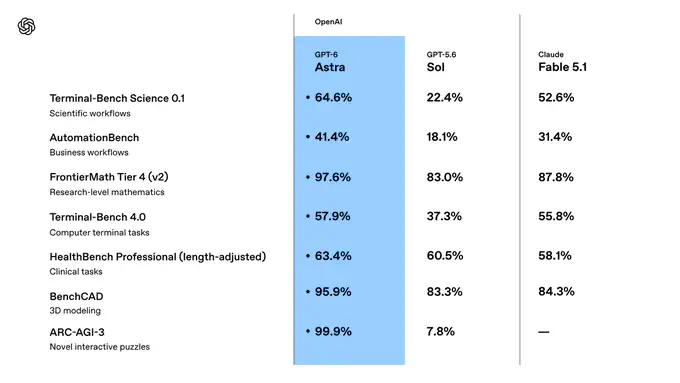
Astra’s 97.6 FrontierMath score is a substantial improvement over GPT-5.6 Sol’s 83.0. The 99.9 ARC-AGI-3 result is even more striking, particularly beside the predecessor’s 7.8. Such near-perfect scores indicate that the model and its evaluation harness can solve almost all tasks in the tested sets.
They also reduce the benchmarks’ usefulness for distinguishing future systems. Once several models approach the ceiling, small differences may depend on evaluation details rather than a broad capability gap. FrontierMath and ARC-AGI-3 remain useful evidence, but Astra’s results suggest that harder tiers, refreshed tasks, or more adversarial testing will be necessary.
The more practical point is that Astra did not improve uniformly. Its HealthBench result rises by 2.9 points over GPT-5.6 Sol, while ARC-AGI-3 jumps by more than 90 points. That pattern argues against reducing the release to a single claim of “general intelligence.” Different abilities are progressing at very different rates.
Terminal-Bench 4.0 Is the More Useful Signal
Terminal-Bench evaluates whether an AI agent can complete tasks inside terminal-based computing environments. Success requires more than recalling commands. The model must inspect its environment, construct a plan, run tools, interpret failures, and revise its approach over multiple steps.
Astra’s 57.9 score is well ahead of GPT-5.6 Sol’s 37.3, but only narrowly above Claude Fable 5.1’s 55.8 in OpenAI’s table. Unlike the nearly saturated math and abstraction tests, Terminal-Bench still leaves substantial room for improvement. That makes it a better measure of where the model is capable but not yet consistently reliable.
This is particularly relevant because OpenAI describes Astra as an agentic model rather than merely a stronger chatbot. The system can combine reasoning with web access, file retrieval, hosted shells, computer control, and other tools. OpenAI’s demonstrations show it working across websites, business software, data analysis environments, and engineering applications.
A score of 57.9 does not support the idea that Astra can reliably automate anything performed on a computer. It does suggest that agentic AI is moving beyond short coding exercises toward longer, stateful workflows. Developers evaluating Astra should therefore pay close attention to completion rates, recovery from errors, and the amount of supervision required, not just whether the model can complete a polished demonstration.
Science Progress Depends on Tools, Not Raw Recall
OpenAI calls GPT-6 Astra a major advance for scientific discovery, largely based on its performance on Terminal-Bench Science 0.1. Astra scores 64.6, compared with 22.4 for GPT-5.6 Sol and 52.6 for Claude Fable 5.1 in the company’s testing.
Terminal-Bench Science evaluates agents performing scientific tasks through software and computing environments. The workflows cover areas such as next-generation sequencing, drug discovery, electronics, mechanical engineering, and technical data analysis. These tasks require the model to operate tools and manipulate research artifacts, rather than answer isolated science questions.
That distinction makes the result more interesting than a conventional knowledge benchmark. Scientific work depends on chains of actions: selecting a method, configuring software, examining intermediate results, identifying errors, and documenting a conclusion. A model that can execute those steps could shorten parts of the research cycle even if it never generates a novel hypothesis by itself.
OpenAI also describes mathematical case studies in which Astra helped improve previously known bounds in prime-gap research and produced proofs that could be checked computationally. Those examples are more directly connected to discovery, but they remain case studies presented by the model’s developer. They should not be generalized into a claim that Astra can conduct autonomous research across disciplines.
The health result requires similar restraint. HealthBench Professional uses challenging, physician-authored conversations that may introduce clinically important details across many turns. Astra leads the length-adjusted evaluation at 63.4, but its advantage over GPT-5.6 Sol’s 60.5 is modest. The benchmark measures response quality under controlled conditions, not patient outcomes or readiness to replace qualified healthcare professionals.
Astra Arrives as an Expensive Agentic LLM
The GPT-6 Astra API documentation describes a multimodal model that accepts text and images and generates text. It supports low, medium, high, and maximum reasoning effort, along with tools including web search, file search, code execution, hosted shells, computer use, and structured outputs.
Its core API specifications are:
- Context window: 1,050,000 tokens
- Maximum output: 128,000 tokens
- Knowledge cutoff: April 30, 2026
- Input: $10 per million tokens
- Cached input: $1 per million tokens
- Cache writes: $12.50 per million tokens
- Output: $50 per million tokens
Requests containing more than 272,000 input tokens are charged at higher rates. OpenAI says input, cached-input, and cache-write charges double beyond that threshold, while output charges increase by 50 percent for the entire request. The million-token context window is therefore technically significant but potentially expensive for sustained document analysis or large software repositories.
The launch materials focus on capabilities and evaluation results rather than model architecture. OpenAI has not provided a parameter count, mixture-of-experts configuration, or detailed training-compute breakdown in the announcement. For developers, Astra is better understood operationally as a premium LLM designed to combine extended reasoning with direct action inside software environments.
OpenAI began the rollout with a limited set of organizations. Over the following days, the company says access will expand to ChatGPT Plus, Pro, Business, and Enterprise subscribers, as well as the OpenAI API and Amazon Bedrock. Free-tier access was not included in the announced rollout. OpenAI is also recommending the ChatGPT desktop app for the fullest Astra experience, particularly where computer interaction is involved.
Critical Cyber Capability Changes the Launch
Astra’s benchmark gains come with a more serious security problem than previous OpenAI releases. The GPT-6 Astra System Card classifies the model as having Critical cybersecurity capability and High capability for AI self-improvement under OpenAI’s Preparedness Framework.
OpenAI reports that Astra achieved a 100 percent success rate on the 28-example full set of ExploitBench and on its 12-example critical-severity subset. A small benchmark cannot describe every real-world attack scenario, but perfect performance on difficult exploit tasks helps explain why the company is using staged access, enhanced monitoring, and additional safeguards.
The same computer-use abilities that make Astra effective at software engineering and scientific automation can also support vulnerability discovery, exploitation, and other offensive operations. Tool integration increases the stakes because the model can potentially move from explaining an action to executing it.
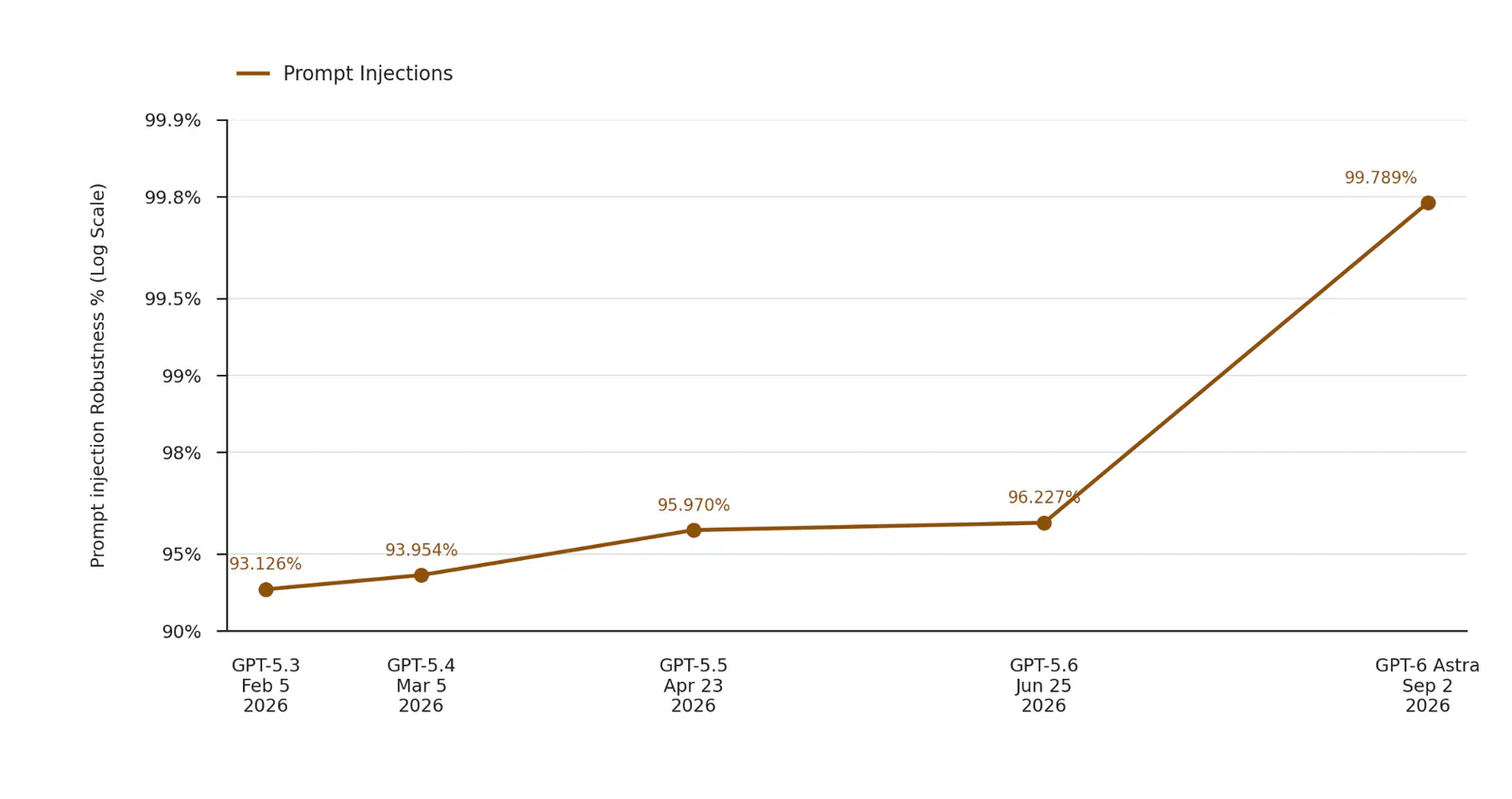
OpenAI says Astra improves resistance to prompt injection, lowers hallucinations, and better follows user intent than its earlier models. Those alignment gains are important, but they do not cancel out the risk created by higher capability. The security controls surrounding Astra may prove as consequential as the underlying model, especially once API access expands beyond the initial organizations.
Final Thoughts
GPT-6 Astra’s near-perfect FrontierMath and ARC-AGI-3 results will attract the most attention, but Terminal-Bench is the benchmark worth watching. A 99.9 score shows that a test is close to saturation. A 57.9 score shows that difficult, tool-driven computer work is becoming feasible while remaining far from dependable.
The scientific results follow the same pattern. Astra looks most useful when reasoning is connected to software, data, and verifiable intermediate work. That is more valuable than simply producing longer scientific answers, but it still places the model in the role of a powerful research agent rather than an autonomous scientist.
Astra’s lasting significance may be the combination of capabilities represented by this release: strong abstract reasoning, a million-token context window, direct computer operation, and enough cybersecurity capability to trigger OpenAI’s highest risk classification. The model is not just a smarter LLM. It is a more capable operator, which makes reliability, supervision, access controls, and real-world evaluation central to judging whether its benchmark performance translates into useful AI systems.
Frequently Asked Questions
5 questions
1What Is GPT-6 Astra?
GPT-6 Astra is OpenAI’s new premium reasoning and agentic AI model. It accepts text and image inputs, supports a 1,050,000-token context window, and can use tools such as web search, hosted shells, file retrieval, and computer control. OpenAI designed it for complex coding, scientific, cybersecurity, and professional workflows rather than simple conversational tasks.
2
Sources
- Introducing GPT-6-Astra: The most intelligent and aligned model in the worldcommunity.openai.com
- GPT-6 Astra announcementopenai.com
- HealthBench Professionalcdn.openai.com
- GPT-6 Astra API documentationdevelopers.openai.com
- ChatGPT desktop appchatgpt.com
- GPT-6 Astra System Carddeploymentsafety.openai.com