
OpenAI just released GPT-5.5, and it looks like a pretty big update, especially if you care about coding, agents, and computer use.
It writes code better, uses computers more reliably, and can handle more agentic work without you constantly checking on it.
The model is rolling out today to Plus, Pro, Business, and Enterprise users inside ChatGPT and Codex. There is also a stronger version called GPT-5.5 Pro, which is coming to Pro, Business, and Enterprise users.
For developers, API access is listed as “coming soon.” The sad part is the price. It is double the per-token price of GPT-5.4, which is probably the number many developers will argue about this week.
Okay, if you have been following me here on Medium, you already know I cover OpenAI releases pretty often. But GPT-5.5 is the first one in a while that feels like more than just another version number.
According to OpenAI, it is the first fully retrained base model since GPT-4.5. The jump in agentic coding benchmarks also seems to back that up.
Let’s get into the details.
What GPT-5.5 actually is
GPT-5.5 is a frontier model built for longer and messier tasks. The main idea is simple. It should need less hand-holding from the user.
OpenAI says it was designed for agentic coding, computer use, knowledge work, and early scientific research. In practice, that means you can give it a broad task and expect it to plan, use tools, check its own work, and keep going instead of stopping every few steps.
It is now available on the ChatGPT app both on the desktop and browser.
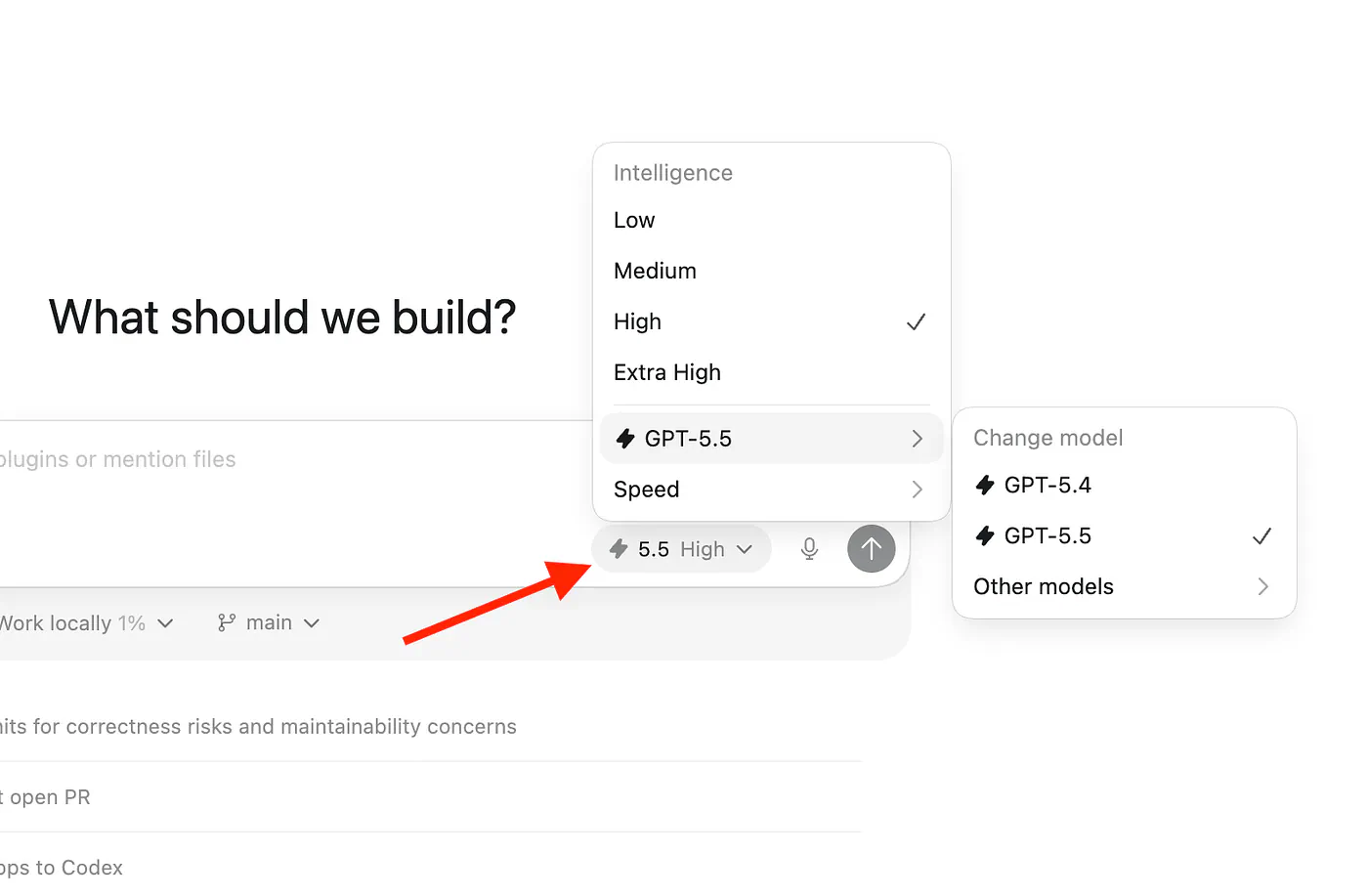
GPT 5.5 in ChatGPT. Image by Jim Clyde Monge
The release comes with two versions.
The standard GPT-5.5 model is the default option for most production workloads. GPT-5.5 Pro uses parallel test-time compute on the same underlying model to push accuracy higher on harder problems. That version is aimed more at research synthesis, technical analysis, and regulated-domain work where a wrong answer can cost more than an expensive API call.
The context window is also huge. GPT-5.5 supports 1 million tokens in the API and 400K tokens in Codex. That is enough to drop an entire mid-sized codebase into one prompt, which used to be the kind of thing people had to fake with retrieval pipelines and clever chunking.
How it performs on benchmarks
The coding numbers are getting most of the attention, and honestly, that makes sense.
On Terminal-Bench 2.0, which tests command-line agentic workflows, GPT-5.5 scored 82.7%. GPT-5.4 scored 75.1%. That puts GPT-5.5 at the top among publicly available models.
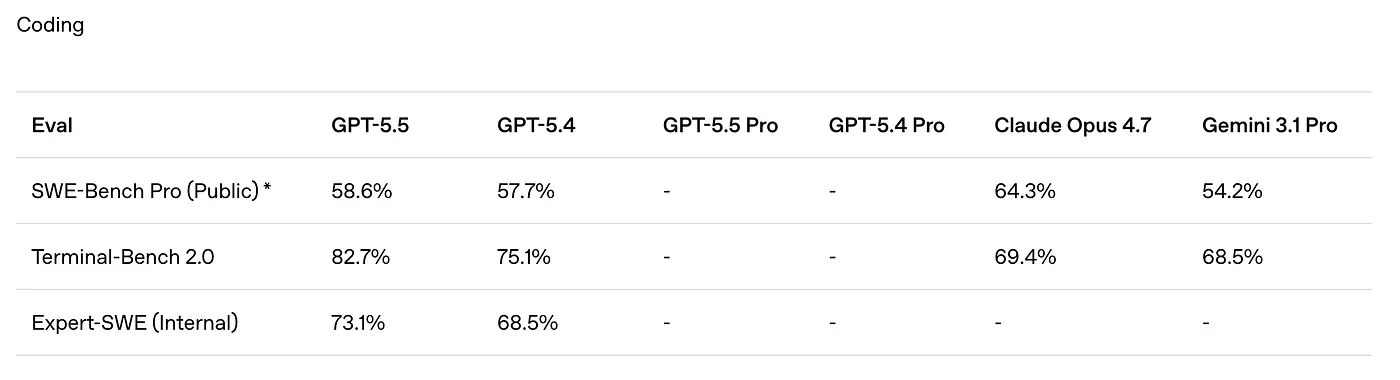
GPT 5.5 coding benchmark. Image by Jim Clyde Monge
Anthropic’s Claude Opus 4.7 sits at 69.4%, while Google’s Gemini 3.1 Pro lands at 68.5% on the same test, according to reporting from The Decoder.
The other coding results tell a similar story.
On OpenAI’s internal Expert-SWE benchmark, which tests long engineering tasks with a median human completion time of around 20 hours, GPT-5.5 reached 73.1%. GPT-5.4 scored 68.5%.
On SWE-Bench Pro, which grades real-world GitHub issue resolution, GPT-5.5 reached 58.6%. Claude Opus 4.7 actually beats it on that specific test with 64.3%, though OpenAI noted that Anthropic had reported signs of memorization on a subset of problems.
Outside of coding, a few numbers stood out to me:
GDPval at 84.9%: This measures performance across 44 real occupations, including finance and legal research. GPT-5.5 matches or beats industry professionals in that percentage of comparisons.
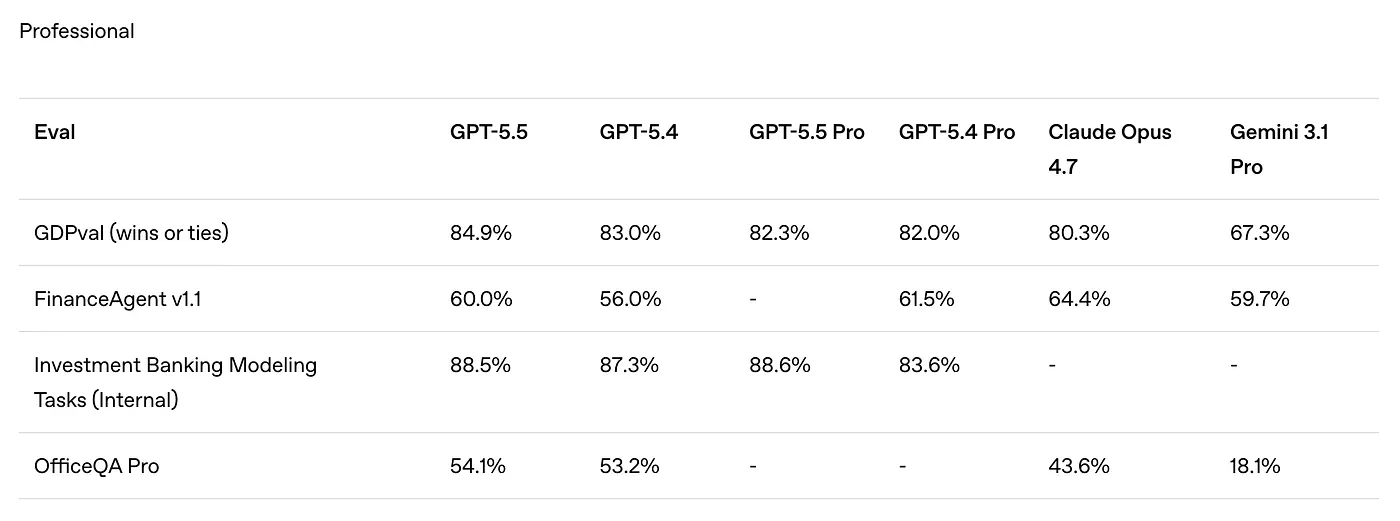
GPT 5.5 professional benchmark. Image by Jim Clyde Monge
FrontierMath Tier 4 at 35.4% for the standard model and 39.6% for Pro: This is the hardest tier of a math benchmark built by working mathematicians and designed to resist memorization.
BrowseComp at 90.1% for Pro: This tests how well a model can find hard-to-locate information on the web.
OSWorld-Verified at 78.7%: This is a desktop computer-use benchmark where the model has to click through real UIs and complete mixed software tasks.
OpenAI also says GPT-5.5 now tops the Artificial Analysis Intelligence Index with a score of 60. That puts it three points ahead of Claude Opus 4.7 and Gemini 3.1 Pro Preview, which were both tied at 57.
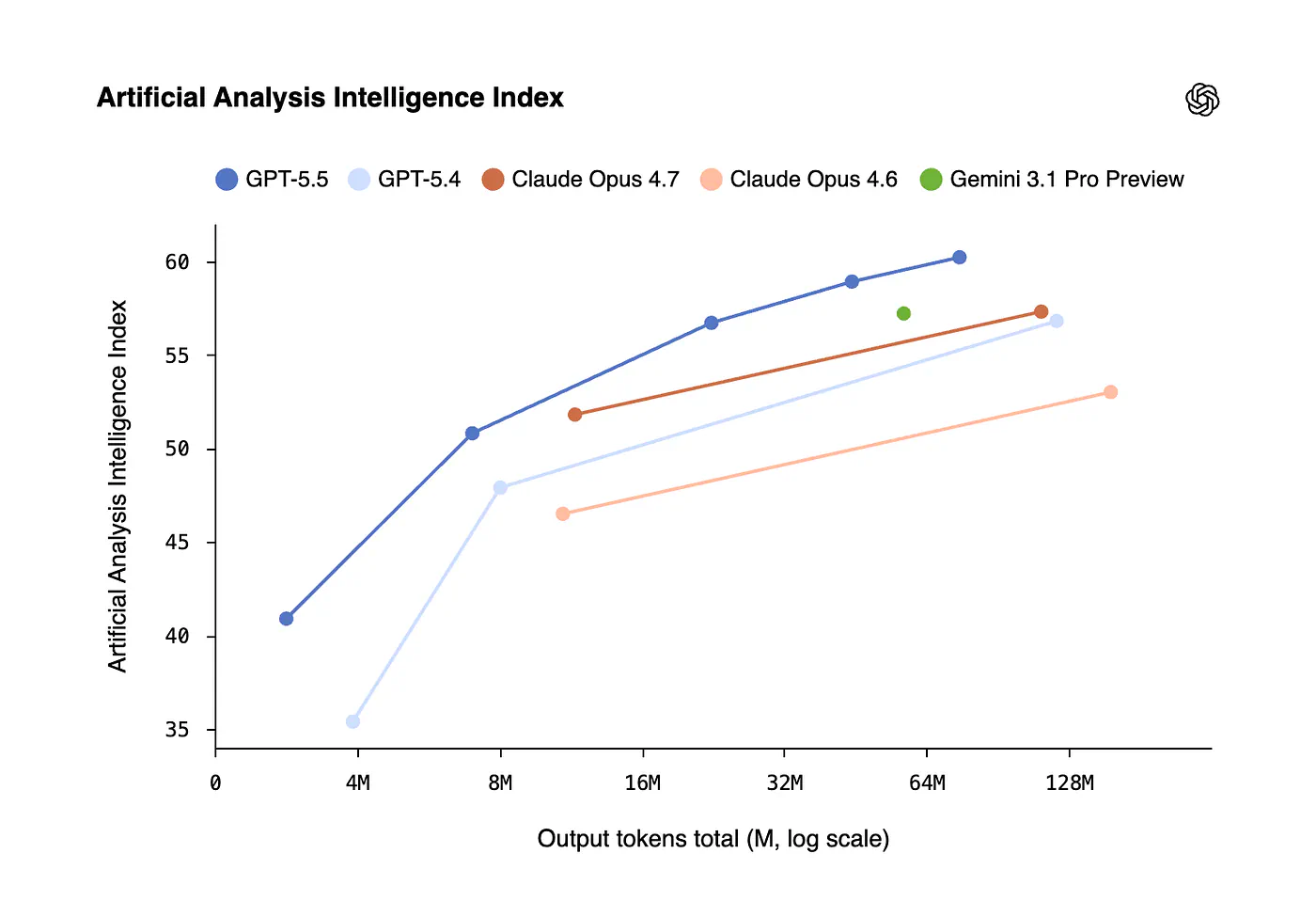
GPT 5.5 Artificial Analysis Index benchmark. Image by Jim Clyde Monge
The frontier model race has been pretty tight this year, especially between OpenAI, Anthropic, and Google. This release puts OpenAI back in front, at least on the public benchmark board.
But there is one honest caveat here.
On GDPval, the improvement over GPT-5.4 is not huge. GPT-5.5 scored 84.9%, while GPT-5.4 scored 83.0%. If that benchmark really measures everyday professional work well, then GPT-5.5 may not feel like a massive jump for normal ChatGPT tasks.
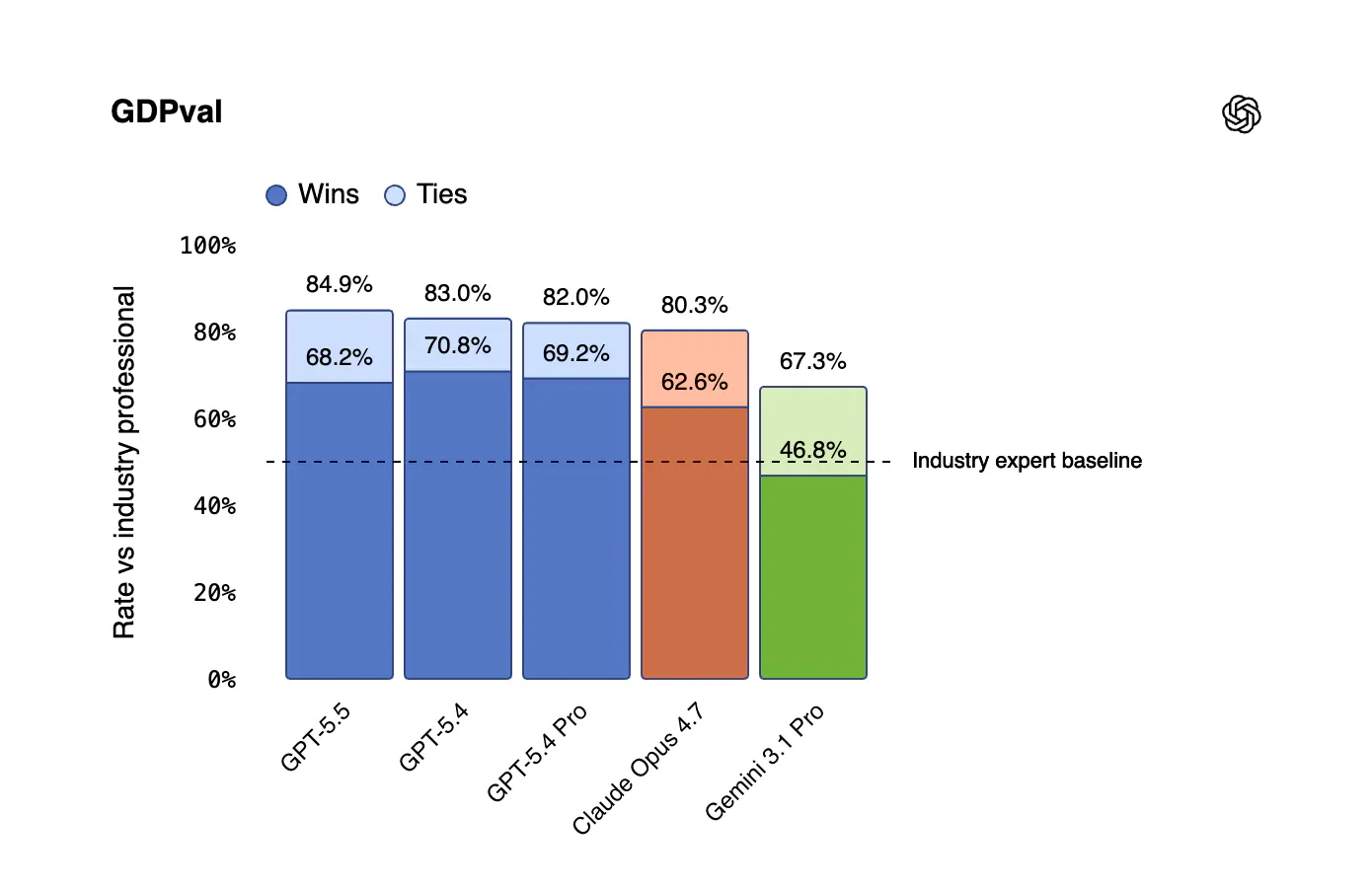
GPT 5.5 GDPval benchmark. Image by Jim Clyde Monge
The coding and agentic improvements are much more convincing.
Token efficiency and speed
Usually, better performance means slower responses or higher costs. Sometimes both.
That is why GPT-5.5 is interesting. OpenAI says the model matches GPT-5.4’s per-token latency in real-world serving while using far fewer tokens to complete the same Codex tasks.
The company claims around a 40% reduction in output token usage on comparable work. That is a real efficiency gain. It also helps soften the blow of the doubled per-token price, at least for some workflows.
There is also a new Fast mode in Codex. It generates tokens 1.5x faster at 2.5x the cost. That is clearly aimed at interactive coding sessions where waiting around for the model can ruin the flow.
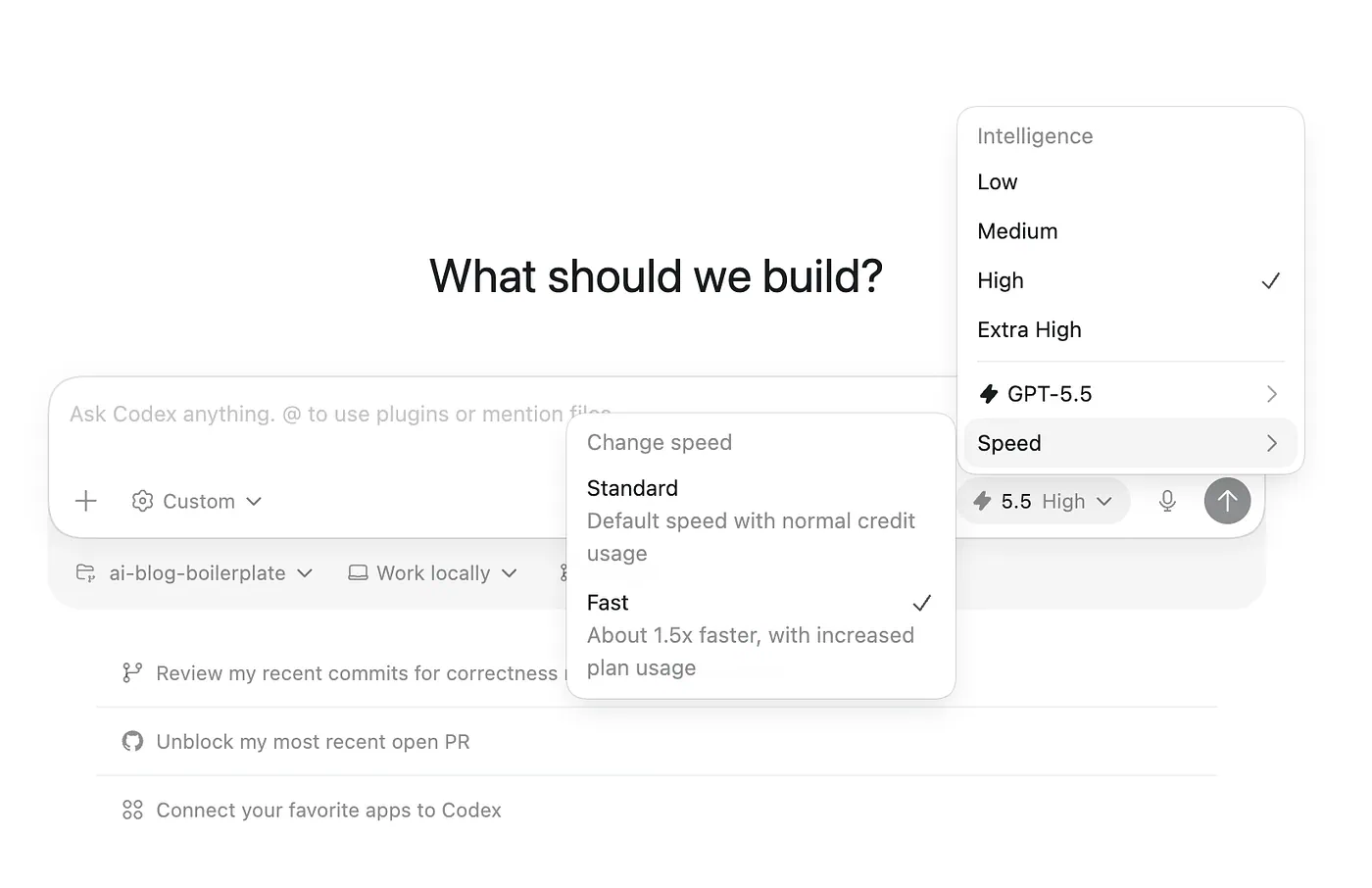
GPT 5.5 in Codex. Image by Jim Clyde Monge
The release also includes five effort levels, ranging from non-reasoning up to “xhigh.” That gives developers more control over how much they want to spend depending on the task.
For quick fixes, you probably do not need the most expensive setting. For deep debugging or long coding tasks, the higher effort levels might make sense.
Right now, I am still waiting for other coding tools, Warp and Antigravity, to add support for GPT 5.5.
Pricing, and why people are talking about it
This is the part that will probably dominate the discussion on Hacker News.
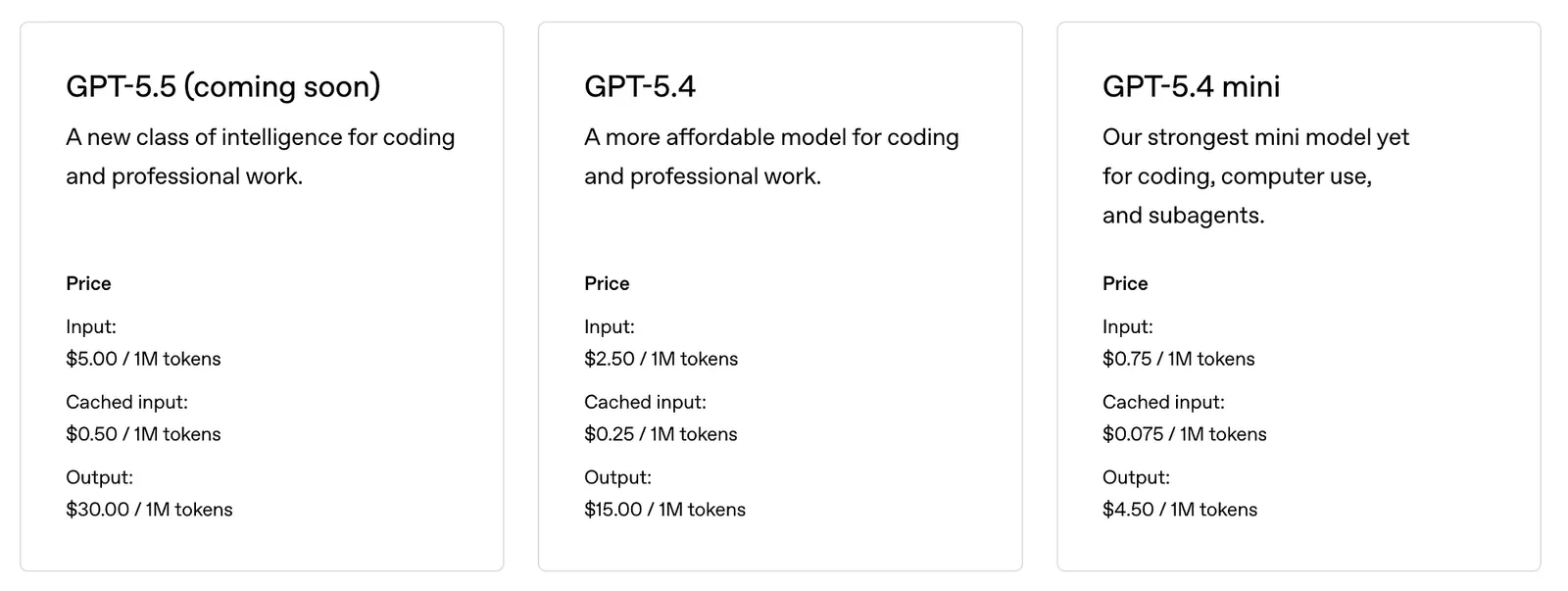
GPT 5.5 pricing comparison against older models. Image by Jim Clyde Monge
The standard GPT-5.5 API will cost $5 per million input tokens and $30 per million output tokens. That is exactly double the price of GPT-5.4, which was $2.50 input and $15 output.
GPT-5.5 Pro is much more expensive. It costs $30 per million input tokens and $180 per million output tokens.
Batch and Flex pricing will be available at half the standard rate. Priority processing will cost 2.5x the standard rate. The 1 million token context window is available across the board.
OpenAI’s argument is that the model uses fewer tokens, so the higher per-token rate does not automatically mean your bill doubles. On Codex tasks specifically, the company says most users may actually spend less because the model produces shorter and more focused runs.
A third-party analysis from Office Chai estimated the net cost increase at around 20% after factoring in the roughly 40% reduction in output tokens.
This makes sense for agentic coding work. But I am less convinced it applies to every use case.
For raw text generation, long articles, heavy-context workflows, or tasks where the output length stays about the same, the cost increase may be more obvious. So before teams switch everything to GPT-5.5, they should probably run their own numbers first.
You can learn more about the pricing here => https://openai.com/api/pricing/
Safety and the preparedness framework
This might be the most interesting part of the release if you follow how frontier labs handle model risk.
OpenAI classifies GPT-5.5 as “High” capability in both cybersecurity and biological or chemical domains under its Preparedness Framework. It is still below the “Critical” threshold, which would trigger different release policies.
The cybersecurity classification is especially important because this appears to be the first public OpenAI release where the company is openly flagging a real jump in offensive security capability.
OpenAI says it ran expanded red-teaming, added targeted cyber and bio capability checks, and deployed stricter classifiers for possible cyber risk. The company also admitted that some users may find those classifiers annoying at first.
Mia Glaese, OpenAI’s VP of research, told CNBC that GPT-5.5 went through extensive third-party safeguard testing and red teaming for cyber and bio risks. She also said the company has been improving its cyber safeguards for months as models have become more capable.
API deployments are being delayed until partner-specific safeguards are ready. OpenAI is also expanding its Trusted Access for Cyber program, which gives verified security professionals access to stronger capabilities while trying to limit casual misuse.
The timing is interesting too.
Anthropic released Claude Mythos Preview earlier in April with its own cybersecurity angle. So the competition around safety-gated frontier capabilities is clearly heating up.
No lab wants to be the one that ships a model that makes real-world cyberattacks easier. But at the same time, no lab wants to fall behind in a capability area that enterprise and security teams clearly care about.
That tension is becoming harder to ignore.
What is actually new under the hood
A few technical details got buried under the benchmark headlines.
- First, GPT-5.5 is the first fully retrained base model since GPT-4.5. That is a big deal for a model in the 5.x family. A lot of minor version updates are mostly post-training improvements on top of an existing base model. This one appears to be a deeper update.
- Second, GPT-5.5 was trained and served on NVIDIA GB200 NVL72 systems, which NVIDIA also confirmed in the launch materials.
- Third, OpenAI says inference was rebuilt as a single system instead of a patchwork of serving optimizations. That is how the company managed to keep latency flat even with the capability jump.
Codex also now includes browser use. That means the agent can interact with web apps, click through pages, capture screenshots, and keep iterating until a task is done.
There is also an improved image generator that can render readable text in outputs. That has been a long-running weakness for many image models, including OpenAI’s own tools, so I am curious to see how much better it actually is in real use.
Final thoughts
GPT-5.5 feels like the kind of update that will matter more to developers than casual ChatGPT users.
For normal writing, summaries, emails, and basic research, I do not think most people will immediately feel the improvements. The model is better, but the improvement there seems more gradual. The bigger story is what happens when you give it a messy coding task and let it work through the problem with tools.
That said, I do not think this is a “switch everything today” kind of release.
The pricing makes it a little harder to treat GPT-5.5 as the default for every workflow. OpenAI says the model uses fewer tokens, and that may be true for Codex-style tasks where the model can solve problems with shorter and more focused runs. But for long-form writing, heavy context workloads, or outputs that naturally need to be long, the higher per-token price may still show up on the bill.
The model is impressive. The price is the part that needs testing. And for developers, that is probably where the real conversation starts.
Sources
- GPT-5.5openai.com
- API accessdevelopers.openai.com
- Jim Clyde Mongemedium.com
- Codexopenai.com
- analysis from Office Chaiofficechai.com
- https://openai.com/api/pricing/openai.com
- Claude Mythos Previewred.anthropic.com


