
OpenAI announced Businesses in ChatGPT on November 10, 2026, launching a beta that lets eligible companies claim business profiles, update information, submit product feeds and view engagement insights through Business Hub. Eligible US ecommerce and online-service businesses can also build customer-facing Business Agents that answer questions about their offerings.
The practical distinction is between supplying information to ChatGPT and operating a branded conversation inside it. A verified profile gives a company a way to maintain its details. A Business Agent gives customers a separate place to ask that company questions. Sponsorship adds paid distribution, which OpenAI says is labeled and separate from ChatGPT’s responses. These are connected features, but they have different eligibility rules and purposes. OpenAI’s announcement describes the rollout.
For businesses, the sensible starting point is information accuracy. A current catalog and a correctly claimed profile are useful foundations even before a company decides whether it needs a conversational sales channel.
Who Can Claim a ChatGPT Business Profile?
OpenAI says any eligible business located where ChatGPT is available can claim its organization through Business Hub. Once verified, the company can update key details and add product feeds.
That is broader availability than Business Agents, which initially serve eligible ecommerce and online-service businesses in the United States. A business outside the US may qualify to claim its profile without qualifying to publish an agent.
OpenAI describes three routes into the claiming process:
| Business situation | Published claiming route | Important condition |
|---|---|---|
| Business using the standard process | Claim the organization through Business Hub | Eligibility and verification still apply |
| Eligible Shopify merchant | Connect a store through Business Hub or Shopify admin | The connection streamlines verification |
| Existing OpenAI Enterprise customer or advertiser | Work directly with an OpenAI representative | This is a claiming route, not a promise of agent eligibility |
The announcement does not provide a universal verification checklist. TechCrunch reports that OpenAI vice president of monetization Benji Shomair said verification methods vary across business types and markets, without disclosing the specific methods.
A useful preparation step is to identify who owns the company’s official business details, store administration and OpenAI relationship. That should make it easier to follow the applicable verification route, although the published material does not establish exactly which documents each business will need.
Product Feeds Supply Pricing and Availability
Verified businesses can submit self-service product feeds containing pricing and availability. The purpose is to give ChatGPT business-supplied information that can help people explore products and services using current details.
Shopify merchants have an additional reason to check their existing catalog before treating this as a completely new distribution project: OpenAI says eligible Shopify products are already integrated into ChatGPT through Shopify Catalog. Connecting a store for verification and having eligible products in that catalog are related parts of the rollout, but neither should be read as automatic Business Agent approval. OpenAI explains both paths here.
I’d prioritize catalog quality before agent copywriting. A polished answer about a product is of limited value if its price or availability is wrong. Businesses should identify which internal system owns those facts and who will maintain the information supplied to ChatGPT.
The announcement does not specify feed schemas, refresh intervals or a guaranteed delay between a merchant update and its appearance in ChatGPT. Businesses should therefore avoid promising customers real-time inventory synchronization based on this announcement alone.
Claiming a profile also comes with no published promise of ranking, recommendations or sales. The documented benefit is a channel for supplying information, not control over when ChatGPT chooses to mention a business.
What Business Hub Insights Actually Reveal
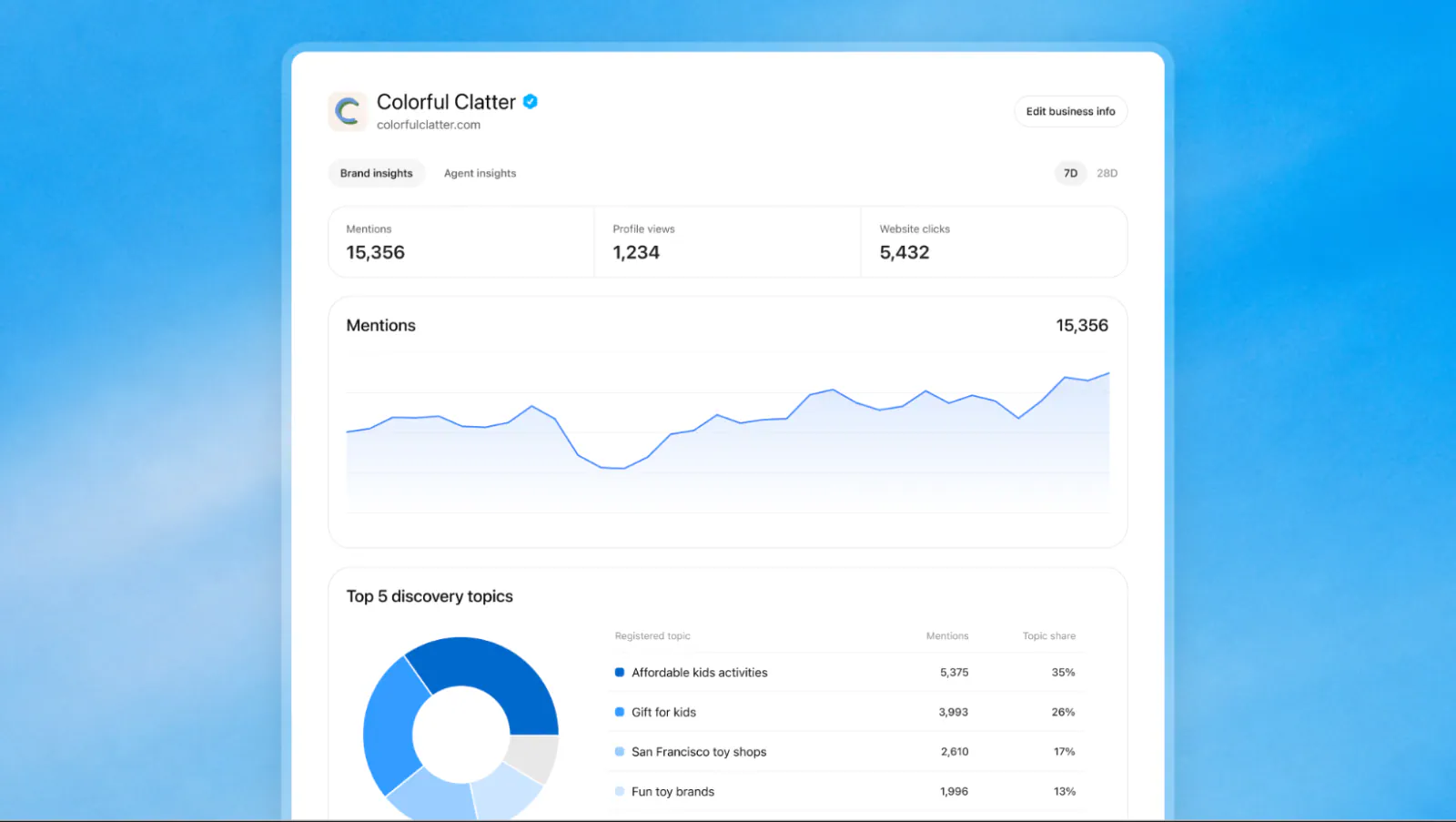
Business Hub provides aggregated information about how people encounter and engage with a company in ChatGPT. OpenAI lists:
- Business mentions: The number of mentions a business receives.
- Website clicks: Clicks through to the business’s website.
- Discovery topics: Common themes across conversations in which the business’s website is cited.
These metrics answer different questions. Mentions indicate exposure; clicks indicate movement to a website. Discovery topics can help a business understand the contexts in which it appears. None of those, by itself, measures a completed purchase or proves that a particular profile change caused more demand.
OpenAI states:
“We don’t share users’ conversations or Business Agent chats with businesses.”
The company says insights are aggregated and appear only when enough conversations or interactions meet certain thresholds. It does not disclose the threshold values in the announcement. The official description therefore supports treating Business Hub as an aggregate discovery dashboard, not a transcript viewer.
That threshold rule has a practical measurement consequence: a missing metric should not automatically be read as zero activity. If reporting depends on sufficient volume, an empty view may reflect limited reportable data. Businesses should establish a baseline over time before drawing conclusions from sparse results.
Discovery topics are best used as prompts for improving information. If a recurring theme concerns product compatibility, for example, a business could review whether its compatibility documentation is clear. The insight does not give the company the underlying customer conversations.
How Customer-Facing Business Agents Work
After claiming their business, eligible organizations can build, test and launch a Business Agent. The initial audience is eligible US ecommerce and online-service businesses, not every organization that can obtain a profile.
OpenAI describes the customer journey in three steps:
- A business appears in a ChatGPT response.
- The user opens that business’s ChatGPT profile.
- If an agent is available, the user chooses to start a separate conversation with it.
The agent can help customers explore the business’s offerings and ask follow-up questions, including comparisons between two products. The Verge reports that businesses can specify agent instructions and provide business context to guide its responses.
That makes the agent a branded information channel. A customer can ask which of a company’s products fits a need, but the conversation represents that company’s offerings. I’d treat it like speaking with a company representative: useful for understanding the seller’s catalog, with outside comparison still valuable when choosing among competing businesses.
For rollout testing, businesses should prepare questions involving product differences, exclusions, unavailable items and uncertain answers. Those are recommended checks, not results from testing this beta. The announcement describes question-answering and product exploration; it does not establish that agents can complete purchases or perform every action a customer might request.
Frequently Asked Questions
4 questions
1Can Businesses Outside the US Claim a Profile?
OpenAI says eligible businesses located where ChatGPT is available can claim a profile. Business Agents initially have a narrower restriction: eligible US ecommerce and online-service businesses.


