
OpenAI announced and began rolling out ChatGPT Images 2.5 on September 8, 2026. The release improves image generation quality, but its more consequential changes target the revision process: preserving reference subjects, limiting edits to requested elements, and maintaining consistency through longer conversations.
That focus reflects how people actually use generative image tools. OpenAI says users now create more than 3 billion images every week across ChatGPT Images and its GPT-Image API models. At that scale, reducing failed revisions and generation time can matter as much as producing a more impressive first image. The ChatGPT Images 2.5 announcement claims up to 50% lower generation latency than Images 2.0, alongside sharper detail, more natural lighting, and richer textures.
The model arrives with a broader set of ChatGPT creation tools, including a drawing interface called Sketch, starter templates, comments attached directly to images, and shareable prompts. Developers get two API variants: the faster GPT-Image-2.5 Flare and the more precision-oriented GPT-Image-2.5 Sunburst.
ChatGPT Images 2.5 Focuses on Reliable Editing
Many AI image generators can produce a convincing initial composition, then struggle when asked to change one small part of it. Replacing a product, correcting text, or changing a person’s clothes may also alter the face, lighting, camera position, background, or overall visual style.
OpenAI says Images 2.5 is better at distinguishing between what should change and what should remain fixed. A user should be able to update one element while retaining the original subject, composition, background, and surrounding details. For developers, OpenAI specifically positions this capability for editing products, copy, and backgrounds without rebuilding the rest of an asset.
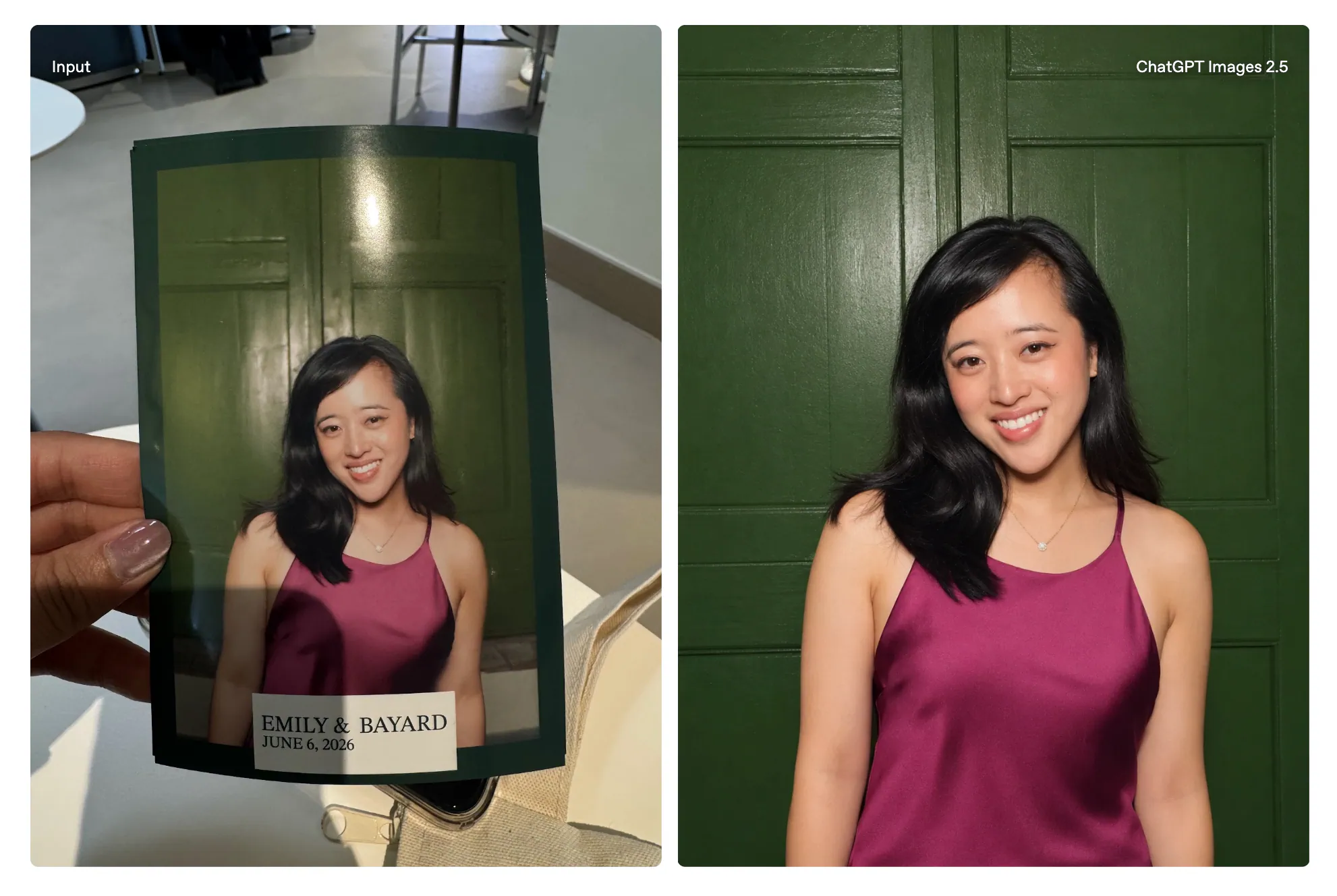
Reference fidelity receives similar attention. When Images 2.5 works from an existing photograph, OpenAI says distinctive features are more likely to survive changes in setting, composition, and visual style. Better subject preservation could make the model more useful for personalized artwork, product photography, advertising variations, character concepts, and other workflows in which recognizability matters.
Multi-turn consistency may be even more important. OpenAI claims earlier edits are less likely to disappear or degrade as a conversation continues. Ideally, a user could change the background, adjust an object, revise the lighting, and add text over several turns without reintroducing errors that had already been corrected.
This is still probabilistic image generation, not deterministic layer-based editing. “More likely to stay consistent” does not guarantee that every untouched pixel will remain identical. The practical question is how often Images 2.5 can complete a focused edit without forcing users to repair something elsewhere.
Lower Latency Makes Iteration More Practical
OpenAI reports that ChatGPT Images 2.5 can reduce image generation latency by up to 50% compared with Images 2.0. Its API announcement makes a similar claim for GPT-Image-2.5 Flare, which it says delivers higher-quality images than GPT-Image-2 at 50% lower latency.
The “up to” qualifier matters. OpenAI has not published a detailed workload breakdown showing how generation time varies by prompt complexity, resolution, input images, or output settings. Users should not assume that every request will finish in half the time.
Even so, lower latency has a direct effect on creative work. Image generation is usually iterative: create a draft, inspect it, change the prompt, correct a detail, and repeat. Faster individual generations shorten that entire loop. It becomes more practical to compare multiple compositions or test small adjustments rather than trying to encode every requirement in one oversized prompt.
Speed also matters for applications serving images dynamically. A 50% reduction can improve responsiveness in visual search, product customization, design assistants, and high-volume content systems. Whether it improves operating economics depends on API pricing and token consumption, not latency alone.
ChatGPT Adds Sketch, Templates, Comments, and Prompt Sharing
Images 2.5 is accompanied by interface features that reduce its dependence on text-only prompting.
Sketch lets users draw directly in ChatGPT and submit the drawing as a visual guide. OpenAI suggests using it for room layouts, clothing contours, and rough doodles, with a written description supplying the desired style and other details. Users can activate the feature by typing @Sketch in ChatGPT.
A sketch can communicate spatial intent more efficiently than a paragraph. Describing the precise location, scale, and orientation of several objects is difficult in natural language. A rough drawing provides an explicit composition, while the accompanying prompt can concentrate on materials, lighting, color, and style.
Templates address a different problem: the blank starting point. ChatGPT now offers predefined structures for common formats such as posters and merchandise. Users select a format and provide the message, visual elements, and stylistic direction. Templates should make routine AI image creation more approachable, although the value will depend on the range of formats and how much control each template exposes.
Users can also place comments directly on images for focused revision requests. This should reduce ambiguous prompts such as “change the object on the left,” particularly in complex compositions containing several similar elements.
Prompt sharing turns a finished creation into a reusable starting point. When sharing an image, a user can include its prompt so another person can apply the concept to different photos or details. The feature treats a prompt less like hidden production metadata and more like a remixable creative recipe.
Together, these tools give ChatGPT four forms of control:
- Sketches communicate layout and shape.
- Templates supply a useful starting structure.
- Image comments identify targeted revisions.
- Shared prompts make successful concepts reusable.
Flare and Sunburst Bring Images 2.5 to the API
OpenAI is releasing two GPT-Image-2.5 models through the Images API.
GPT-Image-2.5 Flare is the default option for most applications. OpenAI positions it for social content, product experiences, visual search, rapid prototyping, and high-volume generation. It prioritizes the combination of image quality and lower latency.
GPT-Image-2.5 Sunburst targets work that benefits from tighter control and additional precision. OpenAI recommends it for polished product imagery, production campaign assets, and other premium creative workflows. The tradeoff is longer generation time.
OpenAI’s current API pricing documentation lists the following standard token rates:
| Model | Image Input | Cached Image Input | Image Output | Text Input |
|---|---|---|---|---|
gpt-image-2.5-flare | $8 | $2 | $30 | $5 |
gpt-image-2.5-sunburst | $8 | $2 | $30 | $5 |
gpt-image-2 | $4 | $1 | $15 | $2.50 |
All figures are per one million tokens. Cached text input costs $1.25 per million tokens for both 2.5 models, compared with $0.625 for GPT-Image-2.
The listed unit rates for Flare and Sunburst are identical, and both are twice GPT-Image-2’s rates across the documented image and text categories. That makes the API release a quality-and-speed upgrade rather than a straightforward cost reduction. Flare’s lower latency could increase throughput, but developers will still need to determine whether fewer retries and better edits offset the higher token rates.
Those rates also should not be mistaken for a fixed per-image price. Actual cost depends on input and output token usage, which can vary with image configuration and the work being performed. OpenAI points developers to its image-generation calculator for per-request estimates.
OpenAI’s Quality Claims Need Independent Testing
OpenAI’s announcement contains demonstration images and statements from early customers including Adobe, Higgsfield, Manus, and Runway. These examples offer an initial view of the model, but they are selected launch material rather than controlled, independent benchmarking.
The company does not provide a standardized quality table comparing Images 2.5 with Images 2.0 across reference fidelity, text rendering, instruction following, or long editing sequences. Image quality is also difficult to compress into a single score because different workflows expose different weaknesses.
Useful independent testing should examine whether the model can:
- Preserve faces and distinctive objects while changing clothing or backgrounds.
- Edit one region without shifting the rest of the composition.
- Maintain previous changes through five or more editing turns.
- Render accurate text inside posters, labels, and interfaces.
- Preserve sharp edges when producing transparent backgrounds.
- Generate a consistent family of branded assets rather than one strong sample.
- Repeat these results across different aspect ratios and prompt styles.
The announcement says Images 2.5 handles complex layouts, transparent backgrounds, real-world information, and artistic styles more reliably. Those are valuable improvements if they hold across ordinary prompts, but users should distinguish OpenAI’s comparative claims from independently measured performance.
Provenance Tools Continue, but They Are Not Foolproof
OpenAI says Images 2.5 checks prompts and generated images for harmful content. It also continues using C2PA metadata and invisible watermarking to help identify AI-generated media. Its ChatGPT Images 2.5 system card specifies that the invisible watermarking layer uses SynthID across ChatGPT, Codex, and the OpenAI API.
These approaches complement each other. C2PA metadata can carry structured provenance information, while an embedded watermark may remain useful when ordinary metadata is removed. OpenAI acknowledges that no single provenance mechanism provides a complete solution.
In OpenAI’s automated adversarial evaluation, unsafe images were presented for 1.09% of prompts with Sunburst and 1.41% with Flare, compared with 1.64% for ChatGPT Images 2.0. However, the system card says none of the differences in the “unsafe generation presented” category reached its statistical-significance threshold. It also warns that automated labels can contain errors and that the results apply to a fixed adversarial test set, not normal production traffic.
The Rollout Covers Every ChatGPT Tier
OpenAI says Images 2.5 is rolling out across all tiers of ChatGPT, ChatGPT Work, and Codex on desktop, mobile, and the web. Flare and Sunburst are available separately through the API. Because OpenAI describes this as a rollout, the feature may not appear in every account at exactly the same time.
Casual ChatGPT users will notice the new creation tools first. Sketch and templates reduce the effort required to describe an idea, while comments should simplify local corrections. Designers and marketers stand to benefit more from improved reference preservation and multi-turn consistency. For developers, the decision is less automatic because the 2.5 API models carry higher token rates than GPT-Image-2.
Final Thoughts
ChatGPT Images 2.5 is less interesting as another image-quality upgrade than as an attempt to make AI images reliably editable. OpenAI is concentrating on the point where many generative workflows break down: the first result looks promising, but every requested correction introduces a new problem.
The new controls support that direction. Sketch supplies spatial guidance, comments narrow the scope of an edit, and multi-turn consistency is meant to preserve previous work. Lower latency makes the resulting edit loop less frustrating.
The decisive test will not be whether Images 2.5 can produce a striking launch sample. It will be whether users can refine an image repeatedly while everything they did not ask to change remains intact. If the model does that consistently, the higher API rates may be easier to justify because teams will spend less time regenerating, repairing, and discarding assets.
Frequently Asked Questions
5 questions
1What is ChatGPT Images 2.5?
ChatGPT Images 2.5 is OpenAI’s latest image-generation and editing model for ChatGPT. It is designed to produce sharper details, more natural lighting, richer textures, and more reliable edits. OpenAI also says it preserves subjects from reference photos more effectively and maintains previous changes across longer, multi-turn editing conversations.
2
Sources
- ChatGPT Images 2.5 announcementopenai.com
- API pricing documentationdevelopers.openai.com
- ChatGPT Images 2.5 system carddeploymentsafety.openai.com


