
A Copilot subscription will not cover every kind of work in Microsoft’s redesigned app. Quick questions and everyday assistance remain part of a user license. Delegating a longer task to Cowork, building an app with Code or assigning ongoing work to Autopilot falls under usage-based billing.
The three headline capabilities are also arriving on different schedules. Home and Code are set to begin rolling out through Microsoft’s Frontier program in the coming weeks. Autopilot, the persistent agent, is expanding to private preview at the end of September. None is available to every Copilot customer yet.
In its September 25 Copilot announcement, Microsoft presents Home, Code and Autopilot as parts of one experience. For organizations evaluating it, the practical question is what happens after a user makes a request: Does Copilot answer under the subscription, run a metered task, create an app or keep acting after the user leaves?
Home Combines Chat, Cowork and Office Files
Home is the new starting point for Copilot. Microsoft says it will bring Chat and Cowork together with recent activity, suggestions and the ability to resume work. Chat handles immediate requests such as lookups and drafts. Cowork is intended for tasks a user delegates and revisits when Copilot returns a result.
Both may appear in the same interface, but they fall on different sides of the billing split. Asking a question in Chat and assigning Cowork a multi-step customer briefing may feel like variations on one request. Microsoft places Cowork under usage-based billing. Home is an entry point, not a promise that everything reached through it is included in the subscription.
Microsoft is also bringing Word, Excel and PowerPoint work into Copilot. From Home, users will be able to create or update editable documents, workbooks and presentations without transferring generated text into a separate file. Microsoft says collaborators’ edits will stay in sync between Copilot and the Office apps. If that works as described, the benefit is keeping the working file and the conversation connected.
Some of the promised simplicity is still ahead. Microsoft says Copilot will eventually route a request to Chat, Cowork or Code without asking users to choose a mode. It describes that routing as coming soon, so organizations should not assume it will be available during the initial Home rollout. Automatic routing also leaves administrators with a practical billing question: how will users know when a request ran in a metered mode?
Code Builds Apps From Descriptions, but Remains a Preview Rollout
Code is Microsoft’s attempt to make small workplace software a Copilot task. A user describes an app, tracker, dashboard, automation or workflow in natural language, and Copilot selects an approach and builds it. Microsoft says the possible outputs range from desktop widgets to interactive dashboards and cloud-hosted internal apps that a team can share.
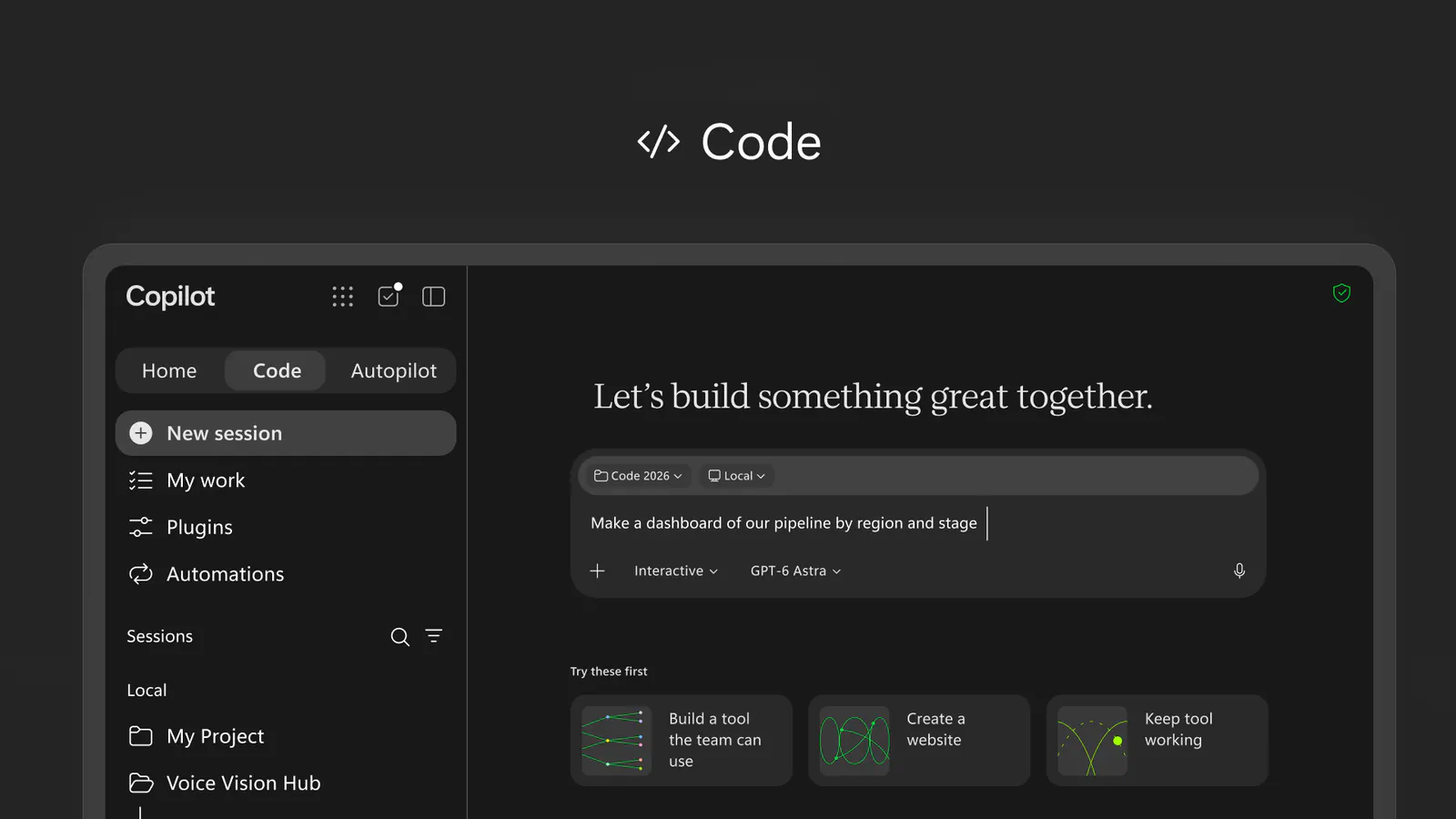
According to Microsoft’s description of Code, it uses the same underlying technology as GitHub Copilot. The products serve different workflows. GitHub Copilot remains a tool for developers working with code; the new Copilot Code experience is aimed at people describing a workplace solution and asking Copilot to produce it.
The announcement says Code runs in a sandboxed environment and can be hosted within an organization’s tenant. Microsoft has also introduced Copilot Managed Runtime, hosting infrastructure for apps created in Code, Cowork and Copilot Studio. Managed Runtime is in preview. Those details are relevant to teams considering internal apps, though the announcement alone does not establish how well a generated app will meet a particular organization’s security, reliability or maintenance requirements. Those are questions for a pilot.
Microsoft says Code is rolling out to Frontier at the end of September and describes broader availability as coming in the following weeks. Its announcement also says a preview for Microsoft 365 Premium and Pro subscribers is planned for later in the year. Access is staged; a planned rollout does not mean general access today.
Autopilot Is Designed to Continue Without Another Prompt
Autopilot takes a different approach from Chat and Code. Previously called Scout, it is Microsoft’s proposed persistent agent: a user gives it a name, role, goal and boundaries, and it can continue work across sessions. Microsoft’s examples include watching channels, following up on threads and managing recurring work.
Microsoft says Autopilot is cloud-hosted and operates in a customer’s tenant with its own identity, memory, computer and workspace. It is designed to appear in places such as Teams, Outlook, chats and documents, where people could mention it as they would a colleague. The company says permissions, audit and governance apply to its activity. These are vendor descriptions of the design, not independent evidence of how the agent performs in a live deployment.
An agent that can follow up with stakeholders or pick up a project days later raises questions that a one-off Copilot response does not: which actions may it take, who can inspect them and when should it stop? Its authority needs to remain understandable to the people responsible for the work.
For now, access is limited. Autopilot is expanding to private preview at the end of September, not launching broadly alongside Home and Code. Organizations should not plan around it as an already available replacement for existing workflows.
The Subscription Covers Everyday Copilot, Not Agentic Work
Microsoft draws a line between a user subscription license and usage-based billing. It says the subscription covers everyday Copilot use in Chat and across Word, Excel, PowerPoint, Outlook and Teams, including quick answers, drafts, summaries and analysis. The license also includes model selection and Microsoft’s Auto routing, which chooses a model for a request based on factors including accuracy, speed and cost.
Usage-based billing covers Cowork, Code and Autopilot, along with long-running agentic capabilities and frontier models that Microsoft names as Astra and Fable. A feature’s location in the Copilot app does not, by itself, explain its cost. Chat and Cowork may sit together in Home while falling on opposite sides of the billing split.
| Copilot activity | Billing category Microsoft describes |
|---|---|
| Everyday Chat and assistance in Word, Excel, PowerPoint, Outlook and Teams | User subscription license |
| Delegated work in Cowork | Usage-based billing |
| Building with Code | Usage-based billing |
Frequently Asked Questions
4 questions
1Is Copilot Code the Same as GitHub Copilot?
No. Microsoft says Copilot Code uses technology underlying GitHub Copilot, but it serves a different workflow. Code lets a user describe a workplace app, dashboard or automation and have Copilot build it. GitHub Copilot remains a developer tool for working with code. Code is beginning a staged Frontier rollout and falls under usage-based billing.
2
Sources
- September 25 Copilot announcementblogs.microsoft.com