
Meta released Muse Spark 1.3 on September 2, 2026, with improvements aimed at agentic work, coding, and the less measurable problems that emerge when an AI system operates across tools for an extended period. The model is rolling out through Muse Code and the Meta Model API.
The headline efficiency claims are substantial. In Meta’s internal comparisons with Muse Spark 1.2, the new model required roughly 20% fewer tool calls and 25% fewer tokens to complete tasks. It is also designed to ask more clarifying questions, tell users when it is stuck, confirm consequential actions, and avoid claiming that unfinished work has been completed.
Those behavioral changes may prove more important than a small benchmark lead. Real agents fail through unnecessary actions, ambiguous instructions, lost context, and false reports of success. Muse Spark 1.3 is Meta’s attempt to address those practical failures while still improving measured performance.
Muse Spark 1.3 Is Built for Messy, Multi-Workflow Threads
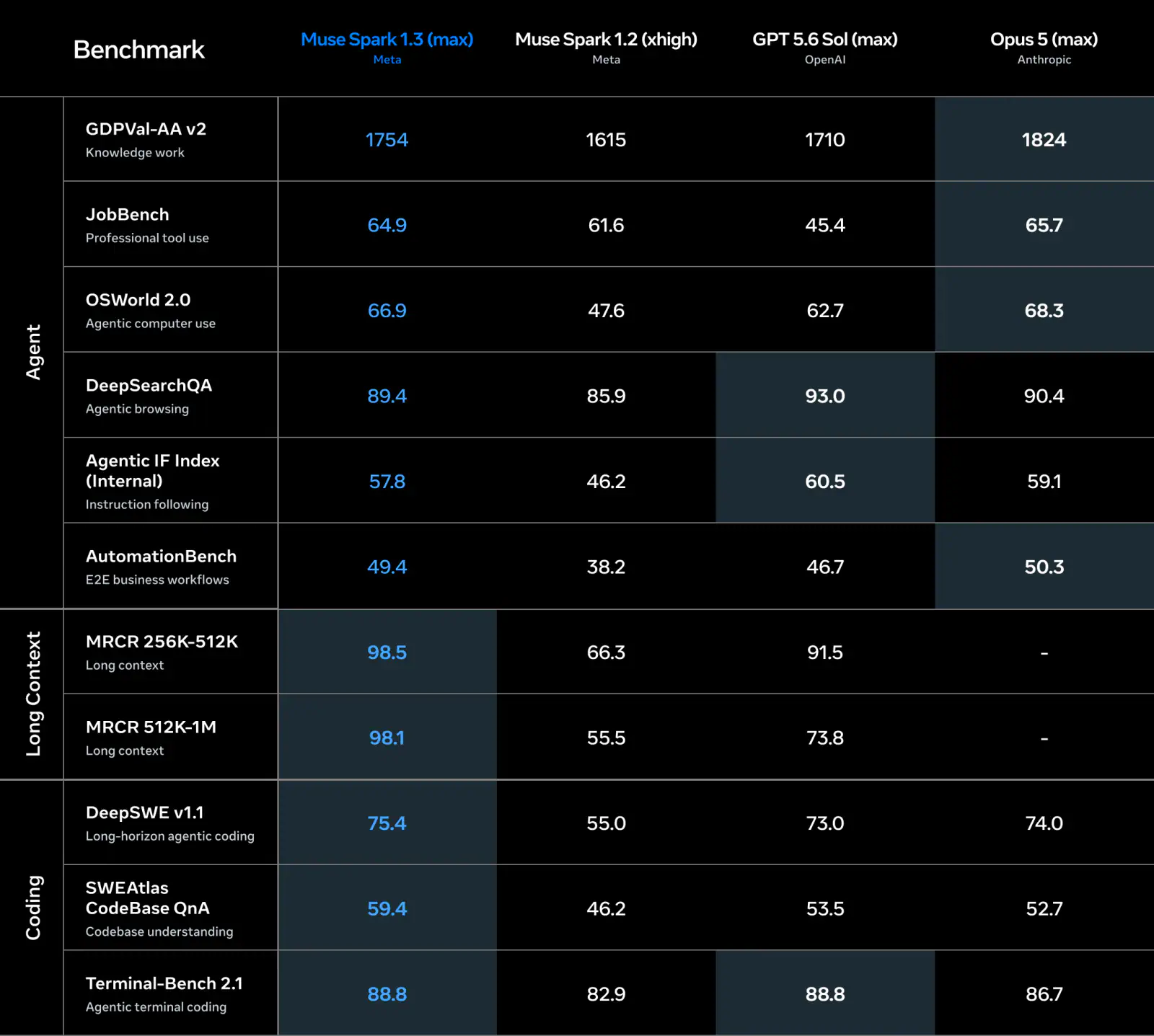
Image: Introducing Muse Spark 1.3.
Meta says Muse Spark 1.3 can sustain longer-horizon work while handling several connected workflows in one conversation. Instead of requiring the user to begin a new thread for each part of a project, the model is supposed to preserve relevant context as the work moves between research, code, files, analysis, and finished artifacts.
That matters because long agent tasks rarely consist of one clean sequence. A model might need to inspect source material, create a plan, run code, correct an error, generate a spreadsheet, and summarize the result. A failure in any intermediate step can invalidate everything that follows.
Meta illustrates the model’s range with tasks including an X-wing flow simulation, a garden design, audio cleanup, spreadsheet analysis, presentation creation, and protein-sequence work. These examples are demonstrations selected by Meta rather than independent evaluations, but they clarify the kind of multi-stage work Muse Spark is intended to handle.
The model retains the large capacity introduced with Muse Spark 1.2. Through the Meta Model API, Muse Spark 1.3 supports a context window of up to one million tokens and output of up to 128,000 tokens. A large context window does not guarantee that every detail will be recalled or applied correctly, but it gives the agent room to keep extensive source material, tool results, code, and conversation history available within one session.
The important claim, then, is not simply that Muse Spark can accept a long prompt. Meta says it can remain productive over a longer sequence of decisions. That is a harder capability to measure because it depends on planning, context management, error recovery, tool selection, and knowing when to involve the user.
Collaboration Changes Matter More Than Politeness
Muse Spark 1.3 is designed to behave less like an autonomous process that always needs to produce an answer and more like a collaborator that can pause when a decision requires additional information.
Meta highlights three changes:
- It asks clarifying questions instead of making assumptions when a request is underspecified.
- It alerts the user when it is stuck rather than repeatedly trying ineffective actions.
- It requests confirmation before taking consequential actions.
These behaviors introduce some friction, but productive friction is preferable to an agent confidently taking the wrong action. A clarification request can prevent an hour-long workflow from proceeding with the wrong file, target format, or business rule. Confirmation is especially valuable when an agent can modify external systems, overwrite work, publish content, or communicate with other people.
Meta also says the model is better calibrated about its limitations. In practice, that should reduce cases where an agent reports that it sent, changed, verified, or completed something that its tools did not actually accomplish.
Calibration is not the same as accuracy. A model can accurately report that it is uncertain and still fail to solve the task. Yet honest failure is easier to recover from than a fabricated success, particularly when a human is supervising a long workflow and cannot manually inspect every intermediate action.
The open question is whether Muse Spark asks for help at the right moments. Too few interruptions can produce unsafe assumptions, while too many can turn an agent into an elaborate form that constantly requests approval. Meta’s announcement describes the intended behavior but does not provide a dedicated evaluation showing how often clarification and confirmation requests were appropriate.
Fewer Tool Calls Could Reduce Cost and Failure Risk
Meta’s internal results indicate that Muse Spark 1.3 completes comparable tasks with approximately 20% fewer tool calls and 25% fewer tokens than Muse Spark 1.2. These figures are averages from internal comparisons, and Meta has not published enough detail to convert them into a universal cost or speed estimate.
Even with that caveat, both reductions are relevant to agent deployment.
Every tool call can add latency and another point of failure. It may trigger an API request, run code, search a database, open a file, or change an external system. Redundant calls waste time and can create duplicated or conflicting actions. A 20% reduction could therefore make an agent faster and easier to audit, depending on which calls the model eliminates.
Token efficiency has similar practical consequences. Long tasks accumulate tokens through planning, intermediate reasoning, retrieved documents, tool outputs, and generated artifacts. Using fewer tokens can lower inference costs and reduce the amount of irrelevant material carried forward through the workflow.
Efficiency alone does not prove that the model is more capable. An agent could make fewer calls because it skipped necessary checks, or use fewer tokens by producing an incomplete result. Meta pairs its efficiency claims with higher internal benchmark scores, which makes that interpretation less likely, but independent testing will still need to confirm that the savings persist across different tools and task types.
Benchmarks Show Broad Gains, Not a Clean Sweep
Meta’s official scorecard compares Muse Spark 1.3 with Muse Spark 1.2, GPT-5.6 Sol, and Opus 5 across agent use, coding, instruction following, and long-context work. The results come from Meta’s own evaluation process through Muse Code, not an independent benchmark provider.
| Evaluation | Muse Spark 1.3 | Muse Spark 1.2 | GPT-5.6 Sol | Opus 5 |
|---|---|---|---|---|
| MCP-Atlas | 67.1 | 46.4 | 54.2 | 38.9 |
| BFCL v4 | 64.9 | 62.0 | 63.3 | 61.0 |
| τ²-bench | 99.0 | 96.5 | 96.7 | 98.2 |
| SciCode | 53.6 | 48.7 | 49.6 | 54.0 |
| LCR | 66.5 | 55.0 | 67.0 | 62.0 |
| Terminal-Bench 2.0 | 57.8 | 52.9 | 52.5 | 58.4 |
| IFBench | 81.1 | 73.5 | 82.7 | 75.4 |
| SWE-bench Multilingual | 77.5 | 76.0 | 77.6 | 78.5 |
| CL-bench | 23.0 | 11.0 | 17.2 | 16.0 |
The clearest result is the generational improvement. Muse Spark 1.3 outscored Muse Spark 1.2 on every evaluation in Meta’s table, with particularly large gains on MCP-Atlas and CL-bench.
Its position against competing models is more mixed. Based on the published scores, Muse Spark 1.3 leads GPT-5.6 Sol on six of the nine evaluations and also leads Opus 5 on six. GPT-5.6 Sol remains ahead on LCR, IFBench, and SWE-bench Multilingual, while Opus 5 scores higher on SciCode, Terminal-Bench 2.0, and SWE-bench Multilingual. Several differences are small enough that they should not determine a model choice by themselves.
The evaluation methodology adds further context. The suites do not all measure the same skill or use the same scoring procedure. Some report pass@1, while others use pass^3, meaning a task counts only if all three attempts succeed. Meta also used task-specific environments and token limits, including a 64,000-token cap for parts of its long-context testing.
This makes the scorecard useful for identifying broad strengths, but not as a single definitive ranking. Muse Spark 1.3 appears strong at tool coordination, instruction following, and certain long-horizon tasks. The results do not show it dominating every coding or long-context evaluation.
Muse Spark 1.3 Refines the Direction Set by 1.2
The Muse Spark 1.2 release in February 2026 emphasized the one-million-token context window, native computer use, coding, document creation, planning, and a claimed 30% response-speed improvement over Muse Spark 1.1.
Muse Spark 1.3 keeps that foundation but shifts attention from maximum capability toward dependable execution. Its most prominent additions concern when the model should ask questions, how it handles stalled work, whether it knows what it actually completed, and how efficiently it uses available tools.
That direction reflects a broader challenge for agent systems. A model can score well on an isolated coding problem while still becoming unreliable during a two-hour workflow involving dozens of decisions. Improving individual answers is only part of the problem. Agents also need to preserve goals, avoid wasteful actions, recover from errors, and maintain an accurate account of their progress.
Meta says Muse Spark 1.3 is based on a next-generation open research architecture that it plans to release publicly. The announcement does not provide a public-release date or enough architectural detail to assess that claim yet. Until the architecture, weights, or a fuller technical report are available, developers must evaluate the model primarily through Meta’s hosted products.
Availability Comes With a Max-Reasoning Caveat
Meta began rolling out Muse Spark 1.3 through Muse Code and the Meta Model API on September 2, 2026. The reasoning modes previously available for Muse models are part of the initial release. Max reasoning, which Meta used for the model in parts of its benchmark evaluation, is scheduled to arrive later after additional safety testing.
That distinction matters for early comparisons. Users testing the initial rollout may not reproduce results obtained with the unreleased max setting. Meta has not given a specific date for its availability, so the benchmark table partly represents a configuration that was not accessible at launch.
Developers should also treat the efficiency numbers as a starting point rather than a deployment forecast. Meta has not disclosed the absolute number of calls or tokens in the comparison, the full distribution of tasks, or corresponding changes in latency and cost. The model may produce different savings when connected to custom tools, large private repositories, or specialized enterprise systems.
Final Thoughts
Muse Spark 1.3’s benchmark gains are credible evidence of progress over Muse Spark 1.2, but they are not the strongest reason to pay attention to this release. Its more consequential promise is an improved interaction contract between the agent and its user.
An agent that pauses before consequential actions, admits when it is stuck, and avoids falsely reporting success is easier to trust with real work. Reducing tool calls and token consumption strengthens that proposition because reliability becomes less useful when every task is slow, expensive, and difficult to audit.
Meta still needs to substantiate these claims outside its internal environment. Independent evaluations, access to max reasoning, and more detail about the promised public architecture will make the model easier to judge. For now, Muse Spark 1.3 looks less like a bid for an uncontested benchmark title and more like a practical attempt to make long-running agents behave responsibly while they work.
Frequently Asked Questions
5 questions
1What is Meta Muse Spark 1.3?
Meta Muse Spark 1.3 is an AI model designed for agentic tasks, coding, tool use, and long-running workflows. Released on September 2, 2026, it improves on Muse Spark 1.2 with stronger benchmark performance, more active user collaboration, better reporting of limitations, and lower tool and token usage in Meta’s internal comparisons.
2
Sources
- Muse Spark 1.3research.meta.ai
- https://x.com/AIatMeta/status/2095234385129963666x.com
- evaluation methodologyresearch.meta.ai
- Muse Spark 1.2 releaseresearch.meta.ai


