
Meta is expanding parental safety alerts to cover teens’ conversations with Meta AI on Facebook, Instagram and Messenger. In an October 29, 2026 update, the company said supervising parents globally can receive a notification when a conversation suggests their teen may be at risk of suicide or self-harm.
The update also brings repeated-search alerts to Facebook, alongside Instagram. Both features require parental supervision; they are not a notification system for every teen account. Meta describes the expansion in an update to its original February 26, 2026 announcement.
The consequential change is the move from counting sensitive searches to assessing conversations. A search alert flags repeated attempts to find certain material. An AI-chat alert draws a conclusion from a more personal exchange, creating a different set of accuracy and privacy questions.
What Changed Across Meta’s Apps
Meta’s February announcement introduced Instagram alerts for parents whose supervised teens repeatedly searched for suicide- or self-harm-related terms within a short period. At that point, similar notifications for AI conversations were described as something the company was building.
The October update expands search coverage to Facebook and confirms that the AI-conversation alerts cover all three named services.
| Activity | Services covered in the October update | Stated alert condition |
|---|---|---|
| Searches | Facebook and Instagram | Repeated searches for suicide or self-harm terms within a short period |
| Conversations with Meta AI | Facebook, Instagram and Messenger | A conversation suggests the teen may be at risk of suicide or self-harm |
Messenger appears in the AI-chat category, not the announced search-alert category. The update concerns conversations with Meta AI, so it should not be read as an announcement that this feature scans every private conversation between teens and other people.
The geographic expansion also happened in stages. Meta’s announcement records additional search-alert rollouts in May and global availability for supervising parents in August. The October update adds services and activity types to that program, according to the company’s published timeline.
That distinction matters for families: global availability describes where eligible parents can receive alerts. It does not remove the requirement to use parental supervision.
When a Parent May Receive an Alert
Meta describes two separate triggers, and their conditions should not be mixed together.
For searches, the company says its threshold requires “a few searches within a short period of time.” Examples in the original Instagram announcement include terms associated with suicide or self-harm, phrases promoting those activities, and phrases suggesting that a teen wants to harm themselves.
These are attempted searches. Meta says it blocks searches clearly associated with suicide and self-harm and directs people toward support resources. A parent alert can therefore follow repeated attempts even when the teen did not receive search results.
For Meta AI, the published condition is broader: the conversation suggests potential suicide or self-harm risk. Meta does not say that an AI conversation must contain repeated requests, so the repeated-search rule should not be carried over to chats. Nor does the update describe a keyword-only trigger or identify the detection system’s technical architecture.
The public explanation leaves important limits unresolved. Meta provides no numerical search count, defined time window, precise AI-chat threshold, error rates or alert-frequency data. The opened reporting also supplies no independent accuracy measurements. Those gaps prevent a reliable prediction of whether a particular exchange will trigger an alert, or how often the system will miss genuine risk.
My reading is that the clearest practical distinction is between a disclosed behavioral pattern and a less-defined contextual judgment. The search rule at least identifies repetition as a requirement. The AI rule leaves families with substantially less detail about where the notification boundary sits.
What Parents Actually See
Meta describes several ways to deliver notifications, depending on the contact details available:
- Email, text message or WhatsApp can carry the alert.
- An in-app notification also appears for the parent.
- A full-screen explanation describes the concern when the search notification is opened.
- Expert resources are available to help parents approach a sensitive conversation.
The original announcement describes that full-screen message specifically for repeated Instagram searches. It does not publish an equivalent, complete example of the AI-chat notification, so the exact wording should not be assumed to be identical across services.
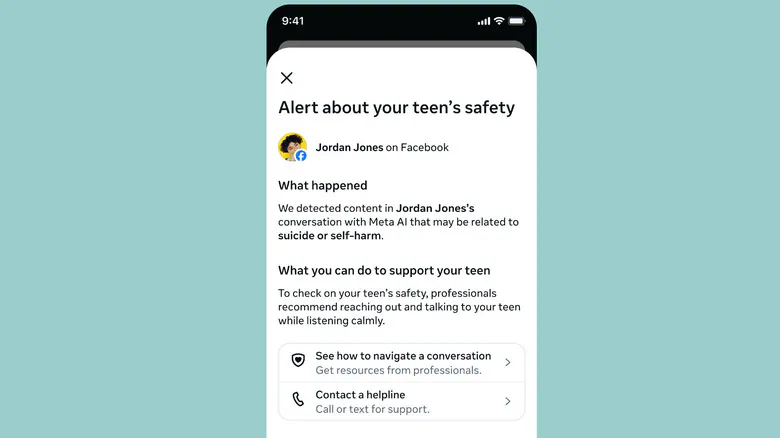
Engadget’s reporting on the October expansion adds an important detail: the alerts do not reveal the specific search terms or the contents of Meta AI conversations. They flag the concern, recommend that parents speak with their teens and provide support resources.
That makes the notification a limited disclosure, not a transcript-sharing feature. Parents learn that activity has been classified as concerning, but they do not receive the conversation needed to assess its context themselves.
I’d treat that design as a reason to begin a calm conversation, not as evidence for an accusation. A notification can draw attention to possible distress, but the alert alone cannot explain what the teen meant, whether they were discussing someone else, or what support they need.
Why AI Chats Change the Privacy Trade-Off
A conversation can contain context that a search query cannot: whether someone is describing their own feelings, discussing a friend or asking about a fictional situation. In principle, that context could help a detection system distinguish different kinds of requests. Meta’s published material does not show how well its system makes those distinctions.
The same context also makes the material more sensitive. Extending parental alerts to Meta AI means that an exchange with the assistant can lead to information being disclosed outside that exchange.
Withholding the transcript limits the amount shared, but the alert still reveals something significant: Meta has interpreted the teen’s activity as potentially related to suicide or self-harm. Privacy therefore depends on more than whether a parent can read the exact words.
In my view, the most useful disclosure would explain the alert boundary before a sensitive conversation begins. Families need to understand:
- Which Meta AI conversations are covered.
- What kind of risk can prompt a notification.
Frequently Asked Questions
4 questions
1Does Every Teen Account Get These Alerts?
No. The announced alerts apply to parents and teens using Meta’s parental supervision tools. Teen-account status alone should not be treated as enrollment.