Meituan Opens LongCat-2.5 Under MIT for Commercial Use | Zeniteq
Loading
Loading article
Zeniteq is now available on mobile for iPhone, iPad and Apple Watch.Download nowLearn more
Meituan Opens LongCat-2.5 Under MIT for Commercial Use
The November 10 open-weights release permits commercial deployment and retraining, while the model’s 1.6 trillion parameters still demand serious infrastructure.
Meituan has released the weights for its LongCat-2.5 model under an MIT license, enabling commercial deployment and secondary training without further authorization. While this permissive licensing removes legal barriers, the model remains technically demanding. As a 1.6-trillion-parameter mixture-of-experts architecture with a one-million-token context window, it requires significant infrastructure. Even with W4A4 quantization reducing memory footprints, the model necessitates distributed systems rather than single-accelerator setups. Developers must balance the newfound freedom to modify and host the model against the substantial operational costs of managing such a massive, compute-intensive architecture.
Meituan released LongCat-2.5’s weights under the MIT license on November 10, 2026, explicitly allowing commercial inference, deployment and secondary training without additional authorization. The weights are available through the company’s official Hugging Face repository. For developers, this is the consequential change: they can now build commercial services and adapted models under a permissive license. (Open-source announcement)
LongCat-2.5 itself was announced on November 2. That earlier post introduced its native multimodal architecture and long-running agent capabilities. November 10 is the separate access and licensing event, not the model’s original launch. (Original launch post)
The technical challenge remains substantial. Meituan describes a mixture-of-experts model with 1.6 trillion total parameters, approximately 48 billion active parameters per token and a one-million-token context window. Its W4A4 inference work and accelerator optimizations matter because permissive licensing alone cannot make a model this large inexpensive to operate.
What MIT Changes for Developers
Meituan’s November 10 announcement explicitly covers commercial inference deployment and secondary training without further authorization. The official Hugging Face model card also identifies the repository’s license as MIT and includes quantization, deployment and NPU usage sections.
In practical terms, the release opens several paths:
Commercial inference: Businesses can use the weights to power products and services.
Self-managed deployment: Teams can operate the model on infrastructure they control.
Secondary training: Developers can fine-tune or further train the released model without seeking a separate permission grant from Meituan.
Modification and redistribution: MIT permits these activities, subject to its notice requirements.
MIT is permissive, but it still has terms. Copies or substantial portions must retain the copyright and permission notice, and the license includes an “as is” warranty disclaimer. Teams distributing modified artifacts should preserve the accompanying notices and review the repository’s license as part of their normal release process.
The important distinction for AI pricing and access is between permission costs and operating costs. This release removes the need to negotiate additional authorization for the uses Meituan names. It does not make accelerator time, storage, networking or a hosted inference service free.
I’d treat that licensing clarity as the main news. A team evaluating domain-specific training can now make its infrastructure decision without leaving commercial-use permission as an unresolved dependency. Whether self-hosting is economical is a separate calculation.
The Model Developers Are Getting
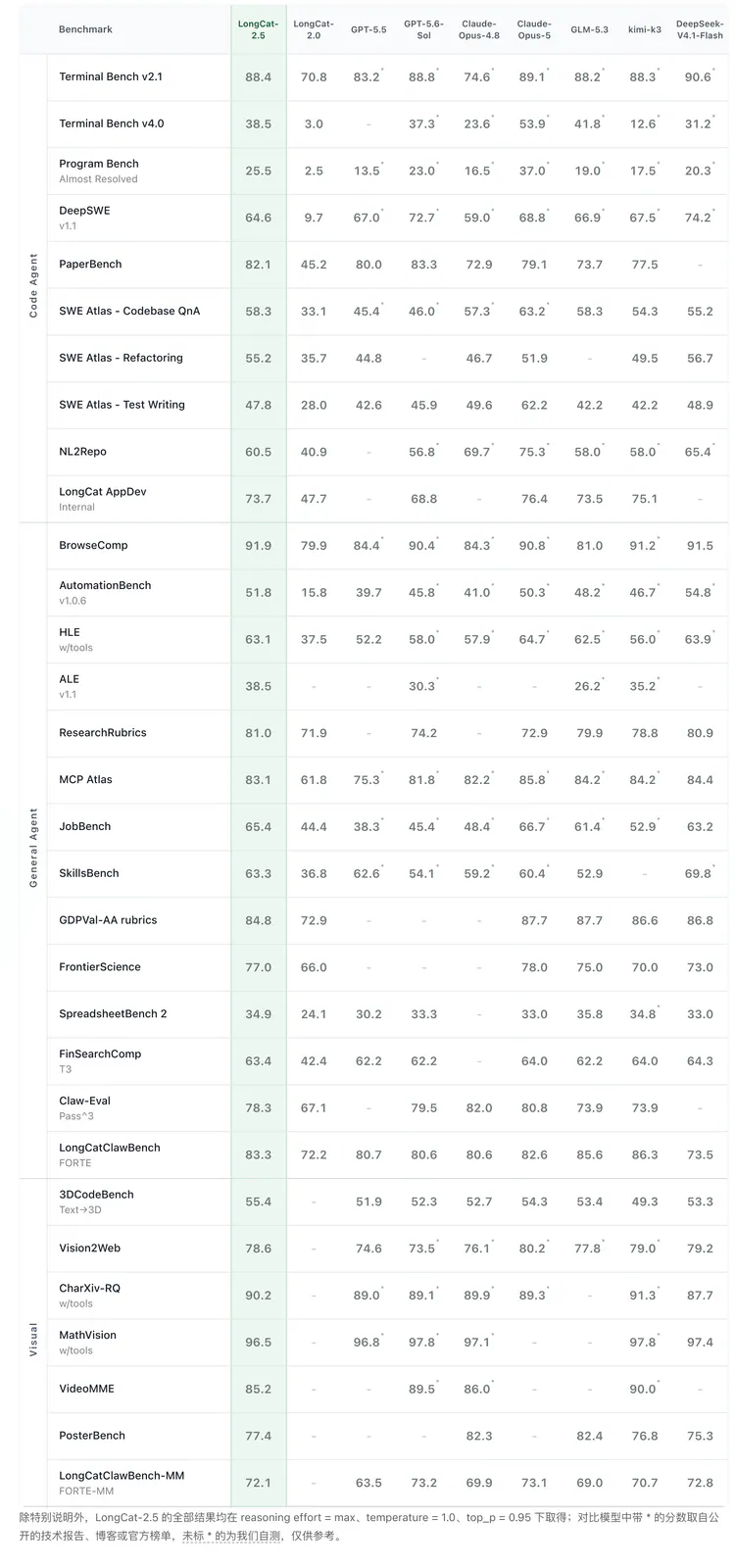
Meituan positions LongCat-2.5 for long-horizon agent work, including complex repository development, complete project construction, visual coding and professional office tasks. These are the company’s descriptions of its intended capabilities, not independent assessments. (November 10 announcement)
Specification
Meituan’s published description
Practical significance
Architecture
Mixture of experts, or MoE
Only part of the model is activated for each token
Total parameters
1.6 trillion
The complete weight set remains very large
Active parameters
Roughly 48 billion per token
Token-level computation uses a fraction of the total parameters
Context window
One million tokens
Supports large inputs and extended interaction histories, with associated memory and processing costs
Multimodal design
Native visual and text processing
Visual information is represented as discrete tokens processed by the backbone
License
MIT
Permits commercial use, modification and retraining under its terms
The difference between total and active parameters is especially important. Expert routing reduces the computation required for an individual token, but the service still needs access to the wider expert weight set. Across different tokens and requests, different experts may be selected.
A 48-billion-active-parameter model is therefore not equivalent to a 48-billion-parameter model for storage or deployment planning.
Meituan’s native multimodal approach represents visual signals as multilevel discrete tokens. Its documentation describes residual vector quantization of native-resolution visual features, with visual codebook embeddings trained jointly with the backbone. Visual token IDs can also be precomputed and cached, reducing online visual processing and simplifying distributed training workloads. (Architecture details)
The million-token context limit needs similar care. It describes supported context capacity, not a guarantee of low latency or reliable retrieval across every million-token input. Long prompts require processing, and retained attention state adds memory pressure. Deployment planning needs a realistic prompt-length distribution and concurrency target alongside the advertised maximum.
W4A4 Helps, but the Weight Set Is Still Huge
Meituan’s W4A4 inference scheme quantizes expert weights and activations to four bits, using native INT4 matrix-multiplication hardware. “W4” refers to the weight precision; “A4” refers to activation precision. (Inference documentation)
Lower precision can reduce weight storage, data movement and arithmetic costs. Real gains depend on hardware support and the software that feeds it. Meituan describes several coordinated changes:
A shared input transformation lets quantization happen before tokens are copied and dispatched to experts.
The same INT4 representation is carried through expert communication and computation.
Dedicated operators fuse transformation, scale calculation, quantization and packing.
Weight layouts and access patterns are optimized to reduce conversion and movement overhead.
Computation and communication are overlapped separately for prompt processing and token generation.
This is more involved than converting a checkpoint to a smaller file. A deployment needs compatible kernels and communication paths to realize the intended benefits.
A Storage Calculation Shows the Remaining Boundary
Consider an intentionally optimistic calculation: if all 1.6 trillion parameters were stored at four bits each, the raw weights would occupy:
1.6 trillion × 4 bits ÷ 8 = 800 billion bytes, or roughly 800 GB in decimal units.
That is an illustrative storage calculation, not Meituan’s published checkpoint size or a measured deployment requirement. Its documented W4A4 scheme specifically covers expert weights and activations. Other tensors, quantization metadata, runtime buffers and attention caches add requirements.
Even this optimistic figure is ten times an 80 GB device’s capacity, before runtime overhead. It explains why the active-parameter count cannot be used as a shortcut to a small hardware budget.
My reading is that W4A4 makes a large distributed deployment more feasible; it does not turn LongCat-2.5 into a routine single-accelerator workload. The exact machine count depends on weight formats, memory capacity, offloading, parallelism and the workload. These sources do not establish a universal minimum server configuration.
What the Sub-80GB Accelerator Work Actually Shows
Meituan separately documents long-sequence training and supervised fine-tuning on Chinese AI accelerators with less than 80 GB of memory per device. That is a distributed training result, not a claim that the whole model fits on one such accelerator. (Training infrastructure details)
Several mechanisms make that distinction concrete:
Double-sharded FSDP: Fully Sharded Data Parallel distributes model state, with additional sharding for full-precision master weights and optimizer state.
Topology-aware parallelism: Major parameter, expert-token and attention-state transfers are kept within a supernode’s high-bandwidth interconnect where possible.
Hybrid vocabulary parallelism: Embedding-related components are partitioned to reduce per-device memory use.
MoonEP dynamic expert replication: Experts are replicated when load imbalance crosses a threshold, avoiding unconditional replication overhead.
Zero-copy communication, prefetching and ScMoE: These reduce intermediate copies and overlap communication with computation.
The practical implication is that memory capacity and interconnect design must be evaluated together. Smaller-memory accelerators can participate in a large deployment or training system when state is partitioned effectively. Poor communication performance can still leave those accelerators waiting.
The sub-80GB result is therefore useful evidence about Meituan’s engineering approach. It is not a shopping-list specification for inference, and it should not be combined with the W4A4 results as though both describe one universal setup.
For teams considering retraining, another boundary matters: permission to train does not supply the compute budget. Fine-tuning introduces gradients, optimizer state or adapter-related requirements depending on the method. The licensing decision is straightforward; the training configuration still needs workload-specific planning.
What Meituan’s Performance Numbers Measure
Meituan published efficiency results in its November 2 technical post. The inference figures below compare its W4A4 implementation with a W8A8 INT8 baseline in the company’s online load testing. The FSDP result comes from a separate long-sequence supervised fine-tuning comparison. (Published results)
Metric
Meituan’s reported result
Comparison
Prefill throughput
43.3% higher
W4A4 versus W8A8
Decode throughput
42.77% higher
W4A4 versus W8A8
Time to first token
15.91% lower
W4A4 versus W8A8
Time per output token
19.72% lower
W4A4 versus W8A8
Grouped matrix-multiplication operator speed
1.73× average speedup
W4A4 versus W8A8 implementation
Per-device training throughput
86% higher
Optimized FSDP versus DDP baseline in long-sequence SFT
Prefill processes the input prompt. Decode generates subsequent tokens. Time to first token measures the initial wait; time per output token describes the pace once generation begins. These measurements expose different bottlenecks, so a throughput improvement need not produce an equally large latency improvement.
The 86% training figure also deserves precise reading. It is a per-device throughput improvement inside a distributed training configuration, not evidence that a single device trained the complete model.
All these figures are vendor-reported. The opened evidence contains no independent measurements, and the summarized results do not provide enough configuration detail to predict another team’s costs. Meituan also says the quantized model retained comparable performance on the downstream tasks it evaluated; that claim is limited to those evaluations.
I’d use the published gains to identify a promising optimization path, then benchmark the intended workload before committing capacity. A long-document service, a coding agent with repeated tool calls and a high-concurrency chat endpoint can put very different pressure on the same system.
What to Check Before Deployment
The official Hugging Face repository is the starting point for the weights, license and deployment guidance. Before reserving hardware, developers should verify:
Artifact and runtime compatibility: Confirm that the chosen checkpoint format, inference engine and accelerator kernels work together.
End-to-end memory needs: Budget for weights, quantization metadata, temporary buffers and attention caches at the intended concurrency.
Communication requirements: Check expert dispatch and parameter-transfer behavior against the available interconnect.
Workload economics: Measure useful task completion, latency and cost under representative prompt lengths and agent behavior.
The November 10 release removes a meaningful authorization barrier. Its practical value now depends on whether a team can turn the published deployment work into an affordable, reliable service for its own workload.
Frequently Asked Questions
3 questions
1
Can Businesses Fine-Tune LongCat-2.5?
Yes. Meituan explicitly permits commercial inference deployment and secondary training without additional authorization under the MIT license. Applicable license notices still need to be preserved.
2
Does MIT Licensing Make Hosted Inference Free?
No. The license grants usage rights. Hosting, accelerator time, storage and any separately offered API service have their own costs.
3
Does W4A4 Mean LongCat-2.5 Fits on One 80GB Device?
No. W4A4 reduces precision for expert weights and activations, but the complete model contains 1.6 trillion parameters. Meituan’s sub-80GB discussion concerns per-device memory within distributed training and fine-tuning infrastructure.