Agentic coding has been a desktop-first discipline — you open your IDE, sit at a laptop, and work through a deliberate session. Lovable has been quietly dismantling that assumption piece by piece. First came Agent Mode, then multiplayer workspaces, then MCP server integrations. Now, the company is taking its biggest step yet toward removing friction from the builder's workflow: a native mobile app.
Published April 27, 2026, the announcement from Lovable confirms that the platform is now available as a mobile app on both iOS and Android. The message is direct: your ideas don't wait for a desk, and now neither does Lovable.
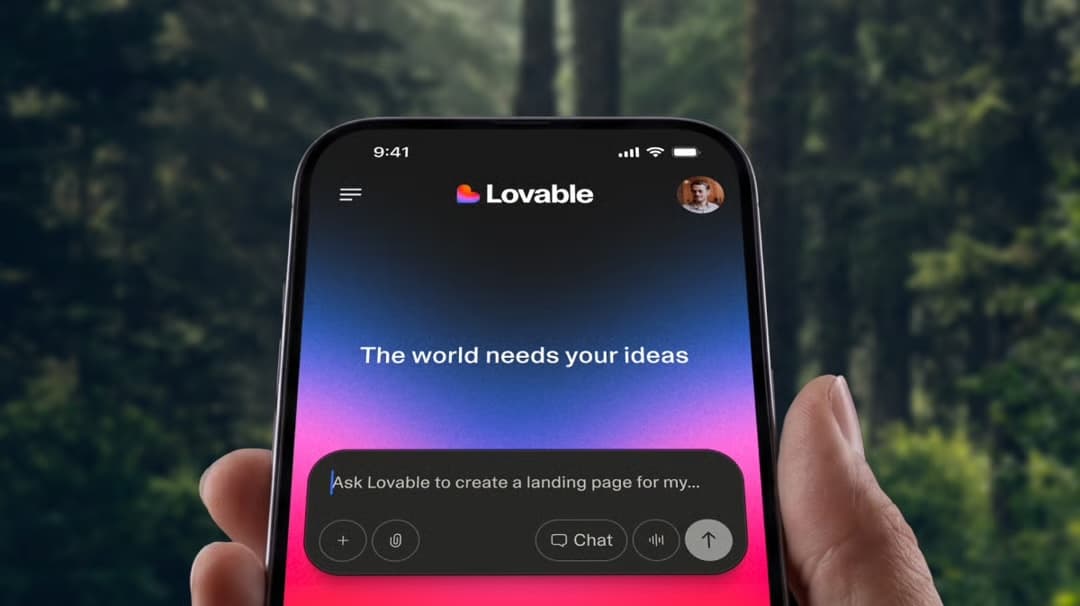
This isn't a stripped-down companion app. It's a genuine extension of the Lovable build loop — voice prompts, autonomous agent execution, and push notifications — all designed to fit the asynchronous, always-on workflow of modern builders.
What the Lovable Mobile App Actually Does
The Lovable mobile app lets you build from anywhere. You can start a project on your laptop, pick it up from the couch, and keep iterating from wherever life takes you — whether you're a founder prototyping a new concept, a designer testing a layout, or someone who's never written a line of code.
The core mechanic that makes this more than a "view your projects" wrapper is prompt queuing. You can queue prompts on the go, since ideas rarely arrive one at a time. Using voice or text prompts to capture ideas as they come, Lovable works through them autonomously — the agent runs testing and keeps building while you do other things.
That last sentence is the one that matters technically. The agent isn't waiting for you. It's running builds, catching errors, and iterating in the background. You're notified when it's done. You get notified when it's done — no need to watch and wait. This is agentic coding taken to its logical mobile conclusion.
How Lovable's Agent Mode Powers the Mobile Experience
To understand why this mobile app is technically significant, you need to understand what Lovable's agent is doing under the hood. Being fully agentic means Lovable can use external tools to take actions beyond just writing code — it can browse websites and fetch content from URLs, search the web for information, generate and edit images, search within your codebase for specific patterns, and update code across multiple files simultaneously.
When you give it a request, it doesn't just execute — it interprets what you're asking for, explores your codebase to understand the context, uncovers missing pieces, makes changes, fixes issues as they come up, and wraps it all up with a clear summary. All without you needing to guide it through every step.

On mobile, this architecture becomes especially powerful. You fire off a voice prompt describing a new feature. The agent begins its autonomous run: it reads your existing files, searches for relevant context, writes the code, runs tests, and resolves errors — all while you're commuting or in a meeting. By the time you check back, the build is done.
Complex, multi-step tasks that used to require careful hand-holding are now handled end-to-end with greater accuracy, reducing errors by 91%. That error reduction rate is what makes async mobile building credible — you're not babysitting the agent, you're trusting it.
Key Technical Highlights
Lovable's stack has always been opinionated and production-ready. Lovable uses React, TypeScript, Tailwind CSS, and Supabase, and users can export their projects to GitHub. The mobile app doesn't change what gets built — it changes where and how you instruct the builder.
Key capabilities available via the mobile app:
- Voice and text prompting — Describe features in natural language; the agent translates them into full-stack code changes
- Autonomous agent execution — Background builds with no required supervision
- Push notifications — Get alerted when your build completes or errors surface
- Cross-device continuity — Seamlessly switch between desktop and mobile sessions on the same project
- Full project access — Every project you've built in Lovable is accessible and editable from the app
The agent generates complete full-stack applications, including React-based frontends, Supabase backends, database schemas, authentication systems, and API integrations from natural language descriptions. All of that capability is now accessible from your phone.
Context: A Platform on a Product Velocity Tear
The mobile app doesn't arrive in isolation. Lovable has been shipping at an aggressive pace in 2026. Recent releases include a Mac desktop app with multi-project support (April 15), Lovable Payments streamlining global tax and secure testing (April 14), and a Twitch connector for stream overlays and real-time tools (March 17).
The company's trajectory has been steep. Lovable-built websites and apps see 5 million visits every day — a 2x increase in just two months. 100,000 new projects are built on Lovable every single day from people around the world. And after one year, Lovable reached $200M in ARR.
The mobile app is a product decision that reflects that scale. When 100,000 projects are being started daily, the builders behind them aren't all sitting at desks. Capturing the mobile moment — the commute, the coffee shop, the late-night idea — is a logical next step for a platform at this volume.
What This Means for the Industry
Gartner research shows that 40% of enterprise applications will feature task-specific AI agents by the end of 2026, up from less than 5% in 2025 — an eightfold increase in a single year. Lovable's mobile app is a direct product response to that shift: if agents are doing more of the work, the human's job becomes directing and reviewing, not executing. You can do that from anywhere.
Gartner projects that by 2026, low-code development tools will account for 75% of new application development, up from 40% in 2021, while Forrester reports that 87% of enterprise developers already use these platforms. A mobile-native build interface fits naturally into a world where the majority of software is being built through conversation rather than code.
For competitors like Bolt.new, Replit, and v0, this raises the bar. Lovable is no longer competing just on what it can build — it's competing on when and where you can build it.
Why You Should Care
If you're already a Lovable user, the mobile app is an immediate workflow upgrade. The ability to queue a build before bed and wake up to a completed feature is genuinely useful — not a gimmick. If you're evaluating AI app builders, Lovable's mobile app adds a dimension that few competitors have addressed directly.
The deeper implication is about what agentic coding looks like when it matures. The agent isn't a tool you use at your desk. It's a collaborator that runs continuously. Your job is to give it direction, review its output, and steer. The mobile app is the interface for that relationship — asynchronous, ambient, and always available.
With tools like Lovable demonstrating that non-technical founders can build production applications in weeks, you can now validate app ideas and launch MVPs significantly faster than traditional development timelines allow. Doing that from your phone is the next frontier.
Have you tried the Lovable mobile app yet? What's your take on agentic coding going fully mobile — productivity unlock or distraction machine? Drop your thoughts in the comments.