
Jensen Huang resigned as president, chief executive, and board member of Nvidia on November 12, 2026, effective immediately. The company named chief financial officer Colette Kress as interim CEO and appointed longtime director Harvey C. Jones as the first board chair in its history.
Nvidia gave no reason. The resignation followed five days of reporting about Huang's personal relationships, including one with a woman U.S. intelligence officials reportedly consider a Chinese spy.
This piece separates what Nvidia has put on the record from what is only reported, explains who is running the company, and lays out what the next two weeks will show.
Key takeaways
- Huang is fully out. Nvidia's filing says he left as president, CEO, and director at once, with no advisory role mentioned.
- Kress holds two jobs. She is interim CEO and remains CFO until a permanent chief executive is named, and the board says it will consider internal and external candidates.
- The reason is not in any company document. The allegations come from news reports. Huang has admitted being unfaithful and has denied knowing of any intelligence ties.
- Nvidia lost about $490 billion in market value in a week, falling from $4.498 trillion to $4.005 trillion, according to Yahoo Finance.
- The China question outlasts Huang. Lawmakers are pressing three chip-control bills, and President Trump meets Xi Jinping on November 18 and 19.
- The first test is November 17, when Kress leads Nvidia's third-quarter earnings call.
What did Nvidia announce when Jensen Huang resigned?
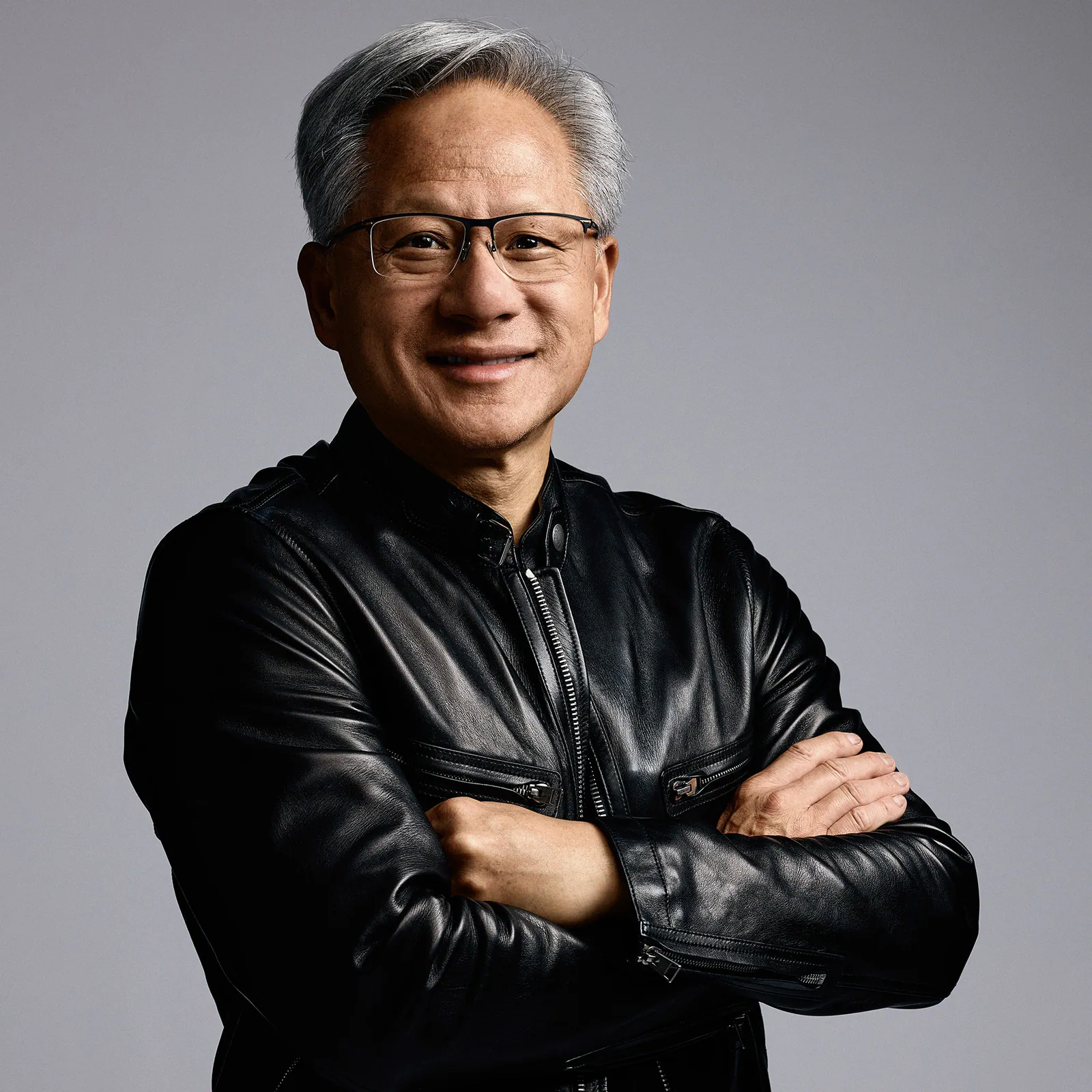
Nvidia announced four things on November 12: Huang's resignation, Kress's interim appointment, Jones's appointment as chair, and a search for a permanent CEO.
The company's wording is brief. In the press release announcing the transition, dated November 12, Nvidia wrote:
Jensen Huang has resigned as President, Chief Executive Officer, and a member of the Board, effective immediately.
The release says Kress "will continue to serve as Executive Vice President and Chief Financial Officer" while she is interim CEO. It says the board "will consider internal and external candidates" for the permanent job.
It also sets the tone the board wants. Jones is quoted saying the board "has full confidence in Colette and the leadership team," and Kress refers to "the extraordinary foundation Jensen created over the last 33 years."
What the SEC filing adds
The legal record is a Form 8-K. It reports that the board accepted the resignation of Jen-Hsun Huang on November 11, a day before the public announcement, and attaches the press release as an exhibit.
The filing uses Item 5.02, the section companies use to report the departure or appointment of officers and directors. It confirms Jones has been on the board since 1993.
What the documents leave out
Neither document says why Huang resigned.
There are four other gaps:
- No separation terms. Nothing on severance, unvested stock, or a consulting arrangement.
- No mention of the investigation the board opened on November 8.
- No timeline for the CEO search and no named search firm.
- No future role for Huang. His official biography now lists his title simply as "Founder."
How did the week unfold?
The week ran from an admission on Sunday to a resignation on Thursday. Dates below are U.S. time.
| Date | What happened | Source |
|---|---|---|
| Sunday, November 8 | Huang tells employees he was unfaithful to his wife. The board says it has confidence in him and opens an independent investigation. | Al Jazeera, Fortune |
| Tuesday, November 10 | The board's independent members retain former acting U.S. Attorney Joon H. Kim and the law firm Wachtell, Lipton, Rosen & Katz. | Nvidia statement |
| Wednesday, November 11 | Reuters reports the board is meeting to consider removing Huang. The New York Times reports a second relationship, with an Nvidia vice president. The board accepts his resignation. | Al Jazeera, Nvidia's 8-K |
| Thursday, November 12 | Nvidia announces the resignation, the interim CEO, and the new chair. Shares fall as much as 14% at the open. | Nvidia, Yahoo Finance |
| Tuesday, November 17 | Nvidia reports third-quarter fiscal 2027 results at about 1:20 p.m. Pacific. | Nvidia |
The speed is the notable part. On Sunday the board publicly backed its CEO. By Wednesday it had accepted his resignation.
Did Jensen Huang resign or was he forced out?
On paper, Huang resigned. Several outlets describe the exit as an ouster, and the two accounts can both be true.
Nvidia's filing and release use only the word "resigned." Al Jazeera, drawing on Reuters, says the board was meeting to consider removing him the day before the announcement. Fortune reports that the board accepted his resignation and, in the same article, calls it an ouster.
A resignation offered when a board is about to act is still a resignation in the legal record. Without a statement from Huang or the directors about how the decision was reached, the accurate description is that he resigned under pressure the company has not characterized.
The distinction may matter financially. Fortune reports that Huang stands to lose about $120 million to $150 million in unvested stock plus his fiscal 2027 bonus. The magazine doesn't source that figure and Nvidia hasn't confirmed it.
What is alleged, and what has Huang said?
Everything in this section comes from news reports. None of it has been confirmed on the record by Nvidia or by the U.S. government.
| Claim | Who reports it | Status |
|---|---|---|
| Huang was unfaithful to his wife | Huang himself, in a message to employees | Admitted |
| A relationship with Alice Huang, a former Megaspeed executive | The New York Times, relayed by CNBC and others | Reported |
| Alice Huang worked for Chinese intelligence | U.S. officials, as described by news outlets | Reported; Megaspeed denies wrongdoing |
| Huang knew of any intelligence ties | Nobody has reported this | Denied by Huang |
| A relationship with an Nvidia vice president who reported to him | The New York Times, relayed by Fortune and Al Jazeera | Reported |
| A relationship with a second Nvidia employee | Reuters, citing two sources, relayed by Yahoo Finance | Reported; Nvidia declined to comment |
The alleged intelligence link
The central allegation concerns Alice Huang, who is not related to Jensen Huang. CNBC, summarizing New York Times reporting, says she was a spy for China's Ministry of State Security, and that Megaspeed, the company she worked for, denies wrongdoing.
Outlets differ on how firm that conclusion is. Some say U.S. intelligence determined it. Others say agencies suspect it.
Megaspeed matters because it was a customer. CNBC reports, citing The Information, that Alice Huang helped facilitate at least $7.5 billion in Nvidia chip shipments to China.
Huang's response
The only statement from Huang quoted in the coverage is an email to staff on November 8. The San Francisco Standard quotes him writing "I was unfaithful to my wife" and "There is no excuse for what I did."
He has denied knowing of any ties to the Chinese Communist Party. Trump told reporters that Huang said he "had no idea that she was a spy," according to CNBC.
That is the whole of his public defense so far. As Al Jazeera correspondent Osama Bin Javaid put it, there is "no established evidence he knowingly assisted Beijing."
The workplace relationships
The second and third reports raise a different problem. A relationship between a CEO and someone who reports to him is a governance issue regardless of who the other person is, because of the authority involved.
The reports don't say whether any Nvidia policy was broken. This article doesn't name the employees, since the accounts rest on single news reports and neither person has commented.
Who is investigating?
Three separate inquiries are running: the board's, Congress's, and, according to news reports, the Justice Department's.
The board's inquiry
Nvidia confirmed the structure itself. On November 10, the company said the independent members of the board retained Joon H. Kim, a former acting U.S. Attorney for the Southern District of New York, and his firm Wachtell, Lipton, Rosen & Katz to run what it called "a thorough and independent investigation."
The San Francisco Standard adds that a committee of independent directors is overseeing the inquiry, with the outside lawyers doing the fact-finding.
That design is standard when a chief executive is the subject. Independent directors run it so nobody who worked for Huang is judging him.
When the inquiry opened, Fortune reports, the board said it had "no reason to believe that either national security or NVIDIA secrets were compromised." That was a starting position, and it's the claim the investigation now has to test.
Congress and the Justice Department
Lawmakers moved before Huang resigned. CNBC reports that three Republican House members sought his testimony by November 18, and that members of both parties had called for him to step down.
Separately, CNBC reports, citing the Times, that a Commerce Department probe of Megaspeed was transferred to the Justice Department. Neither department has confirmed that publicly.
Huang's resignation doesn't end any of this. The open question was never only his conduct. It's whether a customer relationship worth billions of dollars was handled differently because of a personal one.
Who is running Nvidia now?

Colette Kress runs Nvidia as interim CEO, and Harvey Jones chairs the board. Both are insiders with long tenures.
| Person | New role | Background |
|---|---|---|
| Colette Kress | Interim CEO, and still EVP and CFO | Joined Nvidia in September 2013 after finance roles at Cisco, Microsoft, and Texas Instruments |
| Harvey C. Jones | Chair of the board, the first in Nvidia's history | Director since 1993; former CEO and executive chairman of Synopsys |
Colette Kress
Kress has been Nvidia's finance chief for the company's entire AI boom. Her official biography lists about 25 years in finance roles before Nvidia, including 13 years at Microsoft and three at Cisco.
Al Jazeera puts her tenure in numbers: Nvidia's annual revenue grew from $4.13 billion in fiscal 2014 to $215.9 billion in fiscal 2026.
Frequently Asked Questions
6 questions
1Why did Jensen Huang resign as Nvidia CEO?
Nvidia has not given a reason. The resignation on November 12, 2026 came five days after Huang told employees he had been unfaithful to his wife, and after news reports that one relationship was with a woman U.S. officials reportedly consider a Chinese spy. Huang denies knowing of any intelligence ties.


